When the Lunchbox Stayed Empty
“Olga, where’s my lunch?”
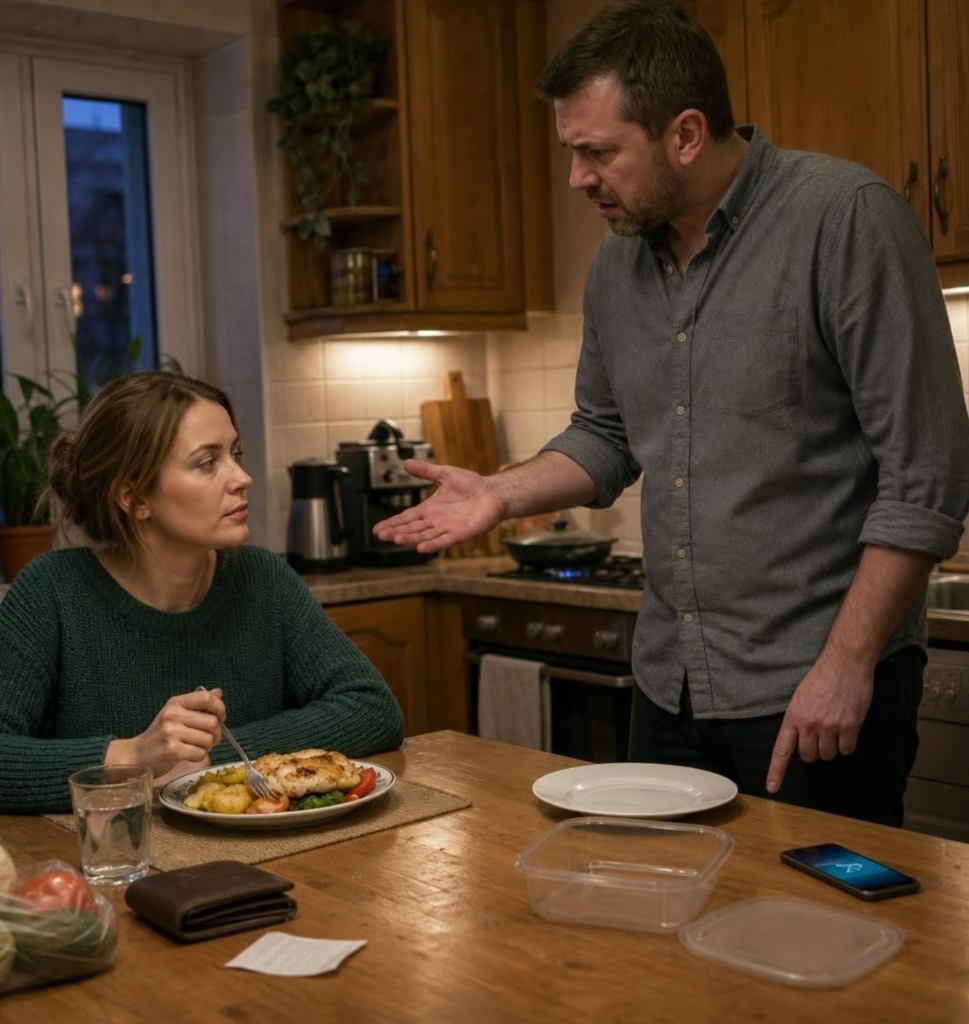
Sergey stood beside the kitchen table, looking into his open work bag. In front of him was the familiar glass lunch container with the blue lid.
Empty.
Usually, by this time, it would already contain meat patties, buckwheat, or roasted chicken. Beside it, there would be an apple and a slice of Olga’s homemade cake.
But today there was nothing.
“In the cupboard, where it always is,” Olga replied calmly, taking another sip of her tea.
“I can see the lunchbox. I’m asking where the food is.”
“At the cafeteria.”
Sergey blinked.
“You didn’t cook yesterday?”
“No.”
“Why?”
“I didn’t feel like it.”
The man simply stared at her.
“Olga, I have to leave in ten minutes.”
“Then leave.”
“I won’t have lunch.”
“Of course you will. You have a cafeteria at work.”
“That’s expensive.”
Olga finally looked up.
“Then use some money.”
“What money?”
“Your own.”
Silence filled the kitchen.
Outside, rain drew thin streaks across the window. Inside, the refrigerator hummed softly.
Sergey lowered his voice.
“This is because of yesterday, isn’t it?”
“What happened yesterday?”
“You know what.”
“I’d like you to say it out loud.”
He zipped up his bag.
“I helped Mom.”
“You transferred eighty-two thousand rubles to her.”
“That’s what helping means.”
“That’s almost your entire salary.”
“I have seven thousand left.”
“For gasoline.”
“Yes.”
“And for food?”
“We have food at home.”
Olga glanced toward the refrigerator.
They didn’t.
There were four eggs, some cottage cheese, a piece of cheese, two carrots, and a jar of mustard. In the freezer there was a small bag of vegetables she had bought for herself.
“Where?” she asked.
Sergey shrugged.
“You usually buy everything.”
“Usually, we both contribute to the household.”
“We’ll manage for a month.”
“You will.”
The man frowned.
“What’s that supposed to mean?”
“It means you decided what to spend your salary on. Now I’ll decide what to spend mine on.”
“We’re married. What do you mean, *your* money?”
Olga looked straight at him.
“When you sent your salary to your mother, did you discuss it with me?”
“I knew you’d object.”
“So you decided not to tell me.”
“They were almost going to cancel her kitchen order. She needed the deposit.”
“Did her old kitchen fall apart?”
“No.”
“Couldn’t she cook in it?”
“Of course she could.”
“Then what was so urgent?”
“She wanted a brighter kitchen.”
Olga gave a short, bitter laugh.
“So apparently our family budget was responsible for making your mother’s kitchen look bigger.”
“She’s my mother.”
“And I’m your wife.”
Sergey picked up the empty lunchbox.
“I’m leaving.”
“Okay.”
“At least make me a sandwich.”
“We’re out of bread.”
He stared at her.
“Are you serious?”
“Completely.”
“You’re punishing me because I helped my mother.”
“No. I’m simply not going to rescue you from the consequences of a decision you made without me.”
Sergey walked out.
For years, Olga would have run after him.
She would have fried some eggs, quickly made a few sandwiches, packed something for him, and then spent the entire morning wondering whether she had been too harsh.
But this time she didn’t move.
She simply finished her tea.
Olga worked as a procurement specialist at a private medical center. Her job was based on one simple principle:
Once money is spent on something, that same money can’t be spent on something else.
She understood this better than anyone.
At home, however, that rule had somehow disappeared.
For years, Olga and Sergey had lived according to a simple arrangement. On every payday, they each transferred forty-five thousand rubles into their joint account. They used it to pay for groceries, utilities, internet, household expenses, repairs, and everything else they shared.
Whatever remained afterward belonged to each of them individually.
Olga usually saved some of hers.
Sergey rarely did.
He spent his money on gasoline, coffee, outings, gifts for his mother, and all sorts of other things. When he ran out of money before payday, he would ask Olga for a few thousand rubles.
Olga usually gave it to him.
Not because it was her responsibility.
But because it was easier than arguing.
This time, however, Sergey hadn’t asked for a few thousand rubles.
He had given almost his entire salary to his mother.
And he expected Olga to quietly fill the hole he had created.
She could no longer accept that.
At lunchtime, Sergey sat in the cafeteria at work, staring at a bowl of soup and a dry meat patty.
“Your wife stopped cooking?” his colleague Andrei asked.
“She’s trying to make a point.”
“About what?”
Sergey shrugged.
“She wants to show me who’s boss.”
But as he said it, an uncomfortable feeling began to nag at him.
Lunch had cost 420 rubles.
He calculated how much he could spend on gasoline.
Then on groceries.
Then for the rest of the month.
For the first time, he realized that seven thousand rubles wasn’t much when Olga wasn’t quietly making up the difference.
Even so, he convinced himself that Olga would calm down.
She always did.
That evening, the smell of fried fish greeted him when he came home.
His mood immediately improved.
He walked into the kitchen.
There was only one plate on the table.
He stopped.
“Where’s mine?”
“I made one serving.”
“Why?”
“I bought the ingredients.”
He opened the refrigerator.
“There’s another piece.”
“That’s for tomorrow.”
“Olga, aren’t you taking this a little too far?”
“No.”
“You’re really going to let your husband sit here hungry?”
“You had lunch at work.”
Sergey sighed, took a package of pasta, and placed it on the table.
“Fine. I’ll cook.”
“Go ahead.”
Ten minutes later, the water was boiling.
Sergey grabbed the lid, burned his finger, splashed water everywhere, and finally dumped a huge amount of overcooked pasta into the colander.
“You could have helped,” he muttered.
“You said you could handle it.”
He tasted it.
“It has no salt.”
“The salt is in the cupboard.”
“I forgot.”
“Then add some.”
“It won’t be the same now.”
Olga said nothing.
That evening Sergey ate his badly cooked pasta alone.
For the first time, he began to understand how much work happened in the kitchen without him ever noticing.
The next morning, he made himself two sandwiches from stale bread.
By lunchtime, they were soggy.
He ate one and bought a bowl of soup at the cafeteria.
That evening, instead of driving, he took the bus home.
Then he bought potatoes, sausages, bread, and canned fish.
“There,” he said proudly, putting the grocery bag on the table. “This should last us a few days.”
“Good.”
“Want a sausage?”
“Thanks. I have chicken.”
Sergey looked at her.
“You really separated the food?”
“From now on, everyone has their own.”
Something about that sentence bothered him.
But he didn’t argue.
He boiled the potatoes.
Badly.
Some pieces burned while others remained hard.
Olga walked past him and lowered the heat.
“I would have figured it out.”
“Good.”
Later that evening, Olga noticed the frying pan in the sink.
“Sergey, wash it.”
“I’ll do it in the morning.”
“It’ll be harder then.”
“I’m tired.”
“So am I.”
The man turned toward the wall.
“You used to wash it.”
“I used to cook.”
A long silence followed.
Finally, Sergey got up.
On Sunday, he went to his mother’s house.
The new kitchen was being installed.
The old cabinets were sturdy, but Valentina Pavlovna had decided they were too dark. She wanted light-colored cabinets with gold-trimmed handles, followed by a new range hood and matching chairs.
Sergey had paid eighty-two thousand rubles as a deposit.
He thought that was the end of it.
It wasn’t.
While carrying an old cabinet down the stairs, his mother called after him.
“Sergey, do you have six thousand on your card?”
“What for?”
“The handles. I don’t like these ones. I want the ones with the gold trim.”
“I don’t have six thousand.”
“You gave me eighty-two thousand.”
“Exactly.”
The woman frowned.
“You’ll find six thousand somewhere.”
Sergey looked at her.
“I can barely afford gasoline.”
“You’ll manage until payday.”
“And lunch?”
“Olga cooks for you.”
“Not anymore.”
His mother was visibly offended.
“Your wife doesn’t cook for her husband?”
“No. Not after I gave you the money I was supposed to put into our joint account.”
Valentina Pavlovna folded her arms.
“So she turned you against me?”
“No.”
Sergey looked around the new kitchen.
“For the first time, I’m simply seeing what actually happened.”
“What does that mean?”
“It means I gave you almost my entire salary without thinking about how my wife and I were going to live afterward.”
“She’s your wife. She should support you.”
Sergey remembered what Olga had said that morning:
*I’m simply not going to rescue you from the consequences of a decision you made without me.*
For the first time, it didn’t sound cruel.
It sounded reasonable.
“I’m going home,” he said.
When Sergey got home, Olga was making a salad.
“Did you eat?” she asked.
“Mom asked for more money.”
“For what?”
“Handles. Then a range hood. Then chairs.”
“Did you give it to her?”
“I couldn’t.”
He sat down.
“I asked her to give me back five thousand rubles. She refused.”
Olga said nothing.
“She said you should be feeding me.”
Silence.
“She also said I needed to show you who was in charge of the house.”
Olga raised an eyebrow.
“And what did you say?”
Sergey lowered his eyes.
“I think she was right about one thing.”
Olga waited.
“I expected you to take care of everything.”
That was the first time he had admitted it.
Not because Olga had forced him to.
But because he finally saw it himself.
“What should I do?” he asked.
“Don’t do it for me. Do it for us.”
Olga took out the notebook where she kept track of the household expenses.
“Put your share back into the joint account. If you can’t immediately pay the full forty-five thousand, then pay specific bills. And from now on, we discuss major financial decisions together.”
Sergey nodded.
“And the housework?”
“We split it.”
“Cooking too?”
“Especially cooking.”
The man looked toward the small blue pot.
“I completely ruined the pasta in that.”
“You weren’t supposed to cook it in that pot.”
“There was another one?”
Olga pulled a large stainless-steel pot from the back of the cupboard.
Sergey shook his head and laughed.
“Looks like I still have a lot to learn.”
“You do.”
They went grocery shopping together.
Sergey had only 780 rubles left.
He bought chicken and bread. Olga already had potatoes and onions.
Together, they made soup.
Sergey cut the potatoes too large.
Then he fixed them.
Twice he wanted to leave the kitchen.
He didn’t.
The soup wasn’t anything special.
But it was theirs.
After dinner, Sergey washed the dishes.
The next morning, he packed his own lunch.
The blue lunchbox no longer filled itself.
He filled it.
Over the next few weeks, he learned.
He learned how much groceries actually cost.
He learned how quickly seven thousand rubles disappeared.
He learned that cooking wasn’t simply about “putting something on the table.”
He learned that a clean kitchen didn’t clean itself.
And perhaps most importantly, he learned that love was not the same thing as unlimited service.
When he received a bonus at work, the first thing he did was transfer ten thousand rubles to the joint account.
When his mother called and asked for money for new chairs, he said no.
When his mother complained that Olga had changed him, he replied:
“No. I changed because I finally understood what was happening.”
A month later, Sergey received his salary.
He sat beside Olga at the kitchen table and transferred forty-five thousand rubles to their joint account.
Then he transferred the rest of what he owed.
“Done,” he said.
Olga checked her phone.
“I see.”
“Can we go back to normal?”
Olga looked at him.
“I don’t want to go back to the old normal.”
Sergey smiled.
“Then what do you want instead?”
“Something better.”
From then on, they made the grocery list together.
They cooked together.
They shared the housework.
And they always discussed larger expenses before making a decision.
One evening, Sergey prepared dinner almost entirely by himself.
He filled two glass containers.
One had a blue lid, the other a green one.
He looked at the containers and smiled.
“A little more sauce?”
“Just a little.”
He carefully divided the food.
Then he placed Olga’s container on the bottom shelf of the refrigerator.
“I’ll put yours here so you don’t forget it tomorrow.”
“Thank you.”
Sergey stopped.
Those two words had once been said mostly by Olga.
Now he understood why.
The empty lunchbox had never been the real problem.
The real problem was everything Sergey had taken for granted.
His wife’s cooking.
Her money.
Her time.
Her patience.
Her invisible work.
Olga had not stopped loving him.
She had simply stopped doing everything for him.
And that empty blue lunchbox finally forced Sergey to notice how much their home had been filled with things he had never appreciated.
Perhaps that was the real lesson of the empty lunchbox.
Sometimes love does not disappear when we stop doing everything for someone.
Sometimes that is exactly when it finally gets a chance to become equal.
The next morning, Sergey woke up before his alarm.
He quietly walked into the kitchen.
For a moment, he stood in front of the refrigerator, looking at the two lunchboxes.
Then he opened the cupboard, took out the frying pan, and started making breakfast.
Olga appeared in the doorway, still half-asleep.
“You’re cooking?”
Sergey smiled.
“I thought I’d try something new.”
“What?”
“Being your husband instead of your dependent.”
Olga said nothing.
She simply walked over, kissed him on the cheek, and took out two plates.
This time, neither of them counted who had given how much.
And for the first time in their lives, the kitchen was not a place where one person served the other while the other expected it.
It was simply their kitchen.
Their home.
Their life.
And the little blue lunchbox, which had once symbolized everything Olga had been carrying alone, now meant something completely different:
A reminder that a marriage is not built by one person giving until there is nothing left inside them.
It is built when two people finally learn to carry the burdens together.
And perhaps that was the real lesson of the empty lunchbox.