I turned around and walked away—no anger, no wounded pride, just that silent withdrawal that says far more than anything shouted ever could.Hours later, my phone wouldn’t stop vibrating.
They were begging me to answer.
I hadn’t planned to spend Thanksgiving alone. But when I drove into my father’s snow-covered driveway in Cedar Grove, Ohio, I felt that familiar burn in my stomach—the quiet certainty that this visit was long overdue. For five years, my father had been shrinking into himself after my mother died,
like a man afraid of confronting his own memories.And in that silence, my younger brother Evan had built a whole narrative for him to hide in—one where I was the cold, selfish son who abandoned them.A convenient story.
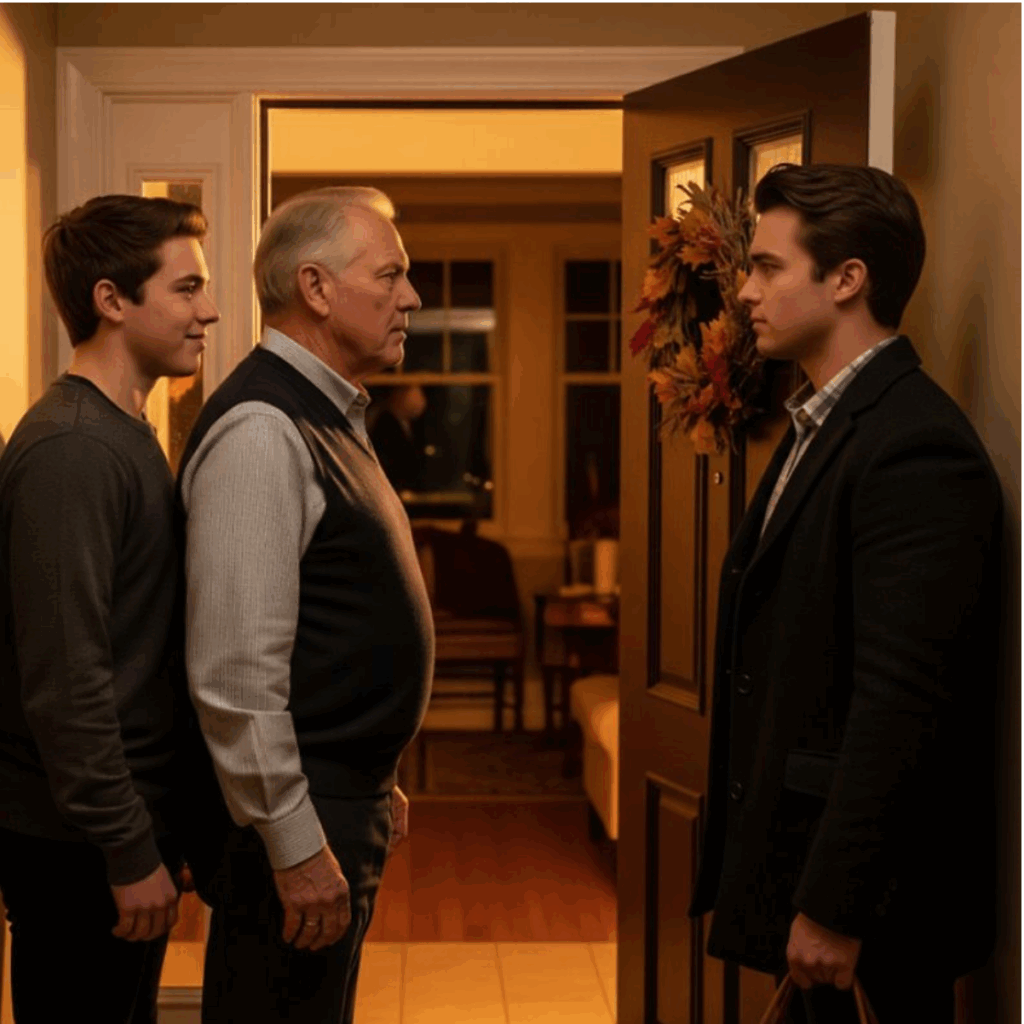
One that made him look bigger, and me smaller.Still, I hoped the holiday might be a fragile ceasefire.But before I could even knock, the door was yanked open.My father stood there, jaw clenched like stone, his face expressionless—one of those expressions that carries more frost than anger ever could.
“We don’t want to see you today, Adam,” he said, like he was turning away a stranger.Behind him, Evan leaned against the wall, arms folded, wearing the kind of smug grin you’d expect from a villain in a cheap play.“Yeah,” he added. “We’re doing just fine without you.”
Their words hit harder than I cared to admit.I had driven three hours.I brought a homemade pumpkin pie.I let myself believe—stupidly—that maybe this year would be different.I didn’t argue.
I didn’t lash out.I didn’t even ask why my father was parroting Evan’s bitterness as if it were some universal truth.
I simply smiled—a quiet, steady smile that made them both flinch.“Okay,” I said.“Happy Thanksgiving.”I turned and walked away.No drama.No tears.No pleading.Just distance.Ironically, the very thing Evan had accused me of for years.Then the calls began.
First Dad.Then Evan.Then both at once.Texts, voicemails, missed calls hitting my phone like a hailstorm.“Adam, pick up.”“We need to talk.”“Don’t ignore us!”“Something happened.”Their voices were different now—small, ragged, afraid.
I didn’t answer.Not to punish them.But because I was tired.Tired of the role they forced me into.Tired of being the villain in Evan’s stories.Tired of being needed only on their terms.Then came my father’s sixth voicemail:“Son… please. It’s important.”
I pressed play.Evan’s voice cracked—high, panicked, unraveling.“Adam… Dad collapsed. Right after you left. The doctors said… the stress… I didn’t know he—”The message cut off.Or maybe he did.I sat in my dark apartment, the untouched pie still on the front seat, and realized:
this wasn’t over.Just before midnight, I walked into Cedar Grove Medical Center.The fluorescent lights of the ER made the floor shine like frozen glass.Up on the fourth floor, Evan was pacing in frantic circles—messy, disheveled, a stranger wearing my brother’s face. He froze when he saw me.
“You came,” he whispered.I didn’t answer.I walked straight to my father’s bed.He looked older.So much older.Fragile in a way I had never seen.He opened his eyes when he heard me approach.“Adam… son,” he breathed. No anger. Only relief.
“What happened?” I asked.Dad and Evan exchanged a look—the kind people share when they’ve lived inside a lie for too long.“He collapsed after you left,” Evan said quietly.“And the doctors said emotional stress was a factor.”
He looked down.“They asked what happened. And Dad… told them.”“Told them WHAT?” My voice was calm, but sharp as a blade.Evan swallowed hard.“I wanted you to come later. So I could make a point.”“A point about what?”“About Mom,” he whispered.
The word hit like an earthquake.“When she died, you left. I stayed. I handled everything—the funeral, Dad’s drinking, the house… and I never forgave you. I wanted Dad to pick me. To see me.”The truth was ugly.But it fit.
I looked at my father.“And you?”He exhaled deeply.“I believed him,” he admitted. “Because I was hurt too. I thought you didn’t want us anymore. But when you walked away today… I realized you’re the only one who keeps trying to bring us back together.”
For the first time in years, the three of us stood in one room with no excuses left.The doctor confirmed it was a mild heart attack—stress, exhaustion, no permanent damage.Dad reached out.
I took his hand.It felt like the beginning of something—unsteady but real.
Three days later, we brought him home.Evan and I beside him, awkward and quiet, like shadows relearning how to overlap.Snow covered Cedar Grove like a thin reminder that everything can look new if you let it.Inside, nothing had changed.
The crooked decorations.The untouched turkey.The silence between the pictures on the wall.Photos of Mom.Of Evan.Of Dad.And then: a blank space where my life should’ve been.A gap louder than any words.
“Adam,” Dad said gently. “Can we talk?”We sat.“I wasn’t fair to you,” he admitted. “I drowned in my own grief. And I lost both my sons.”I told him why I really left back then—not out of apathy, but because the grief was too heavy for me to carry without collapsing.
Evan came in with coffee, his eyes clearer than they’d been in years.“I was cruel,” he said.“And cowardly. I wanted to be the good one—and I sacrificed you to make it true.”I nodded.“You both hurt me. But I don’t want that to be the whole story.”
Dad breathed deeply.“So… now what?”“Now we start,” I said. “Slow. Honest. No more stories behind each other’s backs.”No dramatic hug.No cinematic tears.Just three men deciding not to keep looking away.In the weeks that followed, we talked more than we had in five years.
We fixed things around the house—and inside ourselves.We remembered Mom without falling apart.On Christmas Eve, Dad framed a new photo.Our first together in decades.None of us smiled fully.But the picture was real.
Families don’t break in a day.And they don’t heal in one.But that Thanksgiving—the one where a door slammed in my face—became the day something finally opened.