# “We Took the Treatment Money for the Cruise. You Can Handle Victor When You Get Back. We’re Sick of Taking Care of Him.”
That was the note my mother left on the kitchen counter.
Eight words would have been cruel enough.
But those words told me something far worse:
My family had decided a dying man was an inconvenience.
And they had left him alone to deal with it.
I had just returned to Norfolk after nine months away.
As a Navy flight surgeon, I had spent almost every day of those nine months moving between brutal shifts, emergency transfers, long hours aboard ship, and a medical-support mission at sea.
For months, I had imagined coming home.
I pictured dropping my duffel bag by the door, hugging my mother, teasing my siblings, and then sitting beside Victor—the man who had raised me as his own daughter since I was eight.
Instead, when I unlocked the front door, the house was freezing.
And completely silent.
“Victor?”
Nothing.
I dropped my bag and ran toward his bedroom.
What I found stopped me cold.
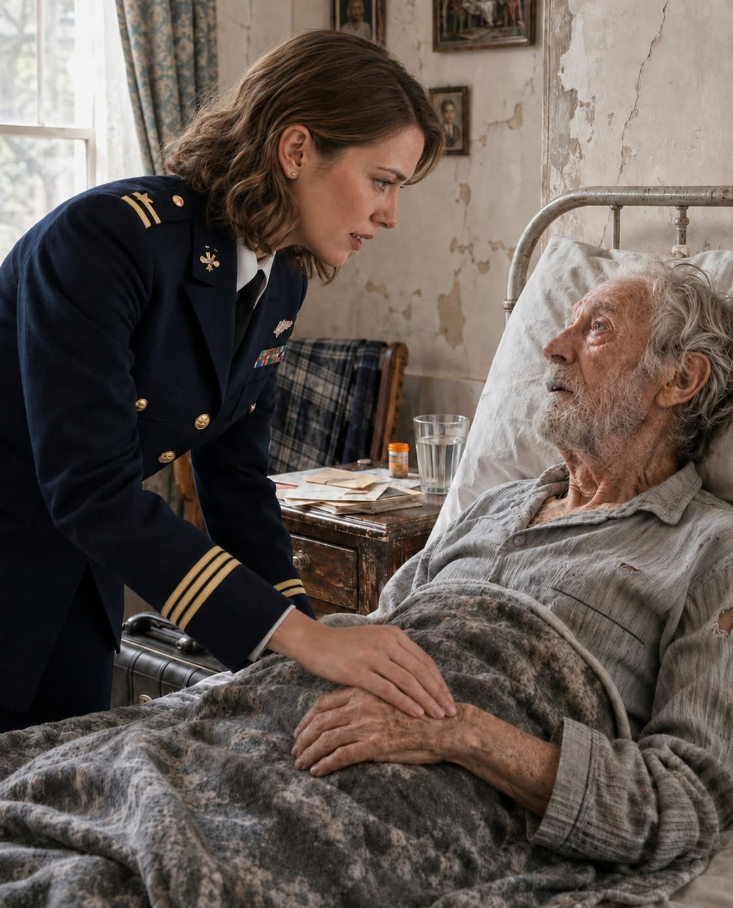
Victor was curled on his side beneath a paper-thin blanket, trembling so violently that the mattress shook.
His lips were dry.
His clothes were soiled.
His skin was pale and clammy.
He looked nothing like the strong man I remembered.
He had late-stage pancreatic cancer, and at this point, he needed help just to sit upright.
His eyes slowly opened.
“Maya…”
His voice was barely a whisper.
“You’re home.”
Something inside me shattered.
I immediately turned up the heat, helped him drink small amounts of water, cleaned him, changed his clothes and bedding, and called his hospice team.
Then I went into the kitchen to find something he could eat.
That was when I saw the note.
I read it once.
Then again.
> “We took the treatment money for the cruise. You can handle Victor when you get back. We’re sick of taking care of him.”
My hands tightened around the paper.
My mother, Evelyn, my brother Mason, and my sister Chloe had taken money from the family emergency account and spent it on a luxury Caribbean cruise.
That account wasn’t some bottomless family fund.
I had been transferring a substantial portion of my Navy paycheck into it every month specifically for Victor’s medication, home-care visits, groceries, and utilities.
I grabbed the tablet from the coffee table.
An Instagram notification was waiting.
Mason.
There he was on the top deck of a cruise ship, wearing brand-new designer sunglasses, one arm around his girlfriend.
His caption read:
“Working hard to play harder. Living the life we deserve.”
I felt sick.
I opened the joint banking account.
The balance loaded.
$14.12.
I stared at the number.
Surely that had to be a mistake.
I opened the transaction history.
It wasn’t.
Cruise tickets.
Designer stores.
Premium drink packages.
Spa treatments.
Restaurant charges.
ATM withdrawals.
Casino purchases.
In less than six days, they had spent nearly $10,000.
Money meant to keep a dying man comfortable.
I walked back toward Victor’s bedroom.
Then I noticed something else.
The glass display cabinet in the hallway was empty.
For twenty-two years, that cabinet had held Victor’s most treasured Marine Corps possessions.
His medals.
His ribbons.
His service decorations.
His photographs.
The shadow box he had carefully maintained for decades.
“Victor…”
He looked toward the empty cabinet.
“Where are your medals?”
His laugh was weak and bitter.
“Your mother sold them.”
I froze.
“What?”
“She said they were just old pieces of metal.”
He swallowed.
“She needed extra money for the cruise excursions.”
I couldn’t speak.
Then Victor suddenly doubled over in pain.
I rushed to his nightstand and reached for his prescribed liquid morphine.
His hand shot out and grabbed my wrist.
“Don’t.”
“Victor, you’re in severe pain.”
“Don’t give me that.”
I looked at the bottle.
“What happened?”
He stared at the ceiling.
“Your mother poured it out three days ago.”
My stomach dropped.
“What?”
“She filled the bottle with tap water.”
For several seconds, neither of us spoke.
“Why would she do that?”
His eyes filled with tears.
“She said the real medicine was too expensive for someone who was going to die anyway.”
I slowly placed the bottle on the table.
Something changed inside me.
I was no longer simply angry.
I was alert.
As a doctor, I had learned never to ignore details that didn’t make sense.
And this didn’t make sense.
This was evidence.
—
# Part 2
By sunrise, my training had taken over.
I photographed everything.
Victor’s physical condition.
The empty refrigerator.
The unpaid utility notices.
The thermostat.
His bedroom.
The medication bottle.
Every transaction in the joint account.
I wasn’t trying to punish anyone.
I was creating a record.
Then I called Victor’s oncologist, Dr. Vance.
I told him everything.
There was a long silence.
Finally, he said:
“Maya, don’t throw away that bottle. Don’t alter it. If Victor has another serious pain crisis, get him transported immediately. We’ll document everything from our end.”
“I understand.”
“Good. Because this may be more serious than neglect.”
He was right.
Later that afternoon, I spoke to our longtime neighbor, Mrs. Gable.
She had seen my mother, Mason, and Chloe leave three days earlier.
“They were laughing,” she told me.
“Your brother was bragging about finally traveling like rich people.”
I swallowed.
“What did they say about Victor?”
Mrs. Gable looked down.
“I asked your mother if someone was staying with him.”
“What did she say?”
“She shrugged.”
Then Mrs. Gable lowered her voice.
“She said, ‘He’s sleeping. He doesn’t need anyone bothering him.’”
I felt my jaw tighten.
That evening, Victor asked me to close his bedroom door.
“There’s something your mother never knew.”
I sat beside him.
“What?”
He pointed toward his closet.
“Behind the winter coats. There’s a briefcase.”
I pulled it down.
It was old, heavy, and locked.
Victor gave me the combination.
Inside were legal documents, investment statements, property records, trust agreements, and financial reports.
I looked at him.
“What is all this?”
He smiled faintly.
“The part of my life Evelyn never knew about.”
I opened the first investment statement.
Then another.
Then another.
The numbers didn’t register immediately.
I looked again.
“Victor…”
He watched me.
“How much money do you have?”
“A little over three million dollars.”
I stared at him.
“Three million?”
He nodded.
His assets were spread across investments, commercial real estate, and an irrevocable trust created years before he married my mother.
Then he showed me their premarital agreement.
Evelyn had signed away any claim to those assets.
My mother had spent years believing Victor was nearly broke.
He had allowed her to believe it.
“Why?”
Victor looked toward the window.
“Because after we married, I noticed something.”
“What?”
“When people thought I had money, they treated me well.”
He paused.
“When they thought the money was gone, they slowly stopped caring.”
His eyes met mine.
“I wanted to know who would stay.”
I looked at him.
“And now you know.”
He nodded.
“The money wasn’t the test, Maya.”
His voice cracked.
“The test was whether anyone would bring me a glass of water when they thought I couldn’t give them anything in return.”
He squeezed my hand.
“You came home.”
I couldn’t answer.
Because I hadn’t come home for his money.
I didn’t even know the money existed.
I came home because he was Victor.
My father in every way that mattered.
—
That afternoon, Victor’s estate attorney, Sarah Jenkins, arrived with a notary and Dr. Vance.
Dr. Vance confirmed that Victor was lucid, understood his decisions, and was mentally competent to revise his estate documents.
For nearly two hours, Victor went through every detail.
He changed everything.
Most of his fortune would eventually support homeless and terminally ill veterans.
A substantial portion would be placed under my administration.
And Evelyn, Mason, and Chloe would receive nothing from the voluntary portion of his estate.
Victor looked at Sarah.
“I will not reward people for waiting around for me to die.”
Then he added quietly:
“I spent twenty years discovering who loved me and who loved what they thought I owned.”
That evening, I opened our family group chat.
I typed:
“Victor’s condition has deteriorated rapidly. The doctor says he may not make it through the night. Please come home. This may be your last chance to say goodbye.”
Mason read it immediately.
Chloe opened it two minutes later.
Five minutes later, my mother replied.
“Stop being dramatic, Maya. The cruise doesn’t dock until Tuesday.”
Then Mason wrote:
“You’re a doctor. Deal with it. That’s what you’re there for.”
I stared at the screen.
Victor was awake.
He had seen every message.
I watched the last bit of hope disappear from his face.
Then I called my mother.
She answered from the cruise ship.
Music blasted in the background.
People were laughing and dancing.
“What do you want now, Maya?”
“I want you to come home.”
“Why?”
“Victor is dying.”
She rolled her eyes.
“Maya, we paid thousands for this vacation. We’re not cutting it short because he decided to get worse now.”
Mason appeared behind her, holding a margarita.
He laughed.
“Tell him to hold on until Tuesday!”
Victor heard it.
Every word.
I reached for the phone.
Then my mother said something that made my blood run cold.
“And if he dies before we get back, call the funeral home and handle it. You’re the responsible one, aren’t you?”
The call ended.
The room went silent.
Victor looked at me.
“Save that recording.”
I nodded.
He pointed toward the leather briefcase.
“When they come through that door, Maya…”
He took a slow breath.
“Make sure they understand something.”
“What?”
His eyes hardened.
“The cruise didn’t cost them ten thousand dollars.”
He paused.
“It cost them three million.”
—
# Part 3
I stayed beside Victor all night.
Every few hours, he opened his eyes to make sure I was still there.
Around three in the morning, he whispered:
“Maya?”
“I’m here.”
“Do you know how to make cinnamon apples?”
I laughed through my tears.
“Probably badly.”
“My mother used to make them for me.”
I went into the kitchen.
There wasn’t much left.
A can of sliced apples.
Brown sugar.
Butter.
Cinnamon.
I cooked them together and carried the small bowl back to his room.
Victor took two bites.
He smiled.
“This is terrible.”
I laughed.
“But…”
He looked at me.
“It tastes like home.”
Then he lifted his left hand.
For forty years, he had worn the same old Marine Corps signet ring.
He slowly removed it.
Then placed it in my palm.
“They share your blood,” he whispered.
“But you’re my daughter.”
That broke me.
I bent over his bed and cried.
Victor had never demanded I call him Dad.
He never tried to replace my biological father.
He simply stayed.
He taught me how to drive.
He came to every track meet.
He waited outside for hours when I took my Navy commission exam.
And when my mother complained that joining the military was “unbecoming for a young woman,” Victor always said:
“Leave her be, Evelyn. If she wants to fly high, let her fly.”
I closed my fingers around his ring.
“I love you, Dad.”
It was the first time I had ever called him that.
And the last.
Victor died shortly before dawn.
Quietly.
Peacefully.
His hand was still holding mine.
There was no dramatic final speech.
No miracle.
Just silence.
The kind of silence that arrives when someone who has been part of your entire life suddenly isn’t there anymore.
I called Dr. Vance.
Then I sat beside Victor for a long time.
I smoothed his blanket.
Closed his eyes.
And cried.
—
I arranged a small military memorial service.
Six Marines came.
Two neighbors.
Dr. Vance.
Sarah.
And me.
My mother wasn’t there.
Neither were Mason or Chloe.
They were still posting pictures from the cruise.
One showed my mother holding a champagne glass beneath a Caribbean sunset.
The caption read:
“Last night in paradise!”
I didn’t comment.
I didn’t call.
I simply waited.
On Tuesday afternoon, I heard a car pull into the driveway.
I had prepared the living room before they arrived.
Victor’s brass urn sat on the mantel.
Beside it were his Marine Corps ring, a photograph of him in uniform, a copy of his revised estate documents, and the official evidence receipt for the medication bottle.
The front door opened.
My mother walked in carrying a brand-new designer handbag, her skin still golden from the sun.
Mason and Chloe followed with their suitcases.
“Maya!” Mom called.
“I hope you aired this place out. It smelled like a nursing home when we left!”
Then she entered the living room.
She saw the mantel.
Stopped.
Her smile disappeared.
“What is that?”
I didn’t answer.
Mason dropped his suitcase.
“Where’s Victor?”
I pointed toward the urn.
“Right there.”
My mother’s face went white.
“No.”
Chloe covered her mouth.
“He died?”
“Sunday morning.”
My mother stared at me.
Then came the question I will never forget.
“And you had him cremated without us?”
Not:
Did he suffer?
Not:
Was he afraid?
Not even:
I’m sorry.
Her first concern was that she had missed the funeral.
I picked up my phone.
“There’s something you should hear.”
I connected it to the speaker.
Then I played the recording.
My mother’s voice filled the room.
“We’re not cutting the vacation short because he decided to get worse now.”
Then Mason:
“Tell him to hold on until Tuesday!”
The recording ended.
Mason swallowed.
“We were drinking.”
He looked at me.
“It was a joke.”
“A joke about a dying man?”
He said nothing.
My mother recovered first.
“Enough. We used the family account. I was his wife. I had every right to manage the household money.”
I placed the bank records on the table.
“You spent almost ten thousand dollars of my military pay transfers while Victor was left without food, medication, and basic care.”
Mason shrugged.
“We’ll pay you back when the estate settles.”
“With what?”
He opened his mouth.
My mother answered for him.
“Victor’s life insurance. His pension. Whatever else he left behind.”
She straightened proudly.
“As his widow, I’m entitled to his estate.”
That was when Sarah stood.
“Mrs. Vance.”
My mother turned.
Sarah held a leather portfolio.
“I suggest you sit down.”
Mom frowned.
“Who are you?”
“Victor’s estate attorney.”
Sarah opened the portfolio.
“Your late husband revised his will and master trust shortly before his death.”
My mother laughed nervously.
“Victor didn’t have a trust.”
Sarah slid a certified asset statement across the table.
My mother picked it up.
Her eyes moved across the page.
Then stopped.
She looked at the next page.
Then the next.
Her hands began to shake.
“Three million…”
Mason snatched the document.
“What?”
He read it.
His face changed.
“Three million dollars?”
He looked at my mother.
“Where did he get three million dollars?”
Sarah answered calmly.
“Mr. Vance maintained substantial assets acquired before your marriage. Under your premarital agreement, those assets remained separate.”
She turned another page.
“And under his revised trust, those assets have been assigned to veteran-support causes and a trust administered by Maya.”
Nobody spoke.
Chloe slowly sat down.
Mason looked like someone had punched him.
My mother stared at Sarah.
“What about me?”
“You signed a waiver of spousal elective rights when you executed the premarital agreement.”
Mom’s voice rose.
“I was his wife!”
Sarah didn’t blink.
“And that agreement was valid.”
My mother turned toward me.
“This is your fault.”
I looked at her.
“No.”
My voice was quiet.
“Your choices are your fault.”
Then I placed the evidence receipt on the table.
“There is one more thing.”
My mother’s eyes dropped to it.
“The medication.”
Her expression changed.
“The police tested the bottle.”
Silence.
“The liquid was almost entirely tap water.”
Mason stepped backward.
I continued.
“A formal investigation has been opened into elder neglect and medication tampering.”
My mother’s mouth fell open.
Mason immediately pointed at her.
“I didn’t touch it!”
Mom spun around.
“You told me to save money!”
“Because YOU said we needed money for the cruise!”
“You were the one who told me to dilute it!”
“You’re lying!”
Within seconds, they were screaming at each other.
Not about Victor.
Not about the man who had raised them.
Not about the years he had given them.
They were fighting over money.
Money they hadn’t even known existed.
I watched them for a moment.
Then I said:
“You have until six o’clock tomorrow evening to collect your personal belongings.”
Everyone went silent.
“This house is now controlled by Victor’s trust.”
I looked at the clock.
“At six-oh-one, the locks will be changed.”
—
The consequences lasted for months.
My mother eventually faced criminal charges related to elder neglect and reckless endangerment.
She accepted a plea agreement that included probation, community service, and restitution.
To meet the financial obligations, she sold her vehicle and much of her jewelry.
Mason’s life collapsed after the financial support he had expected disappeared.
His girlfriend left him.
He moved into a small apartment and took two retail jobs to deal with his debts.
Chloe chose a different path.
She cooperated with investigators.
She admitted she knew Victor wasn’t being properly cared for but had been too afraid to challenge our mother.
I didn’t completely cut Chloe out of my life.
But things were never the same.
Trust doesn’t always return simply because someone apologizes.
Sometimes the distance is the consequence.
I used the assets Victor placed under my administration to establish the Victor Salgado Veteran Care Initiative, providing emergency home-care assistance, meals, and legal advocacy for low-income and terminally ill veterans.
At the entrance to our regional office, I hung one photograph of Victor.
Not his official Marine portrait.
Not his medals.
Not the polished photograph everyone would expect.
It was a picture I had taken years earlier in our backyard.
Victor was sitting in an old lawn chair wearing a faded T-shirt, laughing with a plate of cinnamon apples balanced on his lap.
Underneath it, I placed a simple plaque:
“Family isn’t defined by blood. It is proven by who stands beside you when you have nothing left to offer.”
Sometimes I touch the silver Marine Corps ring hanging around my neck.
And I remember that final night.
The cinnamon apples.
His tired smile.
The way he kept opening his eyes just to make sure I was still there.
My mother, Mason, and Chloe thought they had won.
They spent nearly ten thousand dollars of money they had no right to take.
They drank champagne on a luxury cruise.
They posted photographs of themselves living the life they thought they deserved.
But they didn’t understand what they had really traded away.
It wasn’t three million dollars.
It was Victor.
His trust.
His forgiveness.
His love.
And the loyalty of a man who had spent years quietly watching to see who would stay when he had nothing left to give.
Blood can tell you who you’re related to.
Money can tell you what people want.
But when everything else disappears, only one thing reveals who your family really is:
Who stays when there is nothing left to gain.