When the third dressmaker said, “We don’t sew in those sizes,” my daughter stopped looking at herself in the mirror.
“We make ball gowns, not tents,” she added coldly.
The little workshop went so quiet that every word bounced off the mirrors and fell straight onto my daughter.
Zsófia stood in the fitting room wearing a pale lavender dress, half fastened. The zipper stuck halfway up her back, the fabric pressed under her arms, one strap slipping off her shoulder as if even it wanted to escape.
She was seventeen. Her dark eyes were mine, her soft smile her father’s—but that day, neither of them showed.
“Excuse me?” I asked, though I had heard perfectly.
The dressmaker adjusted her glasses and said she meant no offense, but not every cut suits every body. Zsófia lowered her head.
This was the third shop. In the first, we were told light colors make you look bigger. In the second, a clerk handed her a “safe” black dress. In the third, no one even pretended to be kind anymore.
We walked out in silence.
Outside, Zsófia pulled up her hoodie.
“I’m not going to the prom,” she said.
“You are,” Kuba replied.
He always believed in her more than she believed in herself.
“They’re right,” she whispered.
“They’re not.”
“Everyone says it.”
“Then everyone is repeating the same nonsense.”
She let out a short, broken laugh.
“I don’t want to be brave. I don’t want to be inspiring. I just want to wear something beautiful once without apologizing for taking up space.”
That sentence hurt more than anything we had heard so far.
Kuba stayed silent for a long moment.
Then he said, “Then I’ll sew your dress.”
Zsófia looked at him like she had misunderstood.
“You?”
“Yes.”
“Kuba, you only alter hoodies.”
“I once saved a wedding dress five minutes before the ceremony.”
“That’s not the same.”
“I know. Yours will be better.”
Three weeks. That’s all he had.
“Out of pity?” she asked.
Kuba shook his head.
“Not pity. Anger. At the fact someone made you feel like you don’t fit anywhere.”
And something in her shifted for the first time that day—like a small light flickering on in the dark.
Their home turned into a workshop.
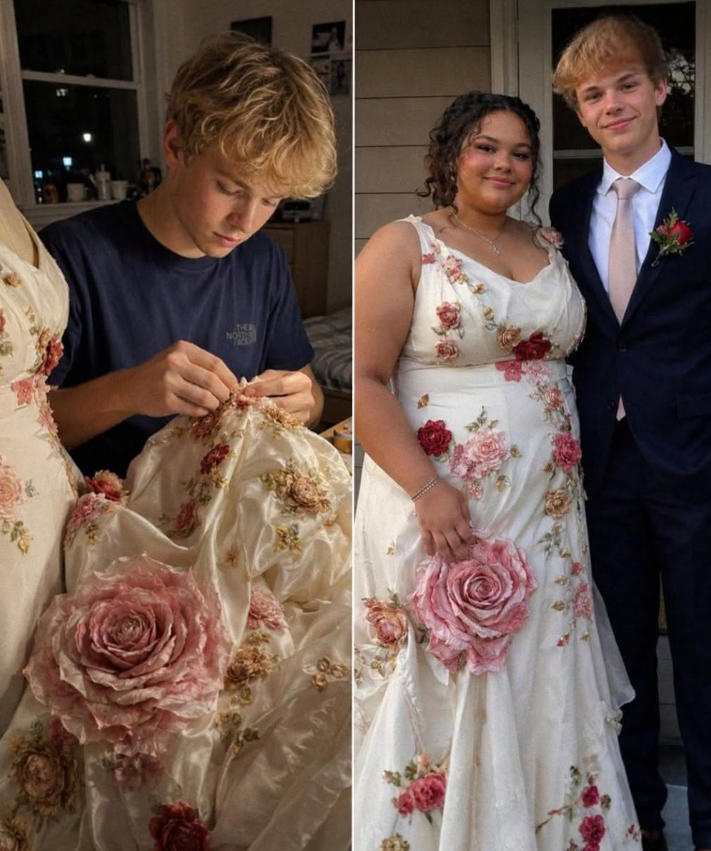
The kitchen table disappeared under sketches, lace, pins, and measuring tape. Kuba sewed late into the night, sometimes unpicking everything because “the fold wasn’t breathing right.” Zsófia stood in the doorway, watching as something impossible slowly began to take shape.
She only touched it when the first embroidered rose appeared.
“A rose?” she asked.
“Your mom said you love them,” Kuba replied.
Zsófia looked at me.
Her father had planted roses in our garden. He had died years ago, and those roses had become something she could not bear to lose.
A week before the prom, a photo appeared online. It showed her in the fitting room—head down, zipper half closed. The caption was cruel, and the comments spread like fire.
Zsófia went pale reading them.
Kuba took her phone away.
“Don’t read it.”
“I already did.”
“They’re idiots.”
“But I’ll be standing in front of them.”
Her voice broke.
“I can’t do it.”
Kuba pulled out an envelope.
“Your father wanted you to have this.”
I froze.
It was his handwriting.
“My little Rose…”
Zsófia read silently as tears fell without sound.
“A rose does not ask the garden if it is allowed to bloom.”
At the end, one line: if you ever feel too small, remember—it’s not you who is too little, it’s the world that can be too narrow.
She was quiet for a long time.
Then she simply said, “I’m going.”
On the day of the prom, the dress hung on the door like something alive—cream-colored, covered in roses that seemed to move with the light. Zsófia stood in front of the mirror, and for the first time, she didn’t look like someone trying to hide, but someone arriving.
“Breathe,” Kuba said.
“I am breathing.”
“No, you’re fighting the air.”
She smiled through tears.
“Shut up.”
“Thanks for three weeks of work.”
“Thank you.”
Quiet. Real.
At the school entrance, she stopped. Her hand instinctively went to the small hidden pocket near her heart. Kuba offered to turn back. She said no. He suggested the back entrance. She said no again.
“Then lead,” she said.
Inside, the hall went silent. Not out of kindness, but shock. People stared because they couldn’t not stare.
The roses on her dress seemed to move with every step.
A girl called out mockingly, “Here comes the curtain princess.”
Zsófia stopped. Kuba tensed, but she squeezed his hand.
“No,” she said calmly.
Then she turned.
“You know what’s funny? Your words aren’t about me. They’re about you.”
And she walked on.
First there was silence. Then someone said, “That dress is beautiful.” Then another voice. Then more.
Something in the room changed.
On stage, the dressmaker spoke about “limits.” Kuba walked up.
“This dress wasn’t made despite her. It was made because of her.”
He read from the letter.
Zsófia finally spoke: “This is my father’s letter. Kuba stitched it into the dress so I would never forget I am not something to hide.”
Not everyone clapped. But enough did that something broke open.
She didn’t win the award.
But she won something else—the right to exist without apology.
Later, the photo went viral again, but this time it wasn’t cruel. It showed her in the rose dress, Kuba beside her. The caption said it was a dress made when the world said she didn’t fit.
Today the dress hangs in our home.
Not as a memory.
As proof.
That Zsófia was never too big.
The world was just too small for her.