My Brother-in-Law Humiliated My Thirteen-Year-Old Son at a Family Cookout—Then He Learned the Truth About Me
The grill crackled beside the patio. Fireworks popped somewhere beyond the Richmond neighborhood, and the smell of charcoal and barbecue sauce hung in the humid July air.
Then my thirteen-year-old son hit the ground.
Caleb landed hard on his hands and knees on the wrestling mat my brother-in-law had dragged into my mother’s backyard “for fun.” For one terrible moment, the entire Fourth of July cookout went silent.
My daughter Emma gasped beside me.
Derek Vaughn stood over Caleb with a smug grin, clapping his hands as if he had just witnessed something entertaining instead of humiliating.
“Come on, Caleb,” he said loudly. “You’ll never become a man if you quit every time something feels difficult.”
Caleb pushed himself up slowly. His face was bright red, his shoulders tight with embarrassment. He stared at the grass, refusing to look at anyone.
Emma pressed herself against my side.
“Mom,” she whispered, “why is Uncle Derek always so mean to Caleb?”
The question cut deeper than she knew.
Because everyone had let him be.
For years, Derek had treated kindness as weakness and volume as authority. He had once served as a military supply corporal, and he talked endlessly about discipline, toughness, and courage as though he were the only person who understood them.
At birthdays, Thanksgiving dinners, summer cookouts, and ordinary Sunday visits, he always found someone to target.
Usually, it was me.
I’m Laurel Bennett. I’m forty-four years old, a mother of two, and a retired United States Marine Corps lieutenant colonel.
My family knew I had been a Marine, but they believed my career had been comfortable and uneventful. They imagined air-conditioned offices, secure bases, paperwork, and a generous pension waiting at the end.
I never corrected them.
I let them think I had been lucky.
I let Derek joke about the “office Marine.”
I let relatives laugh when he said my biggest battlefield had probably been a copier that ran out of toner.
What they didn’t know was that my service record included combat deployments, humanitarian evacuations, a Bronze Star with valor, and a Purple Heart I still couldn’t talk about without remembering the smell of smoke and blood.
I kept the medals in a box at the back of my closet because I never wanted my children to grow up believing bravery needed applause.
But somewhere along the way, humility had turned into silence.
And silence had taught my family that disrespect came without consequences.
Derek slapped the wrestling mat again.
“If you’re so worried about him, Laurel, why don’t you show Caleb how it’s done?”
A few relatives laughed nervously.
My younger sister Mallory stood by the grill, rearranging hamburger buns with intense concentration, pretending not to hear her husband.
My mother, Elaine, sat at the patio table clutching a glass of iced tea.
“Derek, that’s enough,” she said weakly.
But she stayed seated.
She had stayed seated for years.
She stayed silent when Derek mocked my career.
She stayed silent when Mallory secretly asked me for money to help with their mortgage while Derek bragged about being the family provider.
And now she stayed silent while my son stood there wishing he could disappear.
I looked at Caleb.
That was the moment something inside me finally broke.
Not because Derek had insulted me.
Because my children were watching.
They were learning, in real time, whether peace was more important than dignity.
I removed my watch and placed it carefully in Emma’s hand.
“Go stand next to Grandma,” I said.
Her eyes widened. “Mom?”
“I’m okay, sweetheart.”
Then I stepped onto the mat.
Derek grinned, delighted that I had volunteered to become the afternoon’s entertainment.
“Finally,” he said. “I was starting to think the paperwork division had lost its courage.”
“You wanted a demonstration,” I replied.
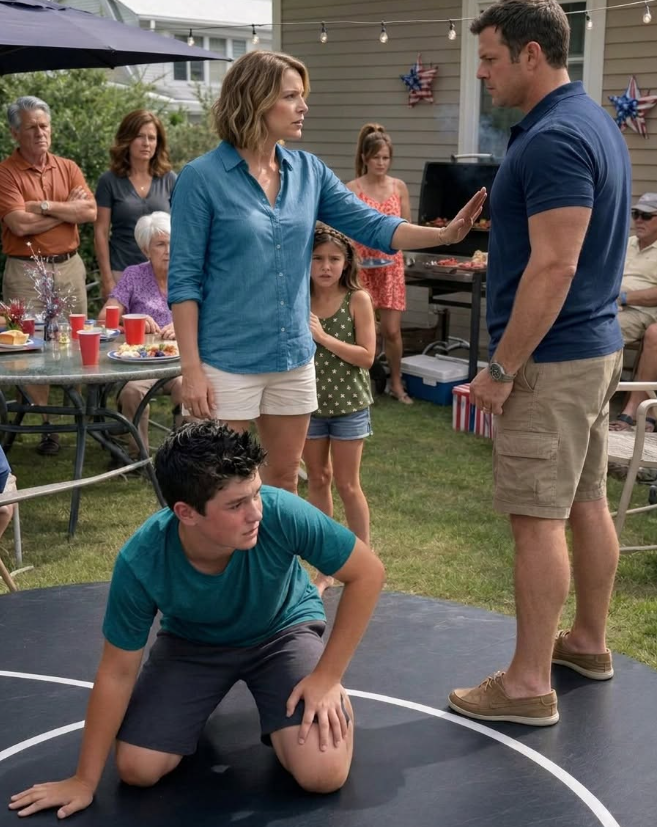
He rolled his shoulders and took a wide stance, full of confidence.
What he expected was hesitation.
What he got was twenty-two years of Marine Corps training.
He lunged for me carelessly, relying on size and strength. I stepped off line, caught his wrist, turned my hips, and used his own momentum against him.
In less than three seconds, Derek hit the mat.
I controlled his arm safely behind his back, applying just enough pressure to make it clear he was no longer in charge.
The backyard froze.
Derek struggled. “Get off me.”
“Say you’re finished.”
He twisted harder, trying to muscle his way free. I adjusted my position slightly.
“Finished,” he muttered.
I released him immediately and stepped back.
Derek scrambled to his feet, his face burning crimson.
“That was a dirty move.”
“No,” I said evenly. “It was a controlled move.”
“You embarrassed me in front of my family!”
I glanced toward Caleb.
“You embarrassed yourself when you pushed my son.”
Derek took an angry step toward me.
A new voice stopped him cold.
“Step back, Corporal Vaughn.”
Everyone turned.
Silas Mercer, my mother’s elderly neighbor, stood at the gate wearing a faded Marine Corps cap and leaning on a cane. His white hair glowed silver beneath the patio lights.
Derek scoffed. “This is family business.”
Silas’s expression hardened.
“This is about respect.”
Then he looked around the yard.
“You people have no idea who you’ve been laughing at.”
My stomach tightened.
“Silas,” I warned quietly, “please don’t.”
He ignored me.
“In 2011, Lieutenant Colonel Bennett’s unit reached our convoy after it was disabled in hostile territory. Six of us were trapped. When my leg stopped working, she carried me to the extraction point herself.”
The silence became absolute.
Mallory stared at me. “Lieutenant colonel?”
Caleb was already searching my name on his phone. A moment later, he held the screen up with trembling hands.
An old veterans’ association article filled the display.
There was my photograph in dress blues.
Bronze Star with Valor. Purple Heart. Humanitarian Evacuation Commendation.
“Mom…” Caleb whispered. “Is this really you?”
Emma looked over his shoulder, her eyes enormous.
“You were hurt?”
Her voice reached the part of me I had spent years trying to protect.
I had hidden the truth because I thought it would keep life simple.
Instead, I had allowed the people I loved to reduce me to a joke.
Mallory stepped closer, tears already forming.
“Why didn’t you ever tell us?”
I looked around the backyard at the family members who had called me whenever they needed money, advice, childcare, transportation, or emergency help.
“Because every time I tried to be more than useful,” I said quietly, “this family became uncomfortable.”
My mother’s eyes filled with tears.
“That isn’t fair.”
I met her gaze.
“No,” I said. “It isn’t.”
I left before the fireworks started.
Emma fell asleep in the back seat on the drive home, curled around my jacket. Caleb stayed awake, staring out the windshield for miles before he finally spoke.
“Why did you let Uncle Derek talk to you like that for so long?”
I could have given him the easy answers.
Family is complicated.
Your grandmother needed help.
I didn’t want conflict.
But none of those were true enough.
“Because I thought staying quiet proved I was strong.”
He turned toward me.
“Did it?”
The question hurt because I already knew the answer.
“No,” I admitted. “It just taught people that I would tolerate being disrespected.”
He looked down at his hands.
“I don’t want to learn that.”
I gripped the steering wheel tighter.
“Then I’m going to stop teaching it.”
The next morning, I canceled every automatic payment I had been quietly sending to my mother and sister.
Utilities.
Mortgage assistance.
Emergency transfers that had somehow become permanent expectations.
Then I wrote them both a message.
I told them I loved them. I did not regret helping them. But I would no longer provide financial support while being mocked, ignored, or valued only for what I could give.
Any future relationship with me would require honesty, boundaries, and basic respect.
Mallory called first, sobbing so hard I could barely understand her.
“I knew Derek went too far,” she confessed. “But you always smiled, so I convinced myself you didn’t care.”
“That made things easier for you,” I said.
“Yes,” she whispered. “I let him turn you into the family joke because it kept peace in my house.”
It was the first truly honest thing she had said to me in years.
Two months later, my former unit invited me to a recognition ceremony at Quantico.
For years, I had avoided those events because public praise made me deeply uncomfortable.
This time, I invited my family.
When the speaker read my service record aloud, my mother cried openly.
When Emma heard the words Purple Heart, she reached for my hand and held it with fierce determination.
When the ceremony ended, Derek approached me slowly near a hallway window.
For once, he had no audience.
“I was wrong,” he said. “I made you seem smaller because I wanted to feel larger. And I did it in front of your children.”
I waited.
“I’m sorry, Lieutenant Colonel.”
I studied him for a long moment.
“I accept your apology,” I said. “But trust has to be rebuilt.”
He nodded. “I understand.”
And for the first time since I had known him, I believed he actually did.
The following Thanksgiving, I hosted the family again.
But this time, I didn’t pay for everything.
Everyone brought food. Everyone helped clean up. No one mocked my career. No one expected me to solve a financial problem before dessert.
Late that evening, I found Caleb and Emma standing in front of the framed photograph from the Quantico ceremony that now sat on our living-room shelf instead of hidden in a closet.
Emma looked up at me.
“Were you scared when you were a Marine?”
“Many times.”
She frowned. “But brave people aren’t scared.”
Before I could answer, Caleb spoke.
“Brave people do the right thing even when they’re scared.”
I looked at my son and realized that the most important lesson from that Fourth of July had nothing to do with wrestling, military service, or medals.
It was about boundaries.
For years, I believed strength meant carrying every burden quietly.
Now I understood something far more important:
Real strength protects people. It does not humiliate them.
And sometimes the bravest thing a person can do is stand up, in front of everyone, and refuse to disappear anymore.
The End