Richard’s question hung in the air like a poorly closed door, leaving a draft slipping into the room.
— A daughter? Why didn’t you tell me? — he repeated, but his voice was no longer the same. There was no curiosity in it anymore. More calculation.
The spoon in my hand stayed still. I watched his face. His eyes. I was looking for that moment when a person drops the role and steps out of it.
But he didn’t step out. He just kept playing, more subtly.
— I didn’t think it was important at the beginning of our relationship — I said calmly. Too calmly. — But now it is.
I saw him process it. Quickly. Too quickly.
— I see — he nodded eventually. — And… where does she live?
That was the first real test.
The question wasn’t about the daughter. It was about the background. The depth of responsibility. The size of the potential “burden.”
I put the fork down.
— She studies abroad. She rarely comes home.
Richard’s face relaxed a fraction. As if he had ticked off an internal calculation.
— That… makes things easier — he said, then immediately added: — I mean, the logistics.
The word “logistics” slipped out like something rehearsed too many times.
I smiled, tilting my head slightly.
— Yes. Logistics are always important.
And that was when I decided to take it further.
In the following days, I watched him like a researcher who is not looking for an answer, but for a flaw in the system.
Small things changed.
He asked more questions. But not about me — about my circumstances.
“Does your daughter have her own savings?”
“How often do you talk?”
“Is there any medical… sensitivity in the family?”
Every question was polite. Too polite. Like a form someone fills out with a smile.
One evening, when he stayed over and the wine glasses were already half empty, he sat down next to me on the couch.
— You know — he began slowly — in life, the most important thing is clarity. No surprises. No misunderstandings.
His voice was warm. His words were cold.
— Yes — I said. — Clarity is important.
And then he gently touched my hand.
— Have you spoken to her… about the future? About you starting a new life?
Behind the question was something else. Something unspoken: how much of that “future” he was part of, and how much anything else would become an obstacle.
I smiled.
— Yes. She accepts it.
It wasn’t true.
But the lie now moved in a shared space between us.
Richard’s eyes lit up for a moment. Relief. Or victory.
I couldn’t decide yet.
That night I didn’t sleep.
I stared at the ceiling, thinking when it all shifted. When romance turned into strategy. Care into inspection. Questions into a map of my wealth.
The next day I called Maggie.
— Are we still doing this? — she asked immediately.
— Yes.
— I don’t like this.
— Neither do I — I said honestly. — But I’m already halfway through.
That evening Richard came again.
This time he didn’t bring flowers.
He placed a folder on the table.
— What do you think about this? — he asked.
He didn’t open it. He just left it there.
— What is it?
— Just a plan — he said. — The financial structure of our shared life. So everything is transparent.
The emphasis on “our shared life” was too precise.
I picked up the folder. I didn’t open it.
— This is moving fast.
— Good things always start fast — he smiled.
That was the moment I almost laughed.
Almost.
But instead I only said:
— I need to speak to my daughter.
Richard nodded, but his gaze tightened.
— Of course. It’s important that everyone is on the same page.
“Everyone.”
Not “the two of us.” Not “the three of us.”
Everyone.
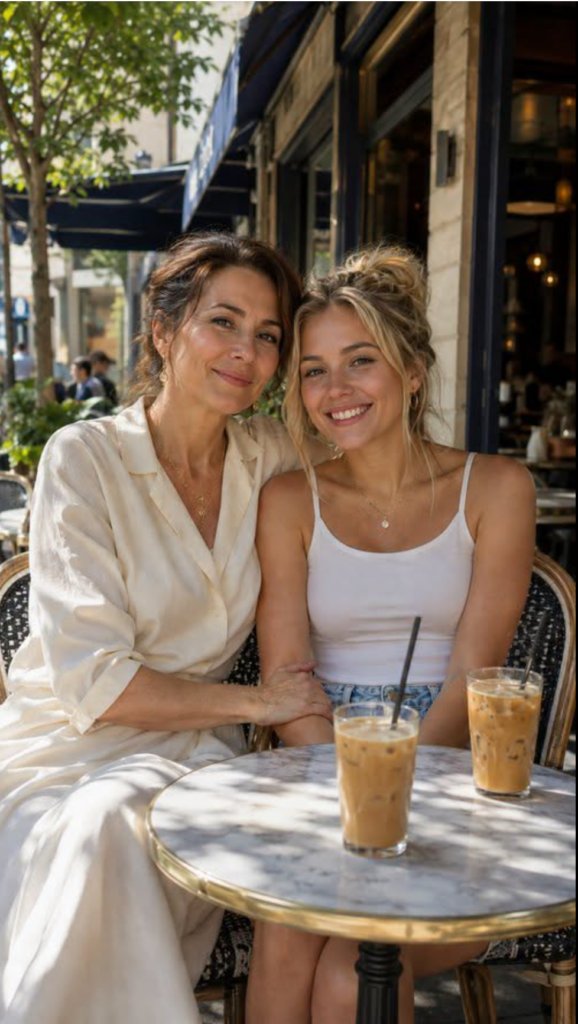
The next afternoon, Maggie arrived.
She looked twenty-five if you didn’t pay attention. If you did, you saw she was far more mature than anything Richard had ever imagined.
— So this is him? — she asked quietly when Richard went out to take a call.
— Yes.
— And?
— He’s observing.
— That’s not an answer.
— Not yet.
Maggie looked around the apartment.
— You know what I see? — she asked.
— What?
— Someone who doesn’t want you. He wants your stability.
The sentence was too precise.
Richard returned then.
He was smiling.
But not the same way anymore.
As if he knew something in the space had changed.
He sat down across from us.
— I’m very happy we finally meet — he said to Maggie.
— Me too — she replied.
Silence.
Then Richard turned to me.
— I’ve been thinking a lot. Your daughter… is an important factor.
“Factor.”
That was the second word that truly revealed him.
And then Maggie spoke:
— You don’t need to worry about me.
Richard turned to her.
— I’m not worried.
He smiled.
But his eyes didn’t smile with him anymore.
And then I understood something completely.
The question was not whether he loved.
It was what he considered a “risk.”
And in that moment, I was no longer sure he was the only one playing this game.