I never knew how stories like this were supposed to begin.People say, “Talk. Tell your story.”So I will—without polishing it, without excuses. Just the truth, as it comes.
My name is Iñaki Salgado. I’m in my early thirties, thin enough that strangers assume I’m sick. The dark circles under my eyes have become permanent residents.
Somewhere along the way, I learned how to look exhausted without asking for pity. How to suffer quietly.Once, my life was simple.My wife, Ximena Arriola, and I lived in a modest adobe house on the outskirts of Puebla.
Mornings smelled of bougainvillea and warm bread drifting in from the street ovens. We were elementary school teachers. Poor by most standards, but rich in routine, respect, and a love that didn’t need noise to prove itself.
Then December arrived.Just weeks before Christmas, Ximena went to the market to buy ingredients for tamales. A delivery truck, its brakes gone on a rain-slick corner, lost control and crushed her path home.
The hospital called while I was teaching. I remember the chalk slipping from my fingers before I even understood why I was running.On the stretcher lay someone I barely recognized.
The woman who used to walk fast, laugh loudly, and sing while cooking stared at the ceiling with terrified eyes. Her body didn’t answer her anymore.
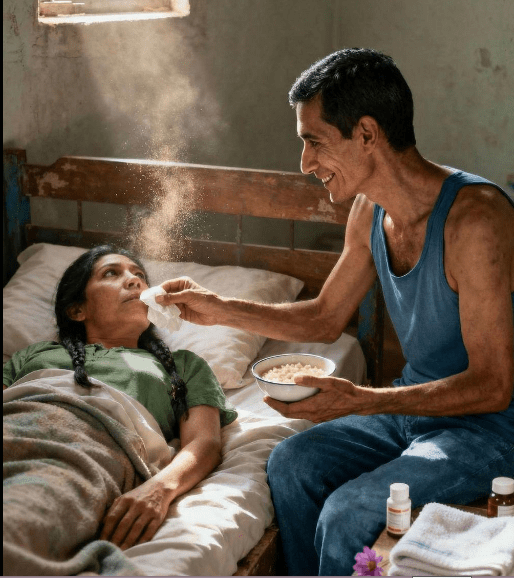
Severe spinal damage.Partial paralysis.From that day on, my world collapsed into a single room.I took an indefinite leave from school. I learned how to lift her without hurting her, how to bathe her,
feed her, clean wounds, massage legs that lay silent beneath my hands. Our home turned into a fragile imitation of a clinic—bandages, pills, rehab tools, and the constant smell of alcohol and quiet despair.
People suggested institutions. Specialists. Places “better equipped.”I always gave the same answer.“She’s my wife. I’ll take care of her.”To survive, I took small electrical jobs—rewiring houses, fixing lights, anything that paid.
I came home exhausted, but every night I sat beside her bed and read aloud. Old books. Stories. Sometimes I talked about my students, the jacarandas blooming in spring, fragments of the world I hoped might still reach her.
Ximena barely spoke.She nodded. She cried softly. I believed it was grief. Pain. Love imprisoned in a broken body.I never doubted her.Years passed.
Friends faded away. Some told me—without cruelty, just honesty—that I should think about myself. I didn’t blame them. Loving someone like that is a long, lonely road.
Then came the afternoon that split my life in two.I was on my way to work when I realized I’d forgotten my wallet. Documents. Money. Everything. I turned back, irritated, expecting to be inside for seconds.
I opened the door.The setting sun poured into the room—and exposed the truth like a blade.Ximena wasn’t in bed.She was standing.Walking.And she wasn’t alone.
A man I had never seen before stood beside her, folding clothes with frantic hands and stuffing them into a large suitcase on our bed. They were laughing—softly, freely.
A laugh I hadn’t heard in five years.“Hurry,” she said, her voice clear and steady. “Before he comes back. Take the money from the wardrobe. We’ll go south. Start over.”
My keys slipped from my hand and struck the floor.They froze.In Ximena’s hands was a thick stack of cash—the money from my sleepless nights, my aching back, the sacrifices made for treatments she had never needed.
I didn’t shout.I didn’t break anything.Something inside me simply… shut off.“Since when?” I asked.Two years.Two years of walking.Two years of pretending.
The man was an old lover. They had reconnected. She had played the role of a paralyzed woman to secure a home, free care, and steady money—while he “sorted out his life.”
“Iñaki… let me explain—” she said, stepping toward me.I stepped back.Five years of my life had been a performance.And I had been its most loyal audience.
I opened the wardrobe, took my wallet, and slid it into my pocket.“Go,” I said calmly. “Keep the money. Consider it payment for an outstanding performance.”
They left in a rush—like thieves who knew the scene was over.The house fell silent.I sat there for a long time, letting the pain move through me without resistance.
It hurt—deeply—but it no longer crushed me. For the first time in years, I wasn’t holding myself together for a lie.I didn’t clean.I opened the windows instead.
The night air of Puebla rushed in, carrying away the scent of medicine, deception, and the past. I realized something quietly miraculous:
I was still here.Still breathing.Still free to choose.The next morning, I returned to school.The chalk trembled in my hand—but it felt honest. My students looked at me, and for the first time in years, I felt anchored to life.
I don’t know what the future holds.But I know this:I will never again destroy myself for a love built on deception.The door to my old life closed—not with violence, but with certainty.And on the other side, a new path finally began.