By the time the first notes of the wedding march drifted through that brick church in Columbus, Ohio, I had already erased seventy-eight thousand dollars from existence.Not out of rage.Not out of spite.Just a calm, three-minute phone call to City Bank.
But that part came later.The part that shattered me came first.I’d driven three long hours up Interstate 71—past miles of farmland, fast-food billboards, and that familiar green blur of exit signs—to watch my only child get married.
The same boy I’d raised entirely on my own after his father vanished one icy Christmas morning. The boy whose asthma kept me awake every winter, whose homework I helped with between cleaning jobs, whose tuition I paid for with burned-out shoulders and hands raw from chemicals.
My old silver Honda hummed into the parking lot like it knew this road by heart. The cars around me sparkled: polished SUVs, fresh-from-the-dealer sedans, luxury imports I’d only ever touched while wiping fingerprints off their doors.
I smoothed the front of my plain blue dress, checked my hair in the rearview mirror, and adjusted the borrowed pearl necklace my neighbor insisted I wear. “Margaret,” she’d said, “at least pretend you’re going to a wedding, not a dentist appointment.”
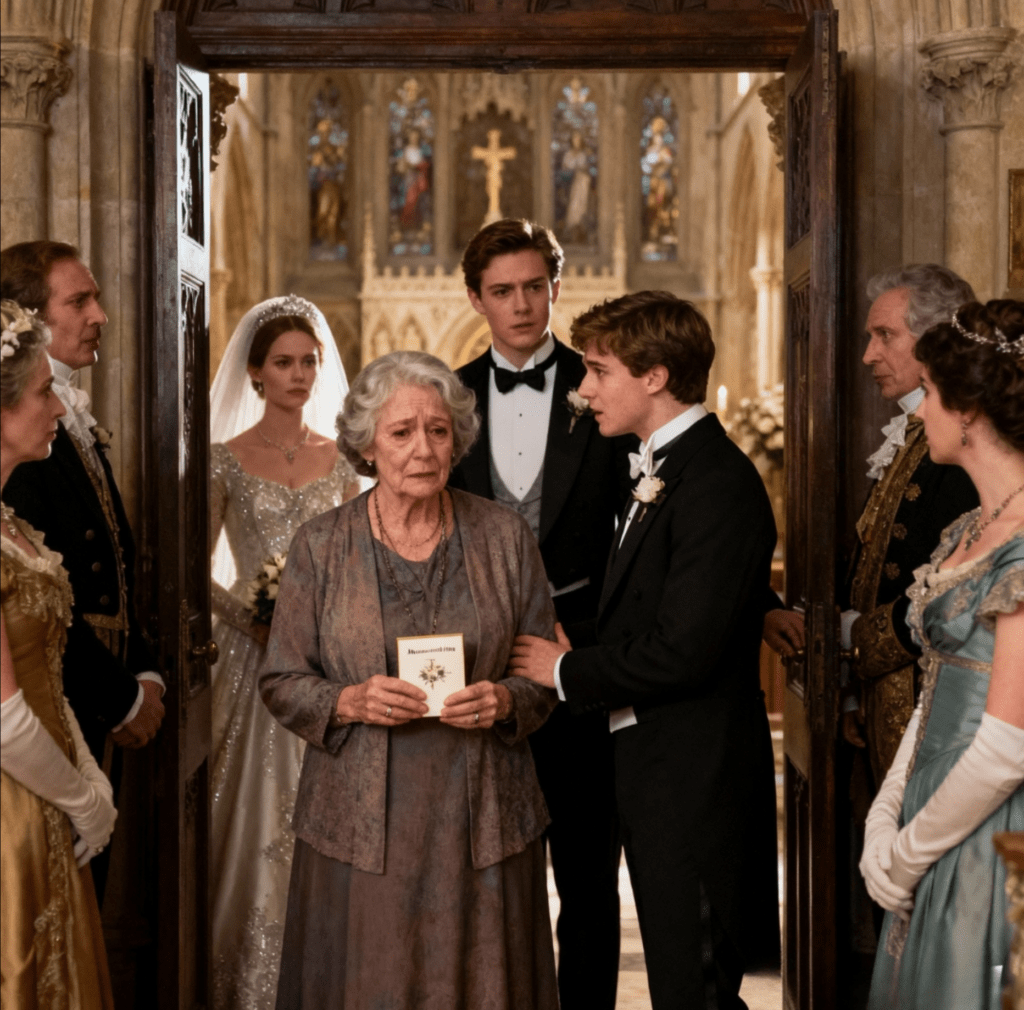
In my purse was a card I’d written carefully:“To David and Sarah — may your life together be built on love, respect, and truth. Love, Mom.”Inside was a generous check. I thought they’d be delighted.If I’d known what waited inside, I wouldn’t have bothered.
The moment I stepped through the heavy doors, warm air and organ music washed over me. Pink roses were everywhere—on pews, around pillars, woven around the altar like spun candy. Chandeliers glowed gold, making everything look expensive and soft.
People turned. They stared. Their whispers floated like perfume.Who is she?Is that the cleaning staff?Why is she wearing that?Then I saw him.David stood at the front in a magazine-worthy tuxedo, looking taller, broader, impossibly polished.
For half a second, I saw the little boy in superhero pajamas who used to run into my arms screaming “Mommy!”But the man in front of me didn’t smile.His face turned red.“Mom,” he whispered, stepping toward me like I was a stranger who’d wandered in by mistake. “What… what are you doing here?”
The organ kept playing. Heads swiveled. Someone’s perfume—expensive, imported—mixed with the heavy scent of roses.“I came to see you get married,” I said quietly. “I drove from Cincinnati.”
Then the bride, Sarah, turned. She was stunning in the wedding gown I had paid for—silk, lace, tiny pearls that shimmered like dew. I remembered her twirling in front of the bridal shop mirror, saying, “I feel like I’m in a magazine.”
Now she looked at me like I’d dragged muddy boots across her white carpet.“You weren’t supposed to come,” she hissed. “This was… curated.”Before I could speak, her father, James Williams, appeared beside her—navy suit, polished shoes, the confidence of a man who never hears the word “no.
”“Mrs. Peterson,” he said, as though addressing a distant acquaintance. “There seems to have been a misunderstanding.”“What misunderstanding?” I asked.“This is a close family celebration,” Sarah said, cheeks flushed not with joy, but embarrassment. “It’s about… the image of the event.”
Thirty years of sacrifice—bedtime stories, scraped knees, double shifts, skipped vacations, endless tuition payments.But I wasn’t “close family.”“I paid for this wedding,” I heard myself say. “Every single part of it.”
James’s smile tightened like a belt.“Money doesn’t buy class,” he murmured. “This is about the kind of people invited.”I understood perfectly.They didn’t want the cleaning lady in their wedding photos.Something inside me went very still.
I set the wedding card on a pew.“I wouldn’t want to embarrass you,” I said.“Mom, don’t make this worse,” David begged, glancing at his in-laws like they were the jury.“You’re right,” I said. “I don’t belong here.”
The walk out felt like wading through cement. But I kept my head high.Outside, the March wind hit me—cold, sharp, honest.I got into my Honda, closed the door, and sat in the quiet. My phone buzzed with calls from City Bank and various vendors. Nothing from David.Finally, I pressed the contact:
CITY BANK CUSTOMER SERVICE“Hello, this is Jennifer. How can I help you?”“Hi Jennifer. This is Margaret Peterson. I need to stop payment on several checks.”Her voice perked up. “Of course. Which ones?”
“All wedding-related checks.”Silence. Shock. Then typing.“Are you sure?” she asked.“Very sure.”One by one, I cancelled every payment: the venue, the catering, the flowers, the music, the photographer, the rentals.Then I called the vendors.
Riverside Catering.Bella’s Blooms.The photographer.The string quartet.The DJ.The chair rental company.All of them would need payment in full—today—or they’d take their things back.By 3:15, I was done.
I drove away just as the catering truck pulled up and the florist’s van followed behind.My phone lit up with David’s frantic calls, but I let them ring.At home, after a long quiet evening, I listened to the voicemails—each one more desperate than the last.
“Mom, what did you do?”“Please call me—this is humiliating!”“We need to talk.”“Please, Mom… we need you.”I sat at my desk, surrounded by decades of neatly kept files—every receipt, every tuition payment, every car loan, every rescue payment, everybill I’d ever covered for him.
When I totaled it all, the number stared back at me like something carved in stone:$473,000.Nearly half a million dollars of my life.Half a million dollars of sacrifice.Half a million dollars that had taught him absolutely nothing.
And for the first time, I realized I had helped create this problem. I had funded it. Enabled it.The next morning, I walked into a law office—quiet, polished, powerful.“Mrs. Peterson,” attorney Jennifer Williams said, “your documentation is remarkable.”
“When you raise a child alone in Ohio,” I replied softly, “you learn to track every dollar.”She nodded.And for the first time in a long time, I felt something settle inside me—not anger, not bitterness.Clarity.
The kind that doesn’t disappear with organ music or pink roses.The kind that comes when you stop apologizing for taking your power back.