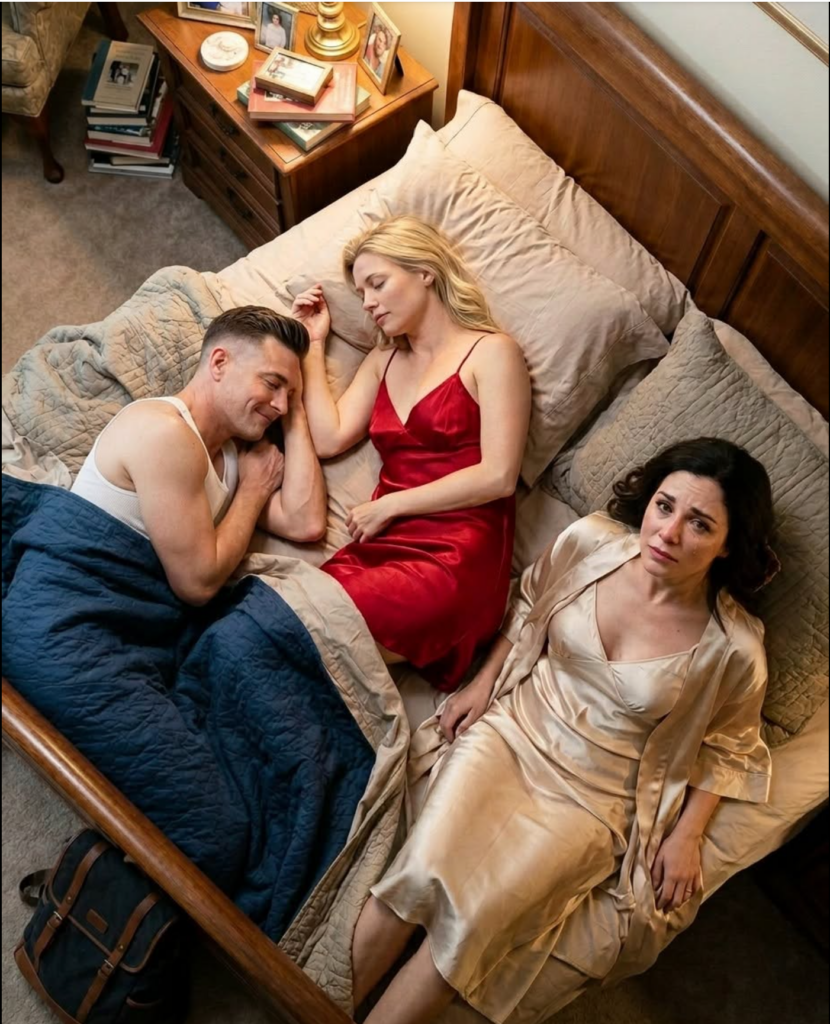
Every night, Lucía came into my room with her pillow tucked under her arm like it belonged there.
At first, I thought it was absurd.
She didn’t ask—she simply appeared at the door, already half-whispering excuses.
“I can’t sleep alone,” she’d say. “Bad dreams.”
And every night, my husband Esteban would sigh like it was an inconvenience, not a problem.
“Just let her stay,” he’d tell me. “It’s harmless.”
So she stayed.
Between us.
Like a quiet, breathing wedge I didn’t know how to remove.
At first I believed what everyone else believed—that Lucía was fragile, maybe attention-seeking, maybe unstable. But sleep has a way of stripping illusions away.
Because it wasn’t just the nights she came in.
It was what happened after.
The moments I stopped pretending I wasn’t awake.
The faint pressure of her hand gripping mine under the blanket.
The way her body would go rigid at certain sounds no one else reacted to.
And the worst part?
Esteban never noticed a thing.
Or acted like he didn’t.
Then came the night the light appeared.
A thin strip slipped under our bedroom door—sharp, deliberate, unnatural in a sleeping house.
Lucía woke instantly.
Not startled.
Prepared.
She covered my hand before I could move, her grip suddenly firm, almost urgent.
Then the light vanished.
And somewhere in the hallway, something shifted—soft footsteps, slow and controlled, like someone trying not to exist.
Silence swallowed everything again.
Except me.
Because I was no longer sure what I had just heard… or who I was sharing a house with.
The next morning, Lucía was back in the kitchen before anyone else woke, stirring oatmeal like the night hadn’t split the world in half.
That’s when I finally asked her.
“Who was outside our room?”
Her spoon stopped mid-circle.
For a second, she looked like she might lie.
“I don’t know what you mean,” she said.
But her voice cracked at the edges.
And that was worse than denial.
That night, she led me to the roof.
Puebla stretched beneath us—warm lights, distant traffic, a world pretending nothing was wrong.
Lucía sat on an old bucket, wrapped in her blanket like armor she’d built herself.
And then she spoke.
Not quickly. Not dramatically.
Carefully. Like every word had consequences.
“It didn’t start here,” she said. “It followed me here.”
My stomach tightened.
At first, she described things that sounded almost harmless if you didn’t listen closely.
A man standing too close.
A comment that felt like a joke until it wasn’t.
A door that didn’t fully close anymore.
Then the nights.
The footsteps outside her room.
The faint turning of a handle.
The light under the door that never should have been there.
And finally, the decision no one sees coming:
She stopped sleeping alone.
Not because she felt safe with us.
But because she felt safer being witnessed.
“He wouldn’t risk it,” she said quietly. “Not if someone else was there.”
The words sat between us like a cold object.
“Why didn’t you tell me?” I asked.
Her eyes didn’t meet mine.
“Because people don’t believe women when everything looks normal on the surface,” she said. “And he looked normal. He always looked normal.”
That was the first moment I understood: fear doesn’t always look like panic. Sometimes it looks like planning.
The breaking point came quietly.
An old phone, hidden in a desk drawer.
No lock. No hesitation.
Just proof waiting to be found.
Photos taken without permission. Screenshots. Cropped images. Watching eyes frozen in digital silence.
And one video—angled toward a bedroom door.
Our bedroom door.
After that, nothing inside my life felt stable anymore.
Not my marriage. Not my memories. Not the man I thought I knew.
When we confronted him, Esteban didn’t explode.
He didn’t confess.
He calculated.
Shrugged.
Explained.
Twisted.
“It’s old,” he said. “It must’ve been hacked.”
But lies don’t survive contact with too much truth.
Not when there are photos.
Not when there’s a witness who finally stops being afraid.
Not when a family realizes too late that the person they trusted most understood exactly how trust could be used.
By the time the police arrived, the story had already collapsed under its own weight.
And afterward, everything that followed was slow and painful in a way justice stories rarely admit.
Statements. Silence. Divorce papers. Empty rooms.
Lucía left first.
Then my husband became my ex-husband.
And I began the uncomfortable work of realizing that I had shared a life with someone I never truly knew.
Months later, Lucía said something I never forgot.
“I thought I was protecting everyone by staying quiet,” she told me. “But I wasn’t protecting anyone. I was just delaying the truth.”
That’s the part people always misunderstand when they retell the story.
They fixate on the strange detail—the woman sleeping between a husband and wife.
But that was never the center of it.
It was the perimeter.
A shield built out of instinct, fear, and limited options.
Because sometimes safety doesn’t look like running away.
Sometimes it looks like sitting in the middle of the danger—so you don’t face it alone.