When the whole school started laughing, Lena squeezed my hand so hard it felt like she was afraid I would disappear along with the music.
“Dad… you don’t have to do this if you’re embarrassed,” she whispered.
She was standing behind the curtain of a small school gym stage. Pink leotard, a tulle skirt bigger than her body but still too small for the size of her dream.
Nine years old. Thin arms. Eyes too old for her face. Hair pulled into a small bun, as if holding on to something that was already slipping away.
Half a year ago, it had reached her waist. Then came the diagnosis. Chemotherapy. In the mornings I would find strands of her hair on the pillow, and she would smile like it didn’t matter, just so I wouldn’t break down in front of her.
Her name was Lena. And she was braver than every grown man I had ever known.
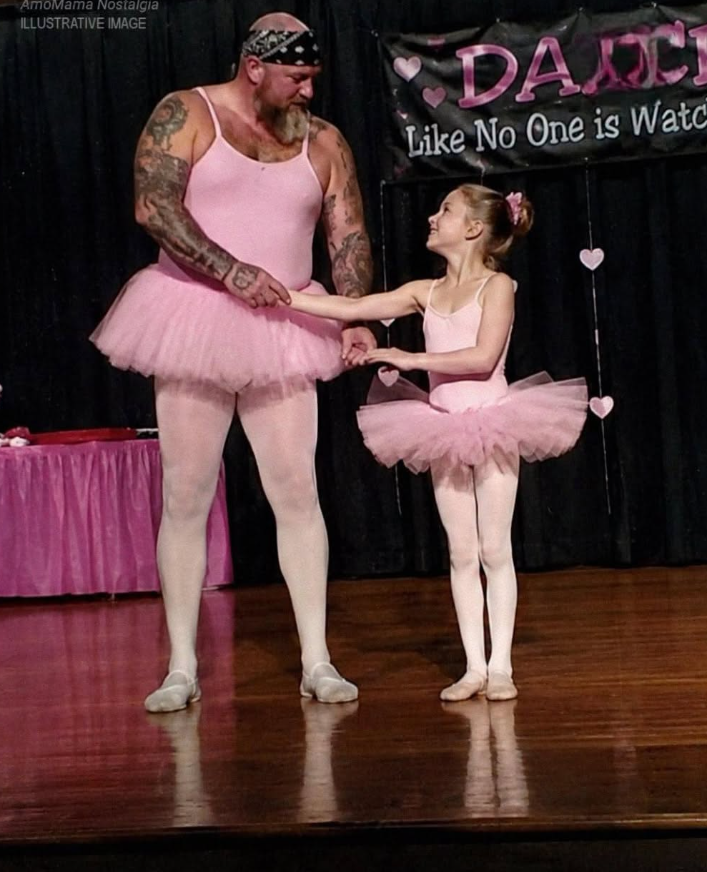
I looked at myself in the cracked mirror by the door. Six-foot-four, over two hundred pounds, beard, tattoos, a black bandana… and a pink ballet skirt I had no business wearing.
The tights felt like punishment. The ballet shoes looked like they had landed on the wrong body.
Through the wall I could already hear the hall: children, parents, chairs scraping, nervous laughter. Above the stage hung a banner: “Dance Like No One Is Watching.” The irony almost hurt physically, because tonight everyone was watching.
“Dad…” Lena squeezed my hand tighter. “I’m scared.”
I knelt down. The tulle cracked like it was resisting the world.
“You know what I used to be ashamed of?” I said quietly. “Not knowing how to read maps in the army. Burning scrambled eggs so badly the neighbors thought the house was on fire.
And when your mom left… I couldn’t even braid your hair. I made it look like a bird’s nest.”
I paused.
“But you? Never. For you, I’d look like a pink flamingo that lost a fight and still walked back in.”
She laughed, then immediately coughed. That cough always hit me like a punch. Short. Dry. Too grown-up for a child’s body.
“Are you okay?” I asked.
She nodded. “Okay” had a new meaning lately: we are not going to the hospital today.
She was supposed to dance with her mother. But two days earlier, a message came: “I can’t do it. It’s too hard to see her like this.”
See her.
As if Lena was something unbearable to look at instead of a child trying to survive.
I didn’t tell Lena the truth. I told her her mother was working. She nodded, but her eyes already understood more than words allowed.
That evening she came into the garage.
“Dad… will you dance with me?”
I thought she was joking. She wasn’t.
So now I stood behind the curtain in a pink skirt, holding her hand like it was the only stable thing left in the world.
“What if they laugh?” she asked.
“Then they don’t understand music,” I said.
The curtain rose.
And silence fell.
The worst kind. The kind that turns into laughter.
“Look!” someone shouted. “Hagrid’s doing ballet!”
The room exploded.
Lena froze. I felt her fingers dig into mine. Her breath break apart.
“Look at me,” I said. “Only me.”
The music started.
The first step was memory. The second was instinct. The third was pure awkward survival. The laughter was there, but fading at the edges.
Because she was still looking at me.
So I danced. Badly. Clumsily. Heavy and untrained. Not to impress anyone. Just to stay with her.
And then the laughter stopped mattering.
Because she smiled.
At first uncertain. Then real. Then bright.
At the end of the routine she was supposed to bow. Instead, she ran into me and hugged my waist.
The hall went silent for a second.
Then someone started clapping.
One person. Then another. Then more. Until most of the room stood up.
Not everyone. There are always those who stay sitting. But enough.
“Dad…” Lena whispered, looking up. “They’re clapping.”
“Because they finally saw what’s real,” I said.
“What’s real?”
“That courage doesn’t look like they expected.”
The next morning I woke up to the sound of motorcycles.
One at first. Then many.
Outside the house stood the Iron Wolves.
My club. My family.
Bartek “Bear” was in front, the others behind him like a wall of engines and leather.
Lena stood at the window.
“Is this because of the video?”
I didn’t answer.
Because it was more than that.
Bartek walked in first.
“Good morning, ballerina,” he said.
“Good morning, Bear,” I replied.
And then the truth came out: bills I hid, debt I carried, treatment costs I tried to absorb alone like it was my job to disappear under them.
“You thought you were alone?” Bartek muttered.
I didn’t answer. Because I had.
Then they moved. No questions. Just action. Fixing, organizing, calling, paying, retrieving my motorcycle, filling out forms I didn’t want to see.
And Lena slept peacefully for the first time in months.
In the end, it wasn’t “me” anymore.
It was “us.”
And a year later, Lena walked onto the stage alone.
Before she started dancing, she looked at me and raised her hand.
Not for help.
For presence.
I stood up.
Because it was never about dancing.
It was about no one having to stand alone.