The frost that morning was merciless. Not just the kind that bites your fingers, but the kind that seeps deep into your bones. And yet, it wasn’t the cold that froze me in place—it was a quiet sob from the very back seat of my school bus. What I found there changed far more than just a single day.
My name is Gennadi. I’m 45 years old, and I’ve been driving a school bus for fifteen years in a small town most people have probably never heard of. Rain, snow, fog—I’ve seen it all. But nothing could have prepared me for what would come from a seemingly insignificant gesture.
Every morning, before sunrise, I enter the bus yard. I open the heavy gates, start the engine of my yellow vehicle, and let it warm up so that it’s cozy inside when the kids get on. Not a glamorous job, that’s for sure. But an honest one. And the kids? They’re the only reason I get up each morning.
Last Tuesday started like any other—but the cold was especially brutal. My fingers were nearly numb before I even turned the key. I stamped the frost off my boots and called into the bus:
“Come on, little polar bears! Get in! The air has teeth today! Grrr!”
I tried to sound stern, but my grin gave me away.Mascha, a five-year-old girl with pink braids, stopped in the doorway, hands on her hips, and examined my old, frayed blue scarf.
“You should ask your mom to buy you a new one!” she teased.
I bent down and whispered,“Oh, my little one… if my mom were still here, she would have gotten me a scarf that would make yours look like an old rag!”She giggled and ran to her seat. That brief laugh warmed me more than any heater could.
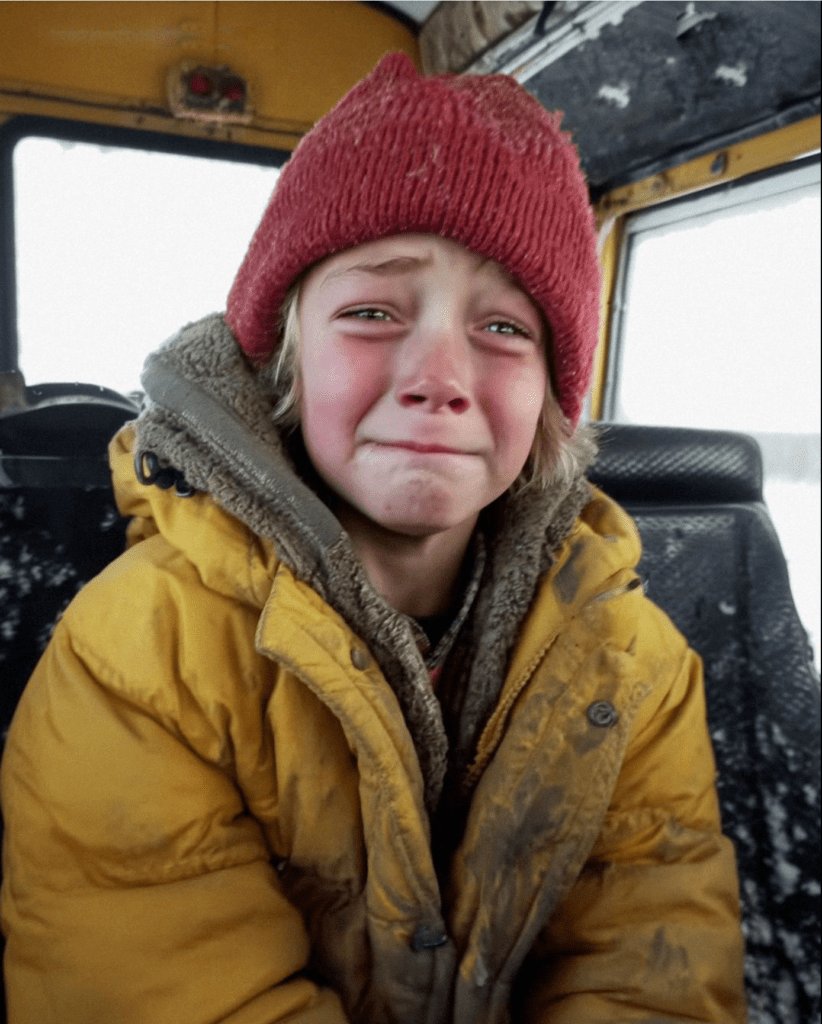
After dropping all the kids off at school, I stayed in the bus a moment to check for forgotten gloves or notebooks. That’s when I heard it—a soft, stifled sob.At the back sat a boy. Silent. Huddled. About seven or eight years old. Artem.“Hey, buddy,” I said gently. “Why are you still here?”
He didn’t lift his gaze.“I… I’m cold,” he whispered.“Show me your hands.”As he slowly extended them, my breath caught. His fingers were blue. Not just cold—frostbitten. Swollen. Too long unprotected.“Oh my God…” I muttered and immediately took off my own gloves.
They were far too big for him, but better than nothing.“Mom and Dad will buy me new ones next month,” he said softly.“The old ones are broken. But it’s okay. Dad tries.”I knew that “it’s okay.” It was a lie you learn when you have to grow up too soon.“You know what,” I said,
winking at him, “I know someone who sells the warmest gloves in the world. After school, you’ll get them. Deal?”For the first time, he smiled.That day, I didn’t go home. I didn’t have coffee. I went to Janina, an acquaintance with a small shop. From my last bit of money,
I bought thick children’s gloves and a dark blue scarf with yellow stripes—fit for a superhero.In the bus, I put everything in an old shoebox behind my seat. On it, a note:“If you’re cold, take it. Your driver, Gennadi.”I didn’t expect thanks. But in the rearview mirror, I saw Artem carefully take the scarf and tuck it under his jacket.
That day, he didn’t shiver. He smiled.What happened next overwhelmed me.A week later, the principal called me in. I was nervous—had I done something wrong? But Vladimir Sergeyevich greeted me with a warm smile.“Gennadi,” he said, “what you did was extraordinary.”
Artem’s family was in a tough spot. His father—a firefighter—had been seriously injured on duty, out of work for months. No income. Big worries.My little box became a spark. Teachers, parents, neighbors—they all joined in.
“They called it Project Warm Ride.” Baskets of scarves, jackets, and gloves appeared in every school bus and at the school entrance. No child had to freeze with blue fingers again.One day, Artem brought me a drawing. On it: me, the bus, many laughing kids with scarves. Below, in crooked letters:
“Thank you for keeping us warm. You are my hero.”The highlight came at the school’s spring festival. I was called to the stage. The entire auditorium stood up. Applause. I had never felt so… seen.“There’s one more surprise,” said the principal.
Artem walked on stage—hand in hand with a large man in a firefighter’s uniform. He moved slowly, with a cane, but his eyes were full of pride.“I’m Yevgeny,” he said, shaking my hand firmly. “Thank you. You didn’t just help my son—you got our whole family through the hardest winter of our lives.”
Then he leaned close and whispered:“Your kindness… it saved me too. It gave me the strength to keep fighting.”In that moment, I understood: my work is more than a steering wheel and a route.It’s noticing.A scarf.A pair of gloves.
And a child who no longer has to hide his hands from the cold.For the first time in a long while, I felt proud.Not of my job—but of the person I had become through it.