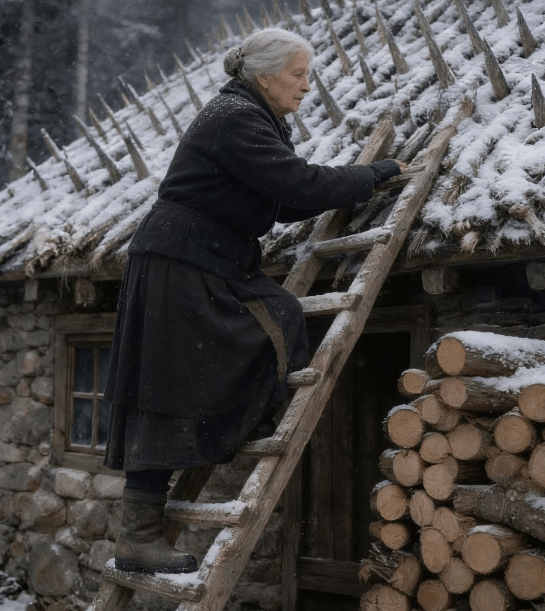
All summer long—and well into the thinning days of autumn—an old woman climbed onto the roof of her house and drove sharpened wooden stakes into the shingles.
Every day.By the time the first leaves let go of their branches, the roof had grown feral. It bristled with points, a jagged halo of wood that caught the light at odd angles.
From a distance, it looked less like a home and more like a warning.People noticed.People whispered.Some felt uneasy. A few felt genuinely afraid.
No one could say exactly when it had begun. Only that after her husband died the previous winter, the woman had faded from village life. She stopped visiting neighbors.
She no longer lingered at the shop. She spoke rarely, and when she did, it was only what was necessary.She had become quiet. Almost invisible.
Until the roof began to change.Each morning, there were more stakes.The house looked wrong—hostile, even. Like a trap laid for something no one else could see.
Speculation spread as quickly as unease.“She’s protecting herself from dark things,” some murmured.“It’s grief,” others said. “Grief does strange things to the mind.”
The boldest lowered their voices and leaned closer. “Maybe it’s a cult. You don’t know what happens inside that house.”Outside the village shop, heads shook.
“No sane person would do that.”“All those points… it makes my skin crawl.”What no one saw was the care behind the work.She selected every piece of wood herself—dry, strong, without warping.
She sharpened each stake by hand, testing the edge with her thumb. She set the angles precisely and drove them deep, anchoring them into the bones of the roof itself.
She knew that roof intimately: where it flexed, where it groaned, where it would fail under pressure.This was not guesswork.This was memory.
Eventually, curiosity overcame fear. Someone finally asked her outright.“Why are you doing this?”“Are you afraid of something?”She didn’t snap. She didn’t bristle. She simply wiped her hands, looked up at the sky, and answered evenly,
“This is my protection.”“Protection from who?” they pressed.She paused, then said softly,“From what’s coming.”She said nothing more.Winter followed soon after.
At first, it was only snow. Then the wind arrived.It came howling through the village like something alive—violent, relentless, clawing at walls and tearing at roofs.
Trees bowed until they cracked. Fences folded. People lay awake in the dark, listening to their homes complain and groan, wondering what would still be standing by morning.
When the storm finally broke, the village stepped into ruin.Shingles littered the ground. Roofs gaped open. Planks lay scattered across yards like snapped ribs.
And then they saw her house.It stood untouched.Not a single shingle torn loose. Not one beam displaced.The stakes had taken the wind head-on—splitting it, lifting it, forcing it up and away.
Where other roofs had been peeled apart, hers had held, stubborn and whole.Only afterward did the truth surface.The winter before, a powerful windstorm had nearly destroyed her home.
Her husband had still been alive then. Standing beside her in the wreckage, he had told her about an old storm-defense method once used in the region—practical, effective, and long dismissed when modern building codes replaced old knowledge.
She had listened.She had remembered.And when he was gone, she did exactly what he told her to do.Only then did the villagers understand.
There had never been anything mad about that roof.Sometimes the people who look the strangestare simply the ones who preparefor what others refuse to believe is coming.