The story centers on Sophie Carter, a teenage artist who finds herself fighting not only a life-threatening illness but also a financial battle far beyond what any young person should face. After months of chemotherapy and hospital visits,
Sophie learns during a difficult appointment with Dr. Patel that although her treatment is working, she still needs two more rounds of chemotherapy to secure her chances of remission. The news itself isn’t what breaks her—it’s the follow-up conversation about the cost.
Her family’s savings have been drained, their finances shredded by months of medical bills. Without insurance to cover the final rounds, the remaining cost becomes a mountain too steep for her parents to climb.
The car ride home that day is filled with suffocating silence. Her mother’s knuckles turn white on the steering wheel, and her father’s attempts at reassurance only highlight their desperation. That night, staring at the patterns of shadows on her bedroom ceiling,
Sophie makes a choice: she will not let her illness sink her family into debt. She refuses to become a burden to the people she loves most.
Art has always been her refuge—a place where fear dissolves and color becomes the language she wishes she could speak out loud. And so, at dawn, with a determination harder than anything she’s felt since her diagnosis,
she decides to use her talent as her weapon. She collects her paints, her brushes, her empty canvases, and begins to create a collection fueled not only by creativity, but by survival. Every stroke—whether soft and dreamy or sharp and furious
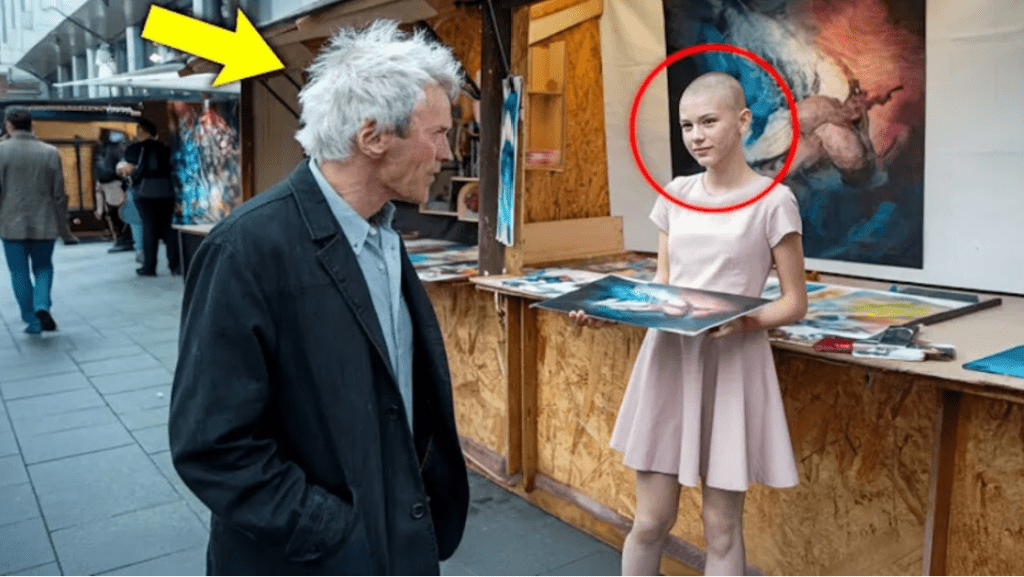
—becomes a declaration that she still has something to fight for.A week later, her small table of paintings sits on a bustling downtown sidewalk. The morning sun warms the pavement, drawing waves of commuters, tourists, and street vendors.
Sophie’s mother helps her set up the stand, but Sophie insists on working the day alone. Each canvas displayed holds a fragment of her soul: desert landscapes, twilight skylines, black-and-white silhouettes, and bursts of abstract emotion made tangible through color.
Yet, the city moves around her like she is invisible.Crowds rush by without stopping. Some give her sympathetic glances, others don’t notice her at all. Occasionally, someone pauses—a woman in a business suit, a jogger slowing down,
a curious tourist—but most drift away after a polite nod or a quick shake of the head. The heat presses on her like a physical weight, and the exhaustion from her treatments gnaws at her bones. Hours pass before she makes her first sale
—a woman and her husband who buy a painting for $80, giving Sophie her first spark of validation.
But even with moments of encouragement, discouragement comes in waves too. A man in a leather jacket mocks her efforts, telling her that “nobody buys real art anymore.” A middle-aged woman offers pity instead of support.
Sophie forces smiles, swallows frustration, and keeps painting through the ache in her muscles. Giving up isn’t an option; failure would mean more than just disappointment—it would mean surrendering her future.
By the fourth day, her stamina is fading. Then, a young journalist with a press badge stops and takes genuine interest in her work. She listens to Sophie’s story, photographs her paintings, and promises to share her journey.
Sophie tries not to become overly hopeful, but the next morning, she feels the shift immediately. People begin approaching her stand with curiosity, with interest, even with excitement. Her sales multiply. The sidewalk, once cold and indifferent,
now feels like a place where miracles might actually happen. Her phone buzzes nonstop with messages as the journalist’s article spreads across the internet under the headline “Fighting for Art, Fighting for Life.”
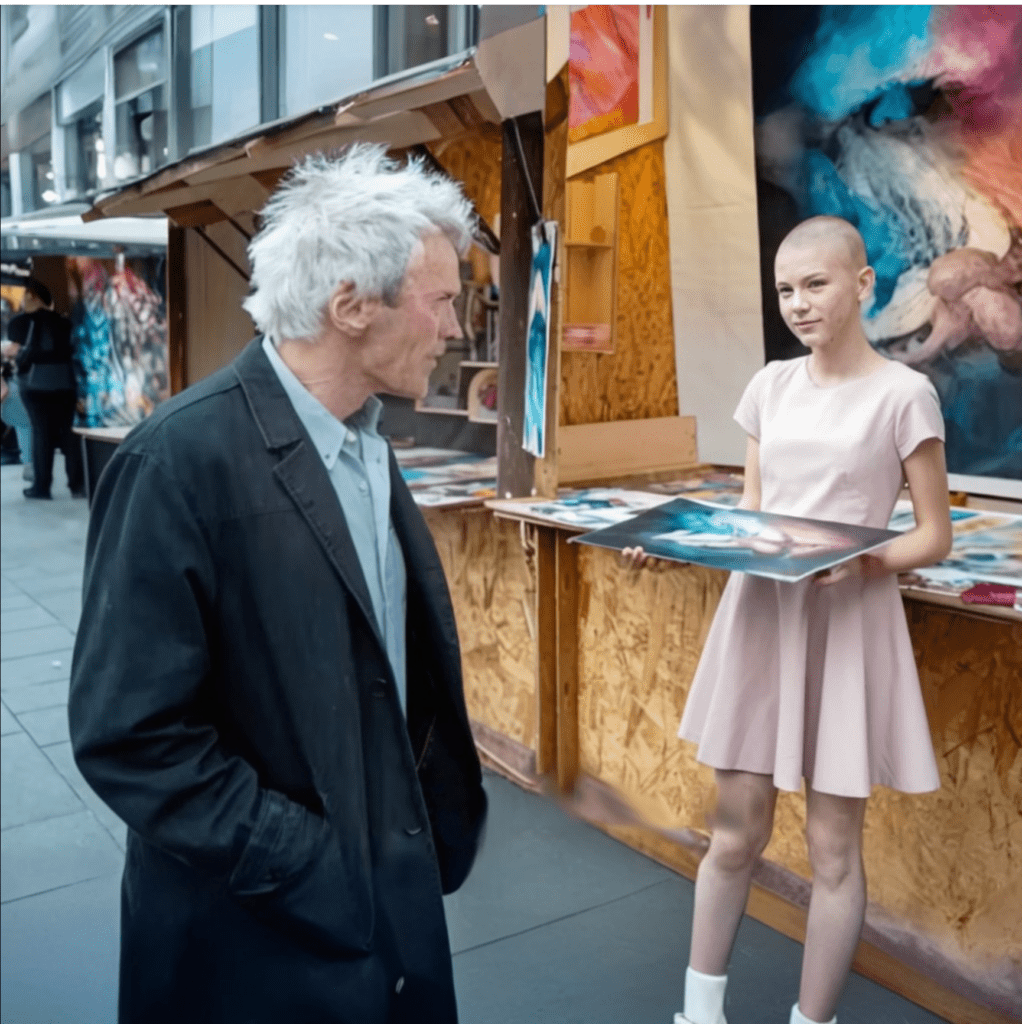
Still, nothing prepares her for the moment when a tall, older man—quiet, unassuming, almost blending into the crowd—steps in front of her stand in the late afternoon. His posture is relaxed, his hands in the pockets of a well-worn leather jacket,
and his head tilted low under a shadowed hat. But there is something unmistakable about the calm intensity with which he studies her paintings. When he finally speaks, his voice is gravelly and deep.
It is Clint Eastwood. Sophie is too stunned to acknowledge it right away. She only notices the familiarity in his eyes, the deep lines carved by decades of storytelling and grit. When he asks her for the story behind her paintings,
he does so with patience—real, human patience. He listens, not like a celebrity indulging a stranger, but like a man who understands struggle, perseverance, and quiet courage.After hearing everything,
Clint picks up a black-and-white desert painting featuring the silhouette of a lone cowboy. Sophie tells him it costs $200. Instead of pulling out cash, Clint brings out a checkbook—a gesture so old-fashioned and unexpected that it momentarily confuses her.
He writes something quickly, tears out the check, and hands it to her.When Sophie looks down, everything blurs.It is made out for $50,000.Her breath halts. Her hands tremble. She insists it must be a mistake.
Clint simply shakes his head, looks her in the eye, and says, “It’s not charity. It’s a damn good painting.”Whispers ripple through the crowd. People begin to realize who he is. Someone gasps. Phones come out.
And suddenly the quiet moment transforms into a whirlwind as pedestrians rush forward, eager to buy one of Sophie’s paintings before they disappear. The table becomes a frenzy of hands, voices, and excitement.
Long-ignored canvases are claimed within minutes. Strangers hand her money with urgency, not out of pity, but out of admiration sparked by the moment they’ve just witnessed.By nightfall, her stand is empty.
Within hours, the story spreads across social media and begins making national headlines:“Clint Eastwood Buys Teen’s Painting for $50,000.”“Hollywood Legend Helps Young Artist Battling Cancer.”
Commissions arrive from across the world. Donations flood into her medical fundraiser. A prestigious New York City gallery contacts her, offering to represent her and showcase her work.
One month later, Sophie walks into the hospital—not defeated, not fearful, but empowered. She pays for her remaining chemotherapy treatments in full. The crushing weight hanging over her family finally lifts. She finishes her last round of chemo with gratitude and strength.
A week later, a letter arrives in the mail. The handwriting is unmistakably Clint Eastwood’s. He writes that her courage reminds him why stories still matter—and encourages her to keep telling hers.
Sophie frames the letter beside her workspace. She continues to paint, preparing for her gallery debut, knowing her journey has only just begun. And somewhere, in Clint Eastwood’s private collection, hangs the original black-and-white cowboy painting—the one that changed everything.