That Saturday morning, I was kneeling in front of the washing machine when someone knocked on the door.
The machine sounded as if it were living its final moments. Six-year-old Lili was drawing on the worn-out rug in the living room, while three-year-old Máté was lining up plastic dinosaurs in front of the kitchen door. The apartment smelled of chicken soup mixed with damp laundry and the metallic warmth of an old radiator.
I assumed it was the neighbor, coming once again to complain about the children making too much noise.
When I opened the door, I froze.
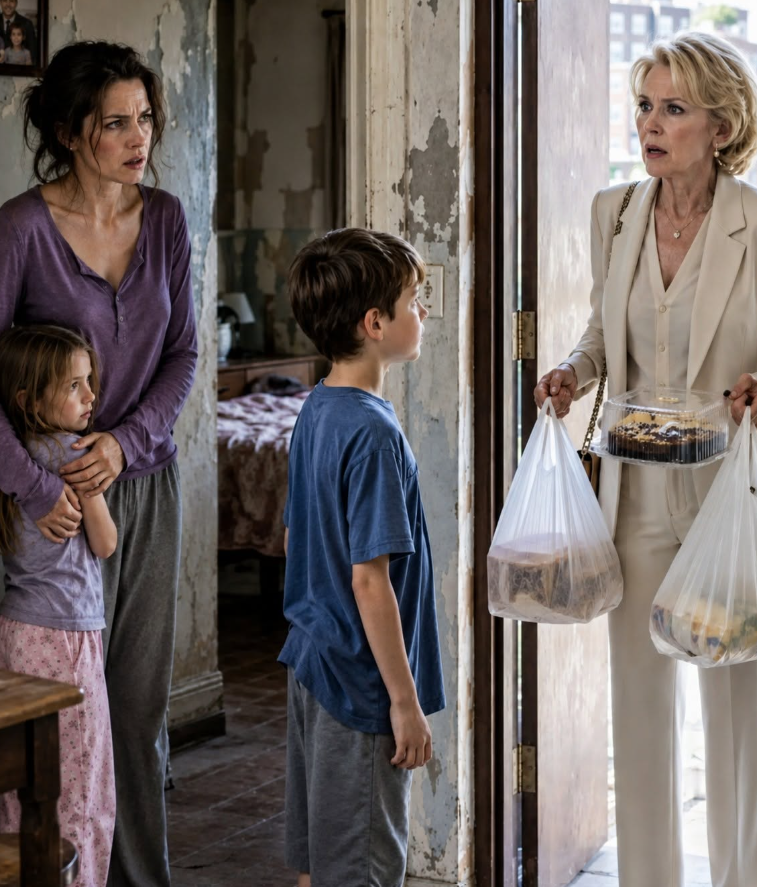
Márta, my mother-in-law, was standing there. She wore a flawless beige coat, her short hair perfectly styled, a large gift bag in one hand and a bouquet of yellow tulips in the other. She looked as if she had stepped out of an interior-design magazine and accidentally arrived at the wrong address.
For a few seconds, neither of us spoke.
“Petra…” she finally said, slowly looking me up and down. Her eyes moved from my faded gray sweater to my paint-stained pants and messy bun. “You… live here?”
There was more shock than curiosity in her voice.
“Good morning to you too,” I replied quietly.
Before she could say anything else, Lili shouted from the living room:
“Grandma Márta!”
The children ran toward her. Márta crouched down and hugged them, but her gaze kept wandering around the apartment: the cracked kitchen counter, the stained curtains, the cardboard boxes shoved into the corner that I still hadn’t had time to unpack.
I could see her desperately trying to make sense of what she was seeing.
From the gift bag came two new sweaters, a board game, and enough candy to excite any child. Lili squealed with delight, and Máté immediately started tearing open a chocolate bar. Márta, however, barely smiled.
I knew the question was coming.
“Where is Bálint?”
My stomach tightened.
“I don’t know.”
Her face hardened.
“What do you mean, you don’t know? My son always calls me. He doesn’t just disappear.”
A bitter laugh escaped me.
“Well, this time he did.”
At that moment, the floorboards in the hallway creaked.
Someone appeared in the bedroom doorway.
An elderly man with completely gray hair stood there, holding a screwdriver. He had been trying to reattach the bathroom cabinet door that had fallen off its hinges.
Márta turned toward him slowly.
Her face lost all color.
“Gábor?” she whispered.
The man nodded.
“Hello, Márta.”
The air seemed to freeze around us.
“What are you doing here?” she asked, as if she had seen a ghost.
Before Gábor could answer, I spoke.
“I asked him to come.”
Márta stared at me.
“You invited my ex-husband here?”
“Yes.”
“Why?”
Lili instantly fell silent. Máté pressed himself against my leg. I stroked his hair and forced myself to stay calm.
“Because when your son left, there was no one else to help me. Gábor did.”
Márta looked genuinely confused.
“Bálint left? Left for where?”
“With another woman.”
Even after months, saying the words out loud still hurt.
“He told me he needed a few days to think about his life. Two days later, he emptied most of our savings from our joint account and sent me a message telling me not to look for him.”
Márta shook her head immediately.
“That can’t be true. Bálint would never do something like that to his children.”
“He already did.”
I didn’t want to tell her about the first night I sat alone in the dark kitchen, calculating whether the tiny amount left in my account could cover the rent that was due in three days. I didn’t want to relive the moment I discovered that Bálint had secretly terminated the lease on our previous apartment long before he disappeared.
By the time I understood what had happened, I wasn’t only without a husband. I was without a home.
I sold half of our furniture just to pay the deposit on that crumbling apartment. At night I worked remote customer-service shifts; before dawn I worked at a bakery. Some mornings I woke up already exhausted, wondering how I would survive another day.
Gábor came back into our lives completely by accident.
One rainy afternoon he saw Lili and me at a bus stop. He hadn’t seen his grandchildren in years. Bálint rarely spoke about him, and Márta behaved as if he didn’t exist.
Gábor asked only one question:
“Can I walk you home?”
When he saw the apartment, he didn’t pity me. He didn’t criticize me. The next day he returned with a toolbox and fixed the leaking faucet.
Two days later he brought a used but working microwave.
A week later he took Máté to kindergarten because I had an early shift at the bakery.
He never moved in with us. There was nothing secret or inappropriate between us. He simply showed up whenever everything else in my life was falling apart.
Márta slowly sat down on the edge of the worn sofa.
“Why didn’t you call me?” she asked quietly.
A sad smile crossed my face.
“I did. Three times.”
She looked up, startled.
“I don’t remember.”
“The first time, you said Bálint was probably just stressed. The second time, you asked what I had done to upset him. The third time, you told me not to involve you in our marital drama.”
Márta lowered her eyes to her hands.
“I just… thought you’d work things out.”
“So did I,” I whispered. “That’s why I waited too long. I thought if I stayed patient, if I didn’t get angry, if I didn’t ask him for anything, he would come back. But he had already left long before I admitted it.”
Silence filled the room.
Meanwhile, Gábor sat on the floor with the children, helping them unpack the new board game. Lili laughed as she arranged the pieces, while Máté watched with serious concentration.
Márta observed them for a long time.
“Does Bálint know his father is helping you?” she finally asked.
“Yes.”
“And what did he say?”
“He called me and said I should be ashamed of myself for dragging his father into our lives.”
“And what did you tell him?”
I looked directly at her.
“I told him I didn’t drag his father into our lives. He was the one who left us alone.”
Tears shimmered in Márta’s eyes.
For the first time, I saw not the critical mother-in-law who always seemed to know exactly what a woman should do, but a woman realizing she had spent years defending her son’s mistakes while blaming everyone else for them.
The months that followed were not magical.
Bálint did not return with an apology. He did not suddenly become a devoted father. I hired a lawyer, and we began sorting out child support and our finances. It was exhausting, humiliating, and painfully slow, but at least I was no longer carrying it alone.
At first, Márta only sent messages.
Then one afternoon she arrived with a painter.
They painted the children’s room light blue and sunny yellow. I had never asked her to do it, and she never pretended it would erase the past.
As she took down the old curtains, she said quietly:
“I can’t undo what I failed to see. But I also don’t want my grandchildren to suffer because of my son’s choices.”
Gábor kept coming whenever something broke or whenever the children needed him. Márta was uncomfortable around him at first, but eventually they learned how to sit at the same table again.
They did not remarry. They didn’t need to.
They were simply two aging people carrying too many old wounds, willing to set them aside for Lili and Máté.
A year later, we were living in a smaller but clean apartment. The walls were freshly painted, the kitchen was bright, and from the window we could see a small park.
One evening Lili took my hand.
“Mom, is everything going to be okay now?”
I looked at her for a long moment.
I didn’t want to give her a promise that no one can truly make.
So I squeezed her hand, pulled her close, and said:
“I don’t know what the future will bring. But I do know one thing: we are not alone anymore. And sometimes, that is worth more than any miracle.”