They Laughed When They Saw Me Enter the Courtroom… Until the Judge Said My Name
When I entered the courtroom, my son Daniel and his wife, Vanessa, did not even try to hide their amusement.
Daniel leaned toward her with a mocking smile.
— There she is. In a few hours, we’ll walk away with everything.
He had spoken loudly enough for the people sitting behind him to hear.
Vanessa covered her mouth with one hand, as if trying to hide her laughter. But her eyes told the truth. They were shining with satisfaction.
To them, I had already lost.
A seventy-one-year-old widow.
A fragile old woman, devastated by the death of her husband and incapable of managing her own affairs.
I wore a simple navy-blue coat. I mostly needed my cane on the stairs. My face carried the marks of the years and the grief I had endured.
I was exactly the woman they had described in their legal documents.
A vulnerable woman.
A woman who could be manipulated.
A woman whose assets could be taken from her.
They had asked the court to grant them guardianship over me, control of my bank accounts, and permission to sell the house where my husband and I had lived for forty years.
In their petition, they claimed that I had become “dangerously confused” since becoming a widow.
But they had forgotten one thing.
I knew how to recognize a lie.
And more importantly, I knew how to prove that it was a lie.
Daniel had already withdrawn some of my emergency savings.
He had forged my signature on a loan application.
Vanessa had moved her brother into my guesthouse without even asking my permission.
When I confronted them in my own kitchen, Vanessa looked at me with a cold smile.
— You should be grateful. Many women your age would dream of having a family to manage their affairs for them.
Daniel did not even dare to meet my eyes.
A few weeks later, they changed the locks.
On my house.
The house where I had raised my son.
The house where my husband had held me in his arms for the last time.
That night, I slept in a motel.
Meanwhile, Daniel posted photographs of my living room online. He was sitting in his father’s favorite armchair, a glass of bourbon in his hand, beneath our old wedding portrait.
At midnight, he sent me a single message:
“Stop making things more difficult.”
He had always mistaken my patience for weakness.
He did not yet understand that the silence of a wounded person is not necessarily the silence of a defeated person.
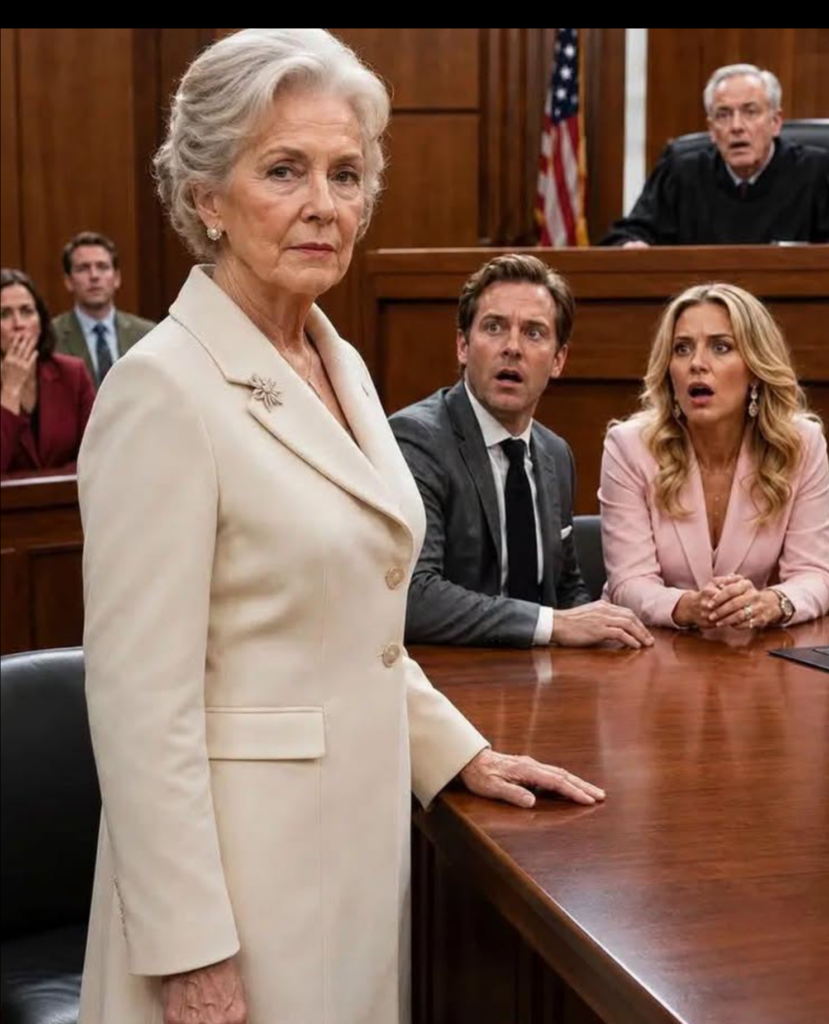
When I reached the table where Daniel and Vanessa were sitting, their attorney, Curtis Hale, stood up with the confidence of a man who already believed he knew how the case would end.
— Your Honor, Mrs. Vance has appeared without an attorney. This once again demonstrates her inability to understand the seriousness of this matter.
Then the courtroom doors opened.
The judge entered.
Everyone stood.
Judge Adrian Mercer took his seat, opened the file, and began going through the documents.
Then he looked up.
His eyes settled on me.
He stopped.
For several seconds, he said nothing.
Then his expression completely changed.
— Mrs. Eleanor Vance?
The courtroom became silent.
I slightly inclined my head.
— Good morning, Your Honor.
He studied me for another few moments.
Then he asked a question that made Vanessa’s smile disappear.
— Are you the same Eleanor Vance who helped expose the Bellweather pension fraud case?
Vanessa’s smile froze.
Daniel stopped laughing.
And for the first time since that day began, I saw fear in his eyes.
Twenty-six years earlier, I had not simply been a “bookkeeper,” as Daniel liked to describe me.
I was a financial-crimes specialist.
I had analyzed millions of documents, uncovered complex fraud networks, and testified against executives responsible for diverting money belonging to thousands of elderly people.
After that case, I founded a firm specializing in financial fraud, diverted inheritances, and the exploitation of vulnerable people.
Daniel knew all of this.
But he had always preferred to tell a different story.
To his wife, he would say:
— My mother? She’s just an old bookkeeper.
He had forgotten that this “old bookkeeper” had taught him, when he was a child, how to recognize a lie.
I sat down calmly.
Judge Mercer returned to the file.
— Mr. Hale, choose your next words very carefully.
This time, Daniel was no longer laughing.
Vanessa was the first to testify.
She had prepared her role perfectly.
She spoke in a trembling, sorrowful voice.
— She forgets a lot of things. Sometimes she leaves the stove on. She has become suspicious. We simply want to protect her.
The judge stared at her.
— Has Mrs. Vance received any medical diagnosis?
Vanessa stopped.
— She… she refused the examinations.
A lie.
A perfectly delivered lie.
Then Daniel stepped forward.
— My mother used to be brilliant. But after my father died, she became paranoid. She hid her money. She threatened to disinherit me. I only wanted to help her.
Another lie.
They presented photographs of expired food.
An unpaid bill.
A photograph of my car with a slightly damaged fender.
Everything seemed perfectly calculated.
Everything was designed to create the image of an elderly woman incapable of taking care of herself.
Then Curtis Hale brought out what he believed was their decisive piece of evidence.
— Nearly nine hundred thousand dollars were transferred from Mrs. Vance’s investment account to an organization called Northstar Shelter Trust. Mrs. Vance is unable to explain this amount.
The judge turned toward me.
— Can you respond to that allegation?
I smiled.
— Of course.
I opened my file.
— I created this foundation to help elderly people who have been victims of financial fraud. The transfer was made in accordance with the trust’s governing documents and approved by independent administrators.
Curtis shook his head.
— We have no evidence of that.
I looked at him.
— You never asked.
A heavy silence settled over the courtroom.
Then I pulled out several documents.
— I also underwent complete neurological and psychological evaluations eight days ago. Two independent specialists confirmed that my cognitive abilities are completely intact. Their reports were submitted to the court yesterday.
Daniel’s face turned red.
— You prepared all of this?
I turned toward him.
— Careful people prepare their evidence before confronting those who intend to harm them.
Then I placed a USB drive on the table.
The silence became even heavier.
— Daniel installed my security system himself. Before changing the locks, they disabled the visible cameras.
Vanessa smiled again.
— So there is no evidence.
I looked at her.
— You disabled the ones you could see.
Her smile disappeared.
A few minutes later, the surveillance footage was projected onto the courtroom screen.
Daniel appeared in my office.
He was holding a document in his hands.
My signature appeared several times on papers he had prepared.
Then another sequence.
Vanessa entered my office and searched through my personal files.
Then their voices filled the courtroom.
— Once the judge signs the guardianship order, we sell the house.
— And the money?
— We’ll get it little by little.
Daniel froze.
Vanessa turned pale.
Then a third voice was heard.
Curtis Hale’s voice.
— Make them believe she’s losing her mind. Judges like stories that follow a familiar pattern.
This time, the attorney jumped to his feet.
— That conversation is protected!
I looked at him.
— Legal privilege does not turn fraud into attorney-client confidentiality.
No one spoke.
Then I brought out the final document.
The property deed.
— And here is something you should have checked before coming into this courtroom.
The judge took it.
He read it.
Then he looked up at Daniel.
The house was not in his name.
It was not in Vanessa’s name either.
It belonged to an irrevocable trust that my husband and I had created years earlier.
Daniel had never owned it.
Not for a single day.
After a brief recess, the hearing resumed.
I stood.
This time, I did not even take my cane.
— Your Honor, I request the permanent dismissal of this petition, sanctions for abuse of the legal process, and an investigation into the financial exploitation of an elderly person.
Curtis scoffed.
— She cannot file motions. She is not an attorney.
I placed my professional identification card in front of him.
He looked at it.
Then he raised his eyes toward me.
My attorney registration number was printed beneath my name.
— I renewed my license to practice law.
Judge Mercer nodded.
— The court recognizes Mrs. Vance as representing herself.
Daniel stared at me as if he had just discovered a stranger.
But I had not changed.
He had simply never taken the time to discover who his mother really was.
The trust documents were examined.
So were the bank statements.
The medical evaluations.
The recordings.
Every piece of evidence tore down another part of their story.
Daniel began blaming Vanessa.
Vanessa blamed Curtis.
Curtis talked about misunderstandings.
But the evidence knew nothing about misunderstandings.
Daniel had used my identity to obtain a six-hundred-thousand-dollar loan.
Vanessa had prevented a genuine medical examination while claiming that I was refusing help.
Curtis had participated in a strategy designed to make me appear incapable so they could take control of my assets.
The judge finally delivered his decision.
The guardianship petition was denied.
The financial measures requested against me were rejected.
A criminal investigation was opened.
And my house was returned to me.
Daniel stood up.
His eyes were filled with tears.
— Mom… we can fix this.
I looked at him for a long time.
I remembered the little boy who used to run through that garden.
The young man I had taught to trust.
Then I remembered the man who had changed the locks on his own mother.
— You didn’t need a mother, Daniel.
My voice remained calm.
— You needed an asset to own.
Vanessa began to cry.
— Daniel said you would eventually forgive us.
I looked at her.
— I can forgive a mistake.
I paused.
— But what you did was not a mistake. It was a choice.
A few months later, my house had regained its light.
The locks had been changed.
The walls had regained their silence.
And for the first time in a long while, I could sit in my living room without feeling that someone was trying to steal my own life from me.
Daniel was convicted of fraud and forgery. Vanessa was also convicted after admitting her involvement. Curtis lost his license to practice law.
I sold the guesthouse.
Not our home.
The money was used to expand Northstar, which opened a legal clinic dedicated to helping elderly people who had become victims of fraud and family abuse.
At the opening ceremony, several women came to thank me.
Some had been cheated by their own children.
Others by relatives they had trusted with their whole lives.
They all had the same expression in their eyes.
Shame.
Fear.
And the silent question:
“How could my own family do this to me?”
Above the entrance to the clinic, we placed a plaque.
“Dignity does not belong to youth. It belongs to every human being.”
On the evening of the opening, I returned home and sat on the porch.
I wrapped myself in my husband’s old blanket.
The sun was slowly disappearing behind the trees.
My phone rang.
I looked at the screen.
Daniel.
Calling from prison.
I let the call end.
Then I placed my phone beside me.
I felt neither anger nor triumph.
Only a strange sense of peace.
All my life, I had believed that love meant forgiveness.
That family meant always leaving a door open.
But that evening, I finally understood something.
Sometimes, the greatest act of love we can show ourselves is to close the door forever on those who chose to break it.