– Are you Nadezhda Ilyinichna? The interpreter?
Artyom stood in the doorway and looked the woman over. He did not hurry. His gaze slowly moved across the gray suit, the thin-framed glasses, and finally stopped on the slightly worn bag that Nadezhda had carried with her for several years.
His expression said everything.
He was disappointed.
– Yes, – Nadezhda answered calmly and extended her hand. – I’m here according to the contract for today.
Artyom, however, did not accept the handshake.
He looked at his watch first, then back at her.
– Let’s go. We don’t have much time. The delegation will arrive in forty minutes.
Nadezhda followed him without a word.
The hotel banquet hall looked as if it had been taken straight from the cover of an elegant business magazine. Under the glow of enormous chandeliers, crystal glasses sparkled, and on the snow-white tablecloths every piece of cutlery was placed with perfect precision. Heavy curtains covered the walls, and the air carried a mixture of expensive perfume and fresh flowers.
In the center of the hall stood the main table.
Set for twelve people.
Every seat had been assigned in advance.
Name cards, flags, folders, notes.
That was where Pyotr Andreyevich Likov, the company director, would sit. Beside him would be the head of the Arab delegation, the sheikh, as well as businessmen and executives from both countries.
And, of course, the interpreter.
At a meeting like this, an interpreter did not simply translate words.
They were the bridge between two cultures.
One poorly chosen expression could cause a misunderstanding. One wrong emphasis could even put a multi-million-dollar agreement at risk.
Nadezhda had just begun to think that perhaps she was being led to the main table when Artyom walked past it.
He kept going.
Past the partner company tables.
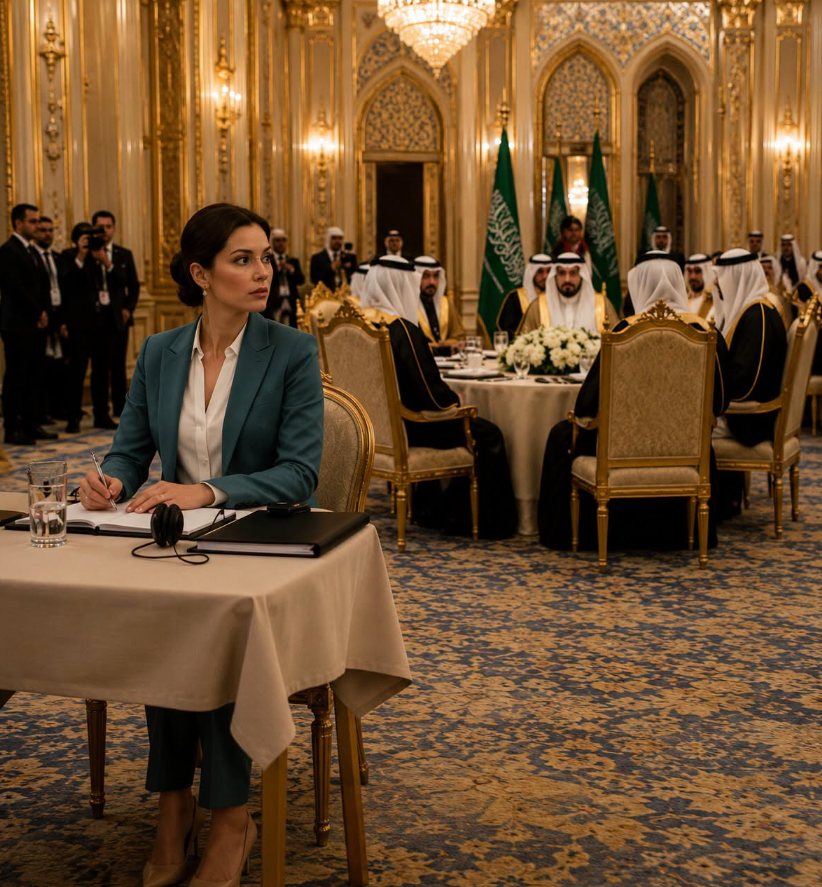
Past the press area.
Then he led her all the way to the far end of the room.
Beside the kitchen door.
– This will be your place, – he said, pointing to a chair.
The chair was squeezed between a driver in an elegant black suit and a young female coordinator.
For several seconds, Nadezhda simply stared at the seat.
Then she slowly looked up.
– Are you sure I’m supposed to sit here?
Artyom was already checking his phone.
– Yes.
– I’m an interpreter, not support staff.
The man shrugged.
– We have our own interpreter. You’re only a backup. If something goes wrong, we’ll call you.
With that, he turned around and walked away.
Nadezhda quietly sat down.
Beside her, the driver ate salmon appetizers, completely unconcerned by the situation. The coordinator gave instructions through her headset, while the smell of fried onions and spices drifted in from the kitchen.
She was sitting on the sidelines of one of the most important business meetings in the world.
Invisible.
Even though she had worked as an interpreter for twenty-five years.
Over those twenty-five years, Nadezhda had learned that the greatest value is often not what people notice at first glance.
She had started her career at the age of twenty-seven, in 1991. At that time, knowledge of Arabic was considered a rare and valuable skill. She had not only learned everyday speech. She studied classical Arabic. Literature. Poetry. Historical and diplomatic nuances.
She knew that behind a single word, centuries of culture could be hidden.
She had participated in more than two hundred high-level negotiations.
She had lived in Cairo for three years.
Two years in Riyadh.
She had accepted this assignment for ten thousand rubles.
Not because that was what she was worth.
But because in January she had not received a single assignment for three weeks.
And the bills did not wait.
Nadezhda opened her old bag and took out her favorite book.
A collection of works by Al-Mutanabbi.
A faded bookmark lay between the yellowed pages. A memory from a time when no one would have thought to question her knowledge.
She began to read.
A few tables away, a young woman was practicing her interpretation.
Alina was twenty-six years old. She wore an elegant ivory-colored dress, high heels, and perfect makeup. She was reviewing business terms on her tablet while quietly repeating sentences to herself.
– Artyom! – she called after him. – What exactly does “musharaka” mean?
The man did not even stop.
– It’s not important. Translate it based on the context.
Alina nodded.
But Nadezhda lowered her book.
Musharaka did not simply mean partnership.
It was one of the most important concepts in Islamic finance.
Shared ownership.
Shared profit.
Shared loss.
A single word that could change the entire meaning of a contract.
A single word that could determine whether trust was created at the negotiation table or whether misunderstanding took its place.
But no one asked her.
No one wanted to hear her opinion.
Nadezhda closed the book and quietly watched the room.
She saw confident people who believed they were prepared for everything.
She saw those who judged appearances instead of knowledge.
And she remembered an old saying she had heard back in Cairo:
“Those who only see the surface can easily lose their way in the depths.”
Nadezhda knew that the moment would come when they would need her.
Because the most dangerous situation is not when someone makes a mistake.
It is when everyone is so certain that they are right that no one notices the mistake at all.