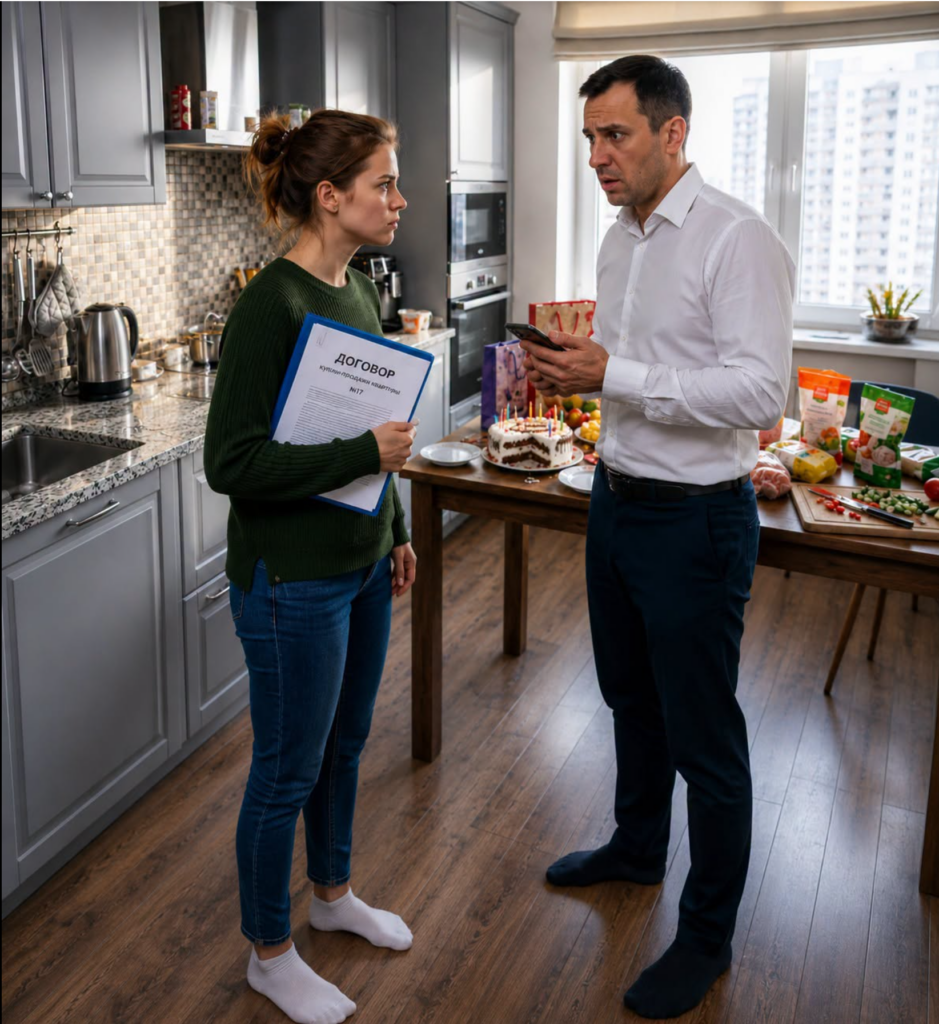
— Marina, you still haven’t cut the salads? — Oksana asked in a tone as if she hadn’t come to visit her own family, but had walked into a poorly run restaurant where she needed to demand answers from the staff. — The guests will be here in forty minutes.
I was standing by the stove. I was wearing the apron I had happily tied around myself that morning because I thought we were preparing for a peaceful family evening. But the table no longer held the simple preparations for dinner: three packs of cheese, a long supermarket receipt, a pack of gold-edged napkins, and a handwritten food list lay in front of me.
It was my mother-in-law Galina Petrovna’s handwriting.
Even her letters seemed to give orders. Big, sharp strokes pressed deeply into the paper, as if she wasn’t simply writing down what needed to be prepared, but issuing instructions for a military operation.
— This isn’t my celebration, — I said quietly.
Oksana took off her coat and casually threw it onto the armchair. Underneath the coat disappeared the blanket I had spent weeks knitting after work in the evenings. While I had counted tiny stitches and followed the pattern, Dmitry had watched television and said, “It’s so nice that we can relax together.”
And now my handmade blanket was lying under a stranger’s coat.
— Oh, Marina, don’t start, — Oksana sighed. — Your apartment is bigger anyway. Cafés have become ridiculously expensive. Mom said you cook wonderfully.
There was no request in her voice at the end of the sentence.
Only expectation.
At that moment, the door opened, and Dmitry walked in carrying two huge bags of ice. He had already changed into a white shirt, as if he too were only a guest. As if he hadn’t been the one who, from nine in the morning, had watched me peel potatoes, wash vegetables, and clean the kitchen.
The price tag was still hanging from his shirt collar.
He noticed me looking at it and quickly tucked it in.
— Marina, please, let’s not make a scene out of this, — he said quietly. — It’s just one evening. It’s Oksana’s fiftieth birthday. It’s not like this happens every day.
I just looked at him.
At his calm face.
At the melting ice in his hands.
At the drops of water slowly running across the floor I had washed that morning.
Last night he had said something completely different.
“I’m just inviting Mom over for tea. She’s a little worried about Oksana’s birthday.”
But that “little tea” had transformed by morning into:
hot dishes,
appetizers,
a cake,
twelve guests,
and my kitchen, where every minute already had a predetermined place.
My mother-in-law arrived last.
Galina Petrovna was holding a jar of homemade pickles in her hand. She looked at me as if she hadn’t brought cucumbers, but an invisible key to my apartment.
— Marina, is the chicken already in the oven? — she asked instead of greeting me. — And don’t forget that Oksana Lyudochka doesn’t eat mayonnaise. You’ll make everything separately for her today.
I put the knife down.
I wiped my hands with a kitchen towel. A large beet stain remained on the white fabric.
— Galina Petrovna… who decided that I would be the one cooking?
My mother-in-law slowly placed the jar of pickles on the table. She adjusted her bracelet.
I already knew that gesture.
For her, it meant the conversation was over because she had already decided what the answer would be.
— Marina, we are family. In a family, we don’t count who did how much.
At that moment, Dmitry suddenly walked over to the sink.
Too suddenly.
As if there was some extremely important task waiting for him there.
And that was when I truly understood.
It wasn’t that he had forgotten to ask.
It wasn’t a misunderstanding.
It wasn’t a bad joke.
He had simply decided that my permission was not necessary.
And perhaps that hurt the most.
Not the salads.
Not the cooking.
Not the single evening.
But the fact that, in front of others, he considered it completely natural that my time, my work, and my home were automatically available.
It had all started a week earlier.
Oksana called Dmitry in the evening while I was sorting through the bills. I wasn’t eavesdropping. The phone was simply loud.
— Dima, these cafés have completely lost their minds with their prices. You pay separately for the hot food, separately for drinks. What do they think, that I print money?
Dmitry looked at me, smiled, and casually replied:
— We can have it at our place. Marina will prepare everything nicely anyway. Our kitchen is big.
The pen stopped in my hand.
I slowly raised my eyes.
The bank statement was still lying in front of me:
utilities,
groceries,
my mother’s medicines,
Dmitry’s laptop installments — the laptop he called a work device, although in the evenings he mostly played tank games on it.
— Who exactly did you just offer my kitchen to? — I asked.
Dmitry covered the phone microphone with his hand.
— Marina, don’t overreact. It was just an idea. It’s not right to refuse your own sister.
That time, I didn’t argue.
I didn’t shout.
I simply put the papers back into the folder.
And on a small note, I wrote:
“Oksana’s birthday. Dmitry decided instead of me.”
In the past, I probably would have told myself:
“It’s a small thing.”
“Family helps each other.”
“I can handle one evening.”
But over time, I learned something.
Big problems rarely begin with one huge decision.
They usually build up from small compromises.
From a forgotten question.
From help that is simply taken for granted.
From a sentence like:
“Don’t make such a big deal out of it.”
And before a person realizes it, they are carrying an entire burden that, somehow, only they ever seem to carry.
And now I was standing in my own kitchen, preparing for a celebration that belonged to strangers, while everyone acted as if this was the most natural thing in the world.
On the table lay Galina Petrovna’s list.
And next to the herring salad there was a single sentence:
“Marina will prepare it beautifully.”