“Where have you been? My family is sitting there hungry!” my husband screamed into the phone. My answer left him speechless.
The phone rang while Lena was standing at her mother’s grave.
The chrysanthemums in her hands trembled in the cold autumn wind. She didn’t even need to look at the screen. She already knew who it was.
After fifteen years of marriage, she had learned to recognize that voice.
“Where have you been?! My family is sitting at home hungry!” Gennady shouted so loudly that Lena had to move the phone away from her ear.
She slowly lifted her eyes to her mother’s photograph on the gravestone.
Three years.
Three years without her.
And Gena didn’t even remember what day it was.
“Are you even listening to me?!”
Yes, she was listening.
She had been listening to the same words for fifteen years.
Every weekend.
Every holiday.
Every time his relatives decided to “stop by for a little while” and stayed until midnight.
Lena closed her eyes.
Then she quietly replied:
“You have two hands, Gena. Cook yourself some dumplings.”
Silence.
A long, stunned silence.
In fifteen years, she had never spoken to him like that.
She had never refused him.
Never put herself before his endless demands.
She had always gotten up.
Always cooked.
Always smiled.
Always adjusted.
But now, standing at her mother’s grave with frozen fingers wrapped around flowers, she said the one word she had been afraid to say her entire life:
“No.”
Gena hung up without saying another word.
Lena remained standing.
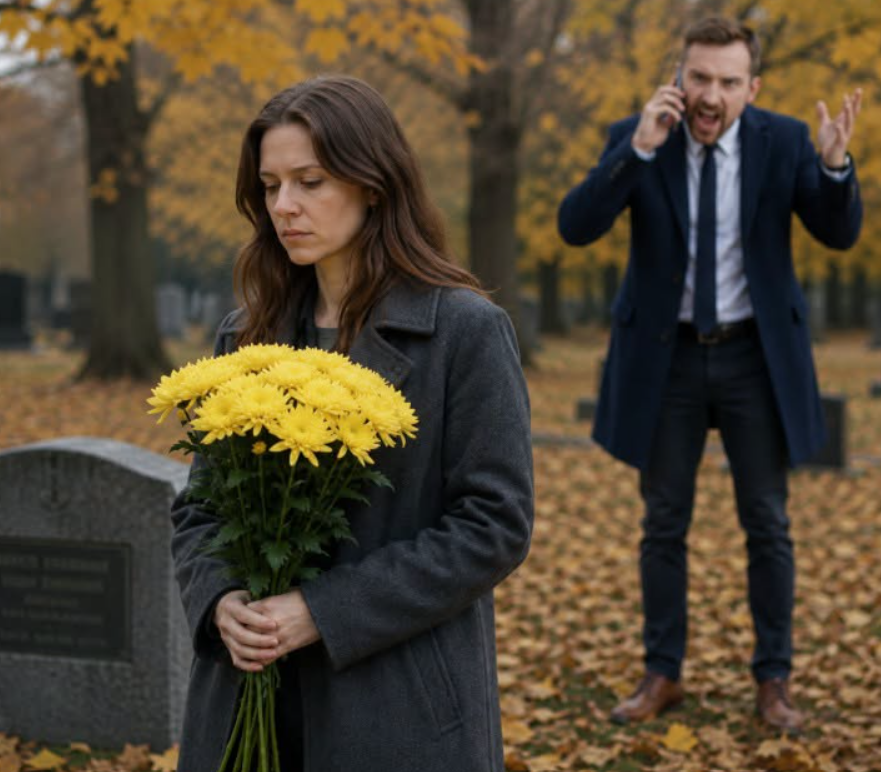
The damp autumn ground felt cold beneath her boots. The wind carried fallen leaves between the graves.
She placed the chrysanthemums beside the stone, ran her hand over the cold granite, and whispered:
“Mom… I think I’m finally starting to listen to you.”
The morning of that day had started like every other morning.
At six o’clock, Lena was already in the kitchen.
She was making eggs, preparing sandwiches, and boiling water for tea.
Gena sat at the table, staring at his phone while eating silently.
In all their years together, he had probably said “thank you” no more than ten times.
And even then, only when guests were around.
Then his mother called.
Valentina Stepanovna never asked.
She simply announced.
“Lenochka, we’re coming over around two. Sergey and Natasha are coming too. Make something nice. And bake a pie. Gena likes the cabbage one.”
Lena wanted to say that today was the anniversary of her mother’s death.
That she needed to go to the cemetery.
That her heart was heavy.
But old habits were stronger.
“Of course, Valentina Stepanovna.”
That was always her answer.
Her mother had taught her:
“Be patient, my daughter. Don’t argue. Your husband knows best.”
Her mother had lived the same way.
And it had exhausted her.
After breakfast, Lena stood by the window for a long time.
Autumn.
Wet leaves covering the pavement.
An empty playground outside.
She tried to remember the last time she had done something only for herself.
She couldn’t.
Finally, she gathered her courage.
“Gena, I need to go to the cemetery today.”
He didn’t even look up from his phone.
“Fine. Just don’t be gone long. My mother is coming.”
Don’t be gone long.
As if her mother’s memory was just an inconvenience in his schedule.
Lena washed the dishes.
Put on her coat.
Closed the door.
And left.
Without a pie.
Without lunch for ten people.
For the first time in years, she walked out of the house without leaving behind something she had prepared for everyone else.
On the bus, the smell of gasoline mixed with someone’s sweet perfume.
Lena looked out the window and remembered.
When she met Gena, she was twenty-seven.
He was thirty.
Confident.
Loud.
Strong.
She had thought:
“With a man like him, I’ll be safe. He’ll be my rock.”
But later she realized that the wall she had trusted had become a cage.
The first year had been wonderful.
Flowers.
Dinner dates.
Sweet words before sleep.
Then his mother became a constant presence.
At first, she was gentle.
“Lenochka, you’re so thin! You need to eat more.”
Then came the sharp comments.
“Do you even know how to cook?”
And finally:
“Gena, why do you need a wife who can’t even make a proper borscht?”
Gena said nothing.
Not once.
He never defended her.
Lena cleaned.
Washed.
Ironed.
Cooked.
Smiled.
His family kept coming more and more often.
His mother.
His two brothers with their wives.
His sister with her husband.
Relatives.
Children.
Sometimes fifteen people sat at their table.
Lena spent entire days in the kitchen.
Pies.
Salads.
Hot dishes.
Desserts.
The table was always overflowing with food.
And the relatives praised Gena.
“What a wonderful host you are, Gena!”
Nobody noticed Lena.
She was like an invisible person working in the background.
On her thirty-fifth birthday, she finally asked for something small.
“Gena, can we just order pizza today? Just once, I don’t want to spend the whole day cooking.”
He looked at her as if she had said something ridiculous.
“What will my mother think if we serve guests pizza?”
The guests were his family.
On her birthday.
Yet Lena still spent the day cooking.
Two pies.
Olivier salad.
Chicken.
Vinaigrette.
When her mother-in-law tasted the food, she only said:
“It’s a little too salty. But it happens.”
That evening, Lena cried quietly in the bathroom.
So nobody would hear.
While his family continued eating her food in the living room.
The first time she asked herself “Why do I tolerate this?” she was forty-two.
Before that, she never questioned it.
She thought this was simply how life worked.
Her mother had lived this way.
Her grandmother had lived this way.
Women around her had lived this way.
Everyone sacrificed.
Everyone stayed silent.
Everyone endured.
A month earlier, however, she met her friend Ira.
They sat together in a small café.
“Lena, when was the last time you went on vacation?” Ira asked.
Lena thought for a moment.
“We went to visit Gena’s relatives in Krasnodar. Four years ago.”
Ira put down her coffee.
“That wasn’t a vacation. That was a work assignment.”
The words hit Lena harder than she expected.
“Lena… do you actually live? Or do you just serve everyone else?”
She opened her mouth.
But no answer came.
Because she already knew.
“Look at yourself,” Ira continued. “You’re forty-two, but you look fifty-five. You don’t sleep properly. You don’t rest. You work for your husband’s family for free.”
“But he’s my husband…”
Ira squeezed her hand.
“A husband is someone who stands beside you. Someone who notices you. Does Gena notice you?”
A long silence followed.
“No,” Lena whispered.
And that one word changed everything.