“Don’t wake her,” my mother-in-law whispered. “If she hears about the will, everything will fall apart.”
I stood frozen in the hallway, barefoot, an empty glass trembling in my hand.
Usually, the apartment was silent at night except for the refrigerator humming and the old pipes clicking inside the walls. But now a thin strip of light spilled from the kitchen, carrying every whispered word.
“Mom, keep your voice down,” my husband, Oleg, said.
“Exactly,” Tamara Pavlovna replied. “Tomorrow you’ll take her to the notary. Tell her it’s just paperwork. Don’t give her time to think.”
“She’ll ask questions,” Oleg muttered.
“Then tell her you’re protecting the family. Appeal to her conscience. She’s your wife.”
“And if she refuses?”
“She won’t. Just don’t ask. Present it as if the decision has already been made.”
I carefully placed the glass on the hallway table before it slipped from my fingers.
So that was the reason.
The unexpected kindness.
The sweet smiles.
The concern about my health.
It had nothing to do with love.
It was about my cottage—the one I had bought with my own savings, registered in my name, and maintained for years without anyone’s help.
I quietly returned to the bedroom. Oleg’s side of the bed remained empty. For the first time in eighteen years, I stopped making excuses for him.
The next morning he entered carrying a cup of tea.
“How are you feeling, Len? Did you sleep well?”
“Fine,” I answered. “Why?”
“You looked tired yesterday.”
That wasn’t true. Yesterday I’d spent the evening organizing receipts for property taxes, electricity, road fees, and repairs at the cottage while Oleg barely glanced at them.
“We should stop by the notary today,” he said casually.
“What for?”
“To organize a few documents.”
“What documents?”
“A will.”
I stared at him.
“For whom?”
He looked surprised.
“For me, of course. I’m your husband.”
“You’ve already decided that?”
“It only makes sense. We’ve been married eighteen years.”
“What does my cottage have to do with that?”
“Well… it’s family property.”
“No,” I replied quietly. “It’s my property.”
Before he could answer, Tamara Pavlovna appeared in the doorway, perfectly dressed, wearing a warm smile that fooled no one.
“My dear Lena,” she said, “every family should have clear paperwork. Oleg should be responsible for everything.”
“For everything?”
“For the house, the cottage, the property.”
She stepped into the room without waiting to be invited.
“If you sign today, everyone will feel secure.”
“Everyone?”
I looked from her to Oleg.
“You mean the two of you?”
Oleg sighed dramatically.
“Our appointment is at eleven.”
“You booked it without asking me?”
“I wanted to save you the trouble.”
“And the decision?”
Tamara Pavlovna folded her arms.
“I knew she’d resist.”
I looked directly at her.
“I’m not going.”
Oleg’s patience disappeared.
“Lena, don’t make this into a fight.”
“I haven’t started one.”
He paced across the room.
“The annual road fee is due soon. You always complain that you’re paying everything yourself.”
“Because I am.”
“There!” his mother interrupted. “She counts every penny.”
“Families don’t secretly discuss someone else’s will in the middle of the night,” I answered.
Silence filled the room.
“You misunderstood,” Oleg finally said.
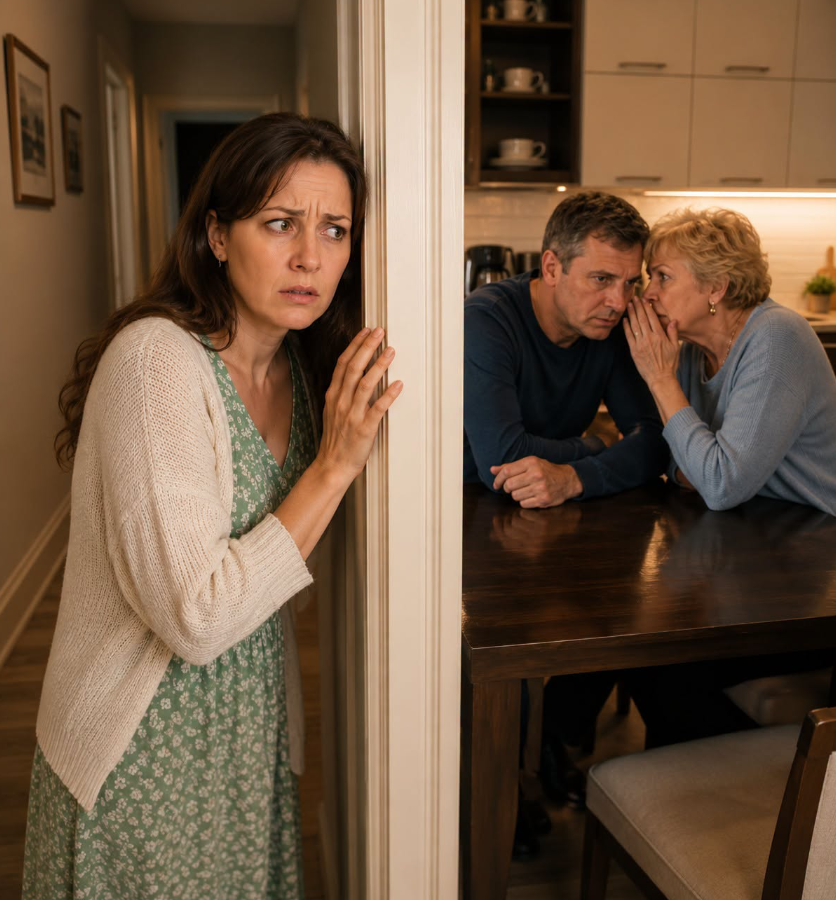
“I heard every word.”
His mother frowned.
“Listening at doors isn’t polite.”
“Neither is planning my future without me.”
I held out my hand.
“Show me the documents.”
“They’re standard forms.”
“Then let me read them.”
“Later,” Tamara Pavlovna replied. “At the notary.”
“So I should travel there before knowing what I’m signing?”
“You should trust your husband.”
“Trust isn’t blind.”
I walked into the kitchen. Her handbag sat on the table, partly open. A folded document peeked from one pocket, and a notary’s business card rested on the windowsill.
“Oleg,” I said calmly. “Cancel the appointment.”
“No.”
“Then I’ll do it myself.”
He stepped toward me.
“Don’t do anything stupid.”
“The stupid part already happened when you arranged a meeting about my property without telling me.”
His mother quickly picked up the business card.
“It was only a consultation.”
“Then why hide it?”
She didn’t answer.
Instead, she said, “You’ve always become cold whenever money is mentioned.”
For the first time, I realized this wasn’t sudden.
For years she’d pushed my boundaries.
First she wanted a key to the cottage.
Then she suggested putting the storage shed in Oleg’s name.
Now she wanted my will.
I picked up my phone and called my friend Nina, who worked at a legal office.
“Nina, I need copies of my ownership documents today.”
Oleg stared at me.
“Who are you calling?”
“Someone who reads papers before signing them.”
“Hang up.”
“No.”
Nina listened quietly before saying, “Bring every document you have. Don’t sign anything until you’ve read every page.”
I thanked her and ended the call.
Tamara Pavlovna’s smile had vanished.
“Fine,” she said coldly. “But don’t complain later if Oleg stops helping with the cottage.”
“He doesn’t help.”
“He painted the fence.”
“I bought the paint.”
Oleg flushed.
“You remember everything.”
“Yes.”
“Because everything was paid for with my card.”
I went into the bedroom to change clothes. Oleg followed.
“Mom went too far,” he admitted.
“She certainly did.”
“But her idea isn’t wrong.”
“What idea?”
“The cottage should stay in the family.”
“It already does—while I decide what happens to it.”
He lowered his head.
“I have debts.”
I stopped.
“How much?”
“Three hundred and sixty thousand rubles.”
Everything suddenly made sense.
Not the tea.
Not the smiles.
Not the sudden concern.
The debt.
“Who do you owe?”
“A business acquaintance.”
“And how does my will help?”
He hesitated.
“Mom’s friend said that if the cottage is left to me, I could convince someone to lend me money.”
I couldn’t believe what I was hearing.
“You wanted to use property that isn’t yours to secure another loan?”
“It wasn’t like that.”
“It was exactly like that.”
He rubbed his face.
“I just need time.”
“And your mother knew?”
“Yes.”
“You planned for me to sign first…”
“…and explain later.”
I gathered my folder containing the purchase agreement, tax receipts, repair invoices, and years of proof that every payment had come from my account.
Tamara Pavlovna blocked the front door.
“Where are you going?”
“To verify my documents.”
“You’re taking family problems to strangers?”
“No.”
I met her gaze without blinking.
“I’m taking control back.”
An hour later, Nina welcomed me into her office, handed me a glass of water, and listened carefully as I described everything—from the whispered conversation to Oleg’s debt and the planned visit to the notary.
When I finished, she folded her hands.
“A will doesn’t transfer ownership while you’re alive,” she said. “But if someone intends to use it to convince lenders that your property will soon belong to them, that’s a serious warning.”
I took a deep breath.
“So what should I do now?”