— “Polinácska, open the door. I didn’t come back for the borscht.”
Grisha was standing at the door with a suitcase, as if he had just returned from a short business trip, not from a broken life. Through the peephole I could see him: grey coat, the scarf I had bought him last New Year, and that familiar expression — offended, but confident. As if he was sure the door would open before the questions arrived.
Next to him was Rita, our daughter. Twenty-eight years old, yet right now she looked like she was escorting her mother to an exam.
— “Mom, open it… he’s not a stranger,” she said quietly.
Not a stranger. That word can carry a lot. A marriage, a lie, habit — and also the moment when someone is no longer home, only comes back to visit.
I didn’t rush. First I turned off the water. Took the pot off the stove. For a moment it felt like even the apartment was holding its breath.
Then I turned the key.
Grisha stepped inside as if he was returning to his rightful place in life.
— “See? I knew you’d let me in,” he said with a half-smile.
— “You weren’t in a hurry,” I replied calmly. “I was thinking where to put your suitcase. It’s quite drafty in the stairwell.”
His smile cracked for a moment.
— “Polina, don’t start…”
He always said that. Even when I was still only thinking about whether there was even such a thing as a “start”.
A month ago he had sat in this same kitchen, staring into his tea as if it held all the answers.
— “It’s over,” he said then. “The feelings. I don’t want to lie.”
— “And me?”
— “You… were security. But I wanted air.”
The “air” was called Zsanna. A colleague, divorced, with a loud laugh — a woman who looked at him as if she was hearing every word for the first time in her life.
Grisha left then. Two suits, a razor, a mug. His slippers stayed here, as if one part of his life hadn’t been invited into the new version.
The first weeks of silence were stranger than arguments.
No more “lump-free porridge,” no more ironing collars, no more “Polina, where is…?”
Just space.
And in that space, numbers started to appear.
Svetlana Arkadyevna, the HR manager, once looked at me and said:
— “You’ve lost weight.”
— “My husband left.”
— “You didn’t lose weight,” she nodded. “You just stopped carrying someone.”
Rita kept calling in the meantime.
— “Mom, dad is just… confused.”
— “Rita, a grown man is not ‘confused’. At best, he made a decision.”
I thought that would be it. But Grisha came back.
With a suitcase.
As if he hadn’t left, just exited through the wrong door.
He sat down in the kitchen.
— “I’ve been thinking,” he said.
— “At Zsanna’s?” I asked.
Silence.
That was his first real answer.
Then he pulled out his phone, the folder, the story he wanted to rewrite.
But by then I was no longer in the same place.
I took out the folder.
Bills. Transfers. Loans. Phone. Car. Kazan. “Short-term loans” that somehow always stayed long-term in my name.
Rita was the first to slowly understand her mother.
— “Dad… is this true?”
Grisha’s face tightened.
— “Polina is exaggerating everything…”
— “No,” said Svetlana Arkadyevna quietly, who had appeared at the door as if she had always been there. “These are numbers. Numbers don’t tend to exaggerate emotionally.”
The air suddenly became heavy.
Then came his final sentence.
Grisha stood up:
— “Someone will have to take you in, Polina. At fifty-four…”
He stopped.
Because Rita cut in:
— “Dad. Leave.”
Silence.
No drama. No music. Just a decision that arrived late, but clearly.
Grisha picked up his suitcase.
At the door he looked back.
— “You’ll regret this.”
— “I don’t think so,” I said.
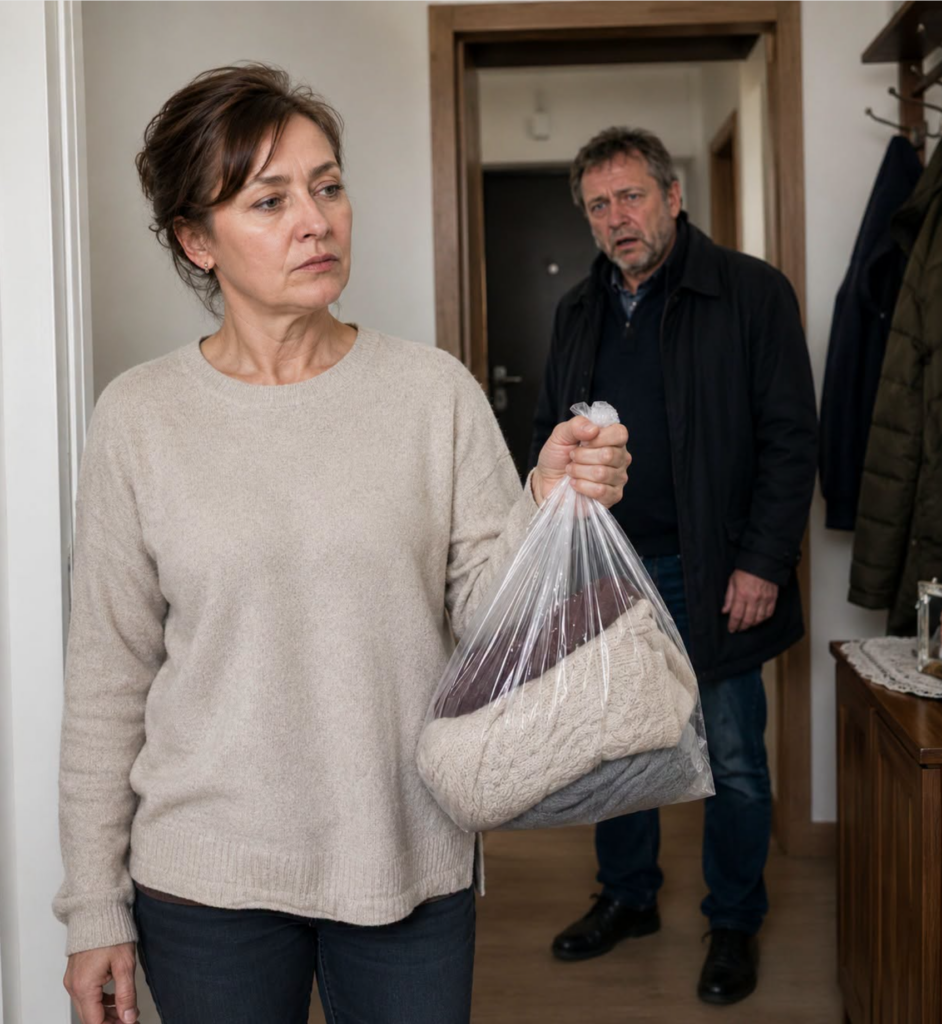
I handed back his slippers in a bag.
— “What’s this?” he asked.
— “The footwear problems of your new life.”
The door closed.
Rita was silent for a long time.
Then she said:
— “I thought he would come back to you.”
— “He did,” I replied. “Just not to where he imagined.”
Outside, it was already dark.
Inside the apartment, for the first time, I didn’t miss anyone.
And that was the first truly quiet victory.