I didn’t cry. There was only a sharp, stubborn ringing in my ears, as if even silence had taken offense.
On my phone screen, Vityali’s message was still glowing.
“Mom, sorry, don’t come today. Veronika says you don’t fit the mood of the evening. You’re not invited, my wife is against it. We’ll drop by later with cake.”
For a moment, I just stared at the words. As if they were written in a foreign language.
I am Zinaida Petrovna, 68 years old. A former chief accountant who spent her whole life finding order in numbers. In the mirror, a neat elderly woman looked back at me: carefully combed hair, modest clothes, flawless discipline.
“You don’t fit in…”
I said it quietly.
The house they lived in was built with my money. The sofa, the car, the schools, the spa memberships, every detail of their “image” life was breathing from my bank account.
I went into the kitchen. My “black notebook” was lying on the table. I recorded everything. A habit from the past: what is not recorded does not exist.
I opened the banking app.
174 automatic deductions.
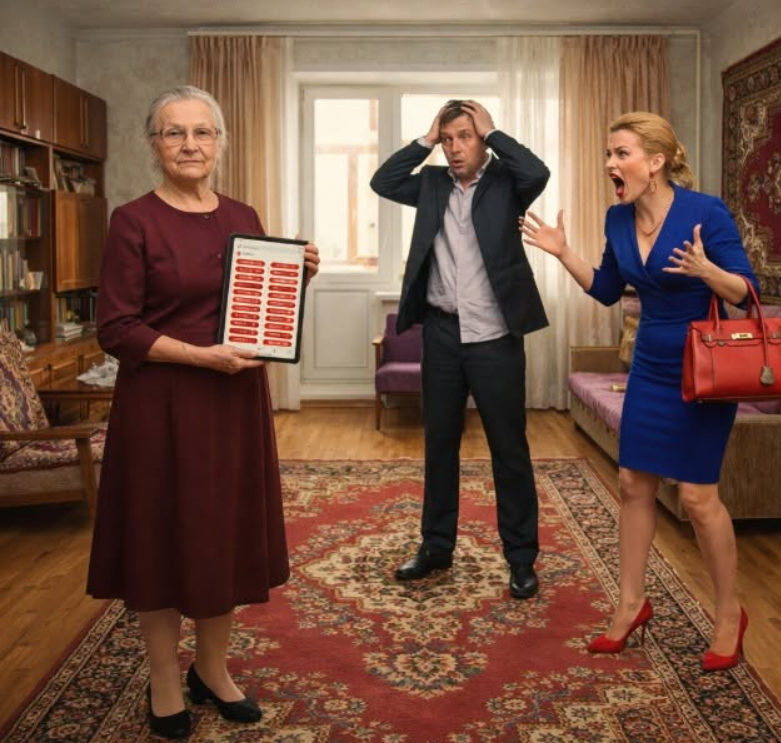
One hundred seventy-four small chains that had been tying their lives to mine for years.
Mortgage on the house.
Veronika’s car.
Private school for my grandson.
Cleaning services, spa, food delivery, subscriptions, insurance.
A whole life I had been financing — and in which I was no longer wanted.
“I’m not invited,” I said. “Alright then.”
And I started deleting.
“Stop.”
“Revoke.”
“Cancel.”
My fingers moved faster than they ever had during my accounting years. Cold, precise decisions. No emotion, only entries.
Car insurance. Deleted.
Loan payment. Stopped.
School fees. Cancelled.
Contract payments. Revoked.
Then I reached my grandson’s card.
I paused.
Sixteen years old. But he already spoke to me as if I were a service provider.
I remembered his words from last week: “Grandma, just send money, I’m going out with the guys.”
I pressed: card blocked. Reason: loss of trust.
Done.
Twenty minutes later, everything was finished.
The amount left in my account felt almost unreal. I couldn’t connect it to a human life anymore. It felt like freedom.
I put the phone down. Brewed bergamot tea. And waited.
I didn’t wait long.
First Veronika called. I didn’t answer.
Then Vityali. Five times.
Messages came one after another:
“The card isn’t working!”
“Is this a bank error?”
“The loan didn’t go through!”
“Mom, answer immediately!”
I drank my tea in silence.
At nine in the morning, the doorbell rang.
Vityali stood at the door, crumpled, anxious. Veronika behind him, with an expensive bag and an offended expression.
“Mom! What is going on?!” he burst out.
“Good morning. Take off your shoes.”
“No time for shoes!” Veronika snapped. “The insurance is gone, the loan stopped!”
“I know,” I said calmly. “I did it.”
Silence fell.
“This is some kind of joke?” Vityali sat down. “We’re family…”
“Yes,” I looked at him. “But you only said that when I was paying for it.”
Veronika shot back:
“A parent’s job is to help!”
“To help, yes,” I replied. “Not to maintain your lives.”
My voice wasn’t loud. That’s what made it heavy.
I took out a folder.
“This is the revocation of the house gift transfer. I intended it for my grandson. Not anymore.”
Veronika’s face tightened.
“And this is the bank document. I am no longer a guarantor.”
Vityali turned pale.
“Mom… you can’t do this. It’s collapse.”
“No,” I said. “It’s correction.”
The silence became thick, almost tangible.
“What are we supposed to live on?” Vityali asked finally.
“The same way I did when I started: by working.”
Veronika’s voice was sharp:
“This is revenge!”
I looked at her.
“No. This is a boundary.”
They left.
Not immediately. First there was shouting, threats, tears. Then exhaustion.
When I closed the door, I didn’t feel emptiness. I felt silence. Clean, organized silence.
In the evening, my grandson banged on the door.
“Grandma! Give it back!”
“No.”
“You’re ruining my life!”
“No. I’m just no longer funding it.”
He slammed the door.
And I did not follow him.
Three months later, I was sitting on the Moscow–Vladivostok train.
The world outside the window was slowly changing: cities, forests, endless space.
I was heading toward Lake Baikal.
I had always wanted to go there. But I had always been financing other people’s lives instead.
Now, for the first time, my own.
My phone vibrated.
A photo: my grandson in a car wash, wet clothes, tired smile.
“Grandma, I’m working. Turns out this brings money. Sorry about last time.”
I smiled.
“This is your first honest money. I’m proud of you.”
My son didn’t write.
I only heard that they sold the house, moved to a smaller apartment, Veronika works now, Vityali is trying to stay afloat.
It’s hard for them.
But for the first time, they are living their own lives.
The train rattled on.
Baikal was ahead.
And for the first time, I wasn’t paying for someone else’s life.
I was living my own.