The Girl Who Paid a Stranger’s Fare
The bus was nearly empty when the incident happened.
Rain pressed against the windows in slow, tired sheets, and the city outside looked washed of color. At the front of the bus stood a man who did not belong there—not in appearance, not in energy, not in presence.
He wore the remnants of wealth like a forgotten memory: expensive shoes now smeared with street grime, a torn shirt under a soaked coat. Only hours earlier, Ethan Blake had been one of the most powerful investors in the city. Now, after a violent mugging that stole his wallet, phone, and identity, he was just another man stranded in anonymity.
The driver crossed his arms.
“No fare, no ride.”
No one moved. No one cared. The silence of strangers is its own kind of cruelty.
Then a voice broke through it.
“You don’t have enough, mister?”
A small girl stepped forward.
She couldn’t have been more than ten. Dark-skinned, thin, wrapped in an oversized hoodie that had lost its color to time. A frayed red backpack hung off her shoulder. In her hand, she held a handful of coins—everything she owned in the world.
“I can pay for him,” she said.
Before anyone could stop her, she pressed the coins into the driver’s hand.
The man scoffed, but the payment was enough. The doors hissed open.
Ethan stood frozen.
Not because he had been helped—but because he had been helped by someone who had less than him.
Her name was Maya.
They sat together near the back of the bus, strangers drawn into reluctant proximity. Outside, neon lights blurred into water-streaked streaks of color.
“You’re welcome,” she said simply.
Ethan nodded slowly. “I’m Ethan.”
She didn’t ask what he did or who he was. In her world, those things rarely mattered.
At the final stop, she stood to leave.
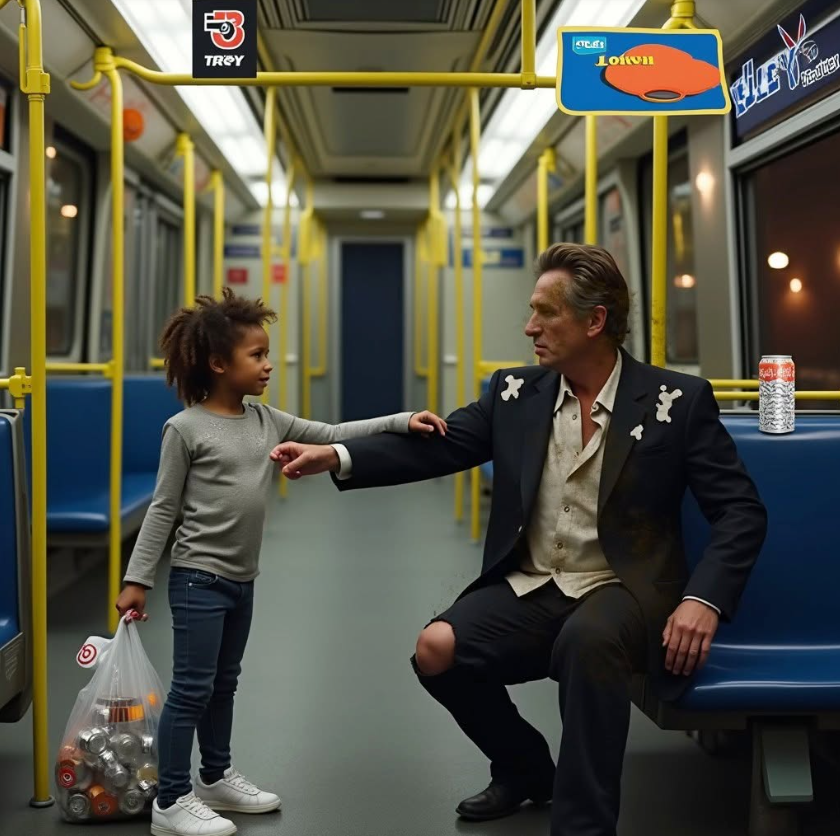
“I sleep under the Fifth Street Bridge,” she said casually, as if describing a bus route. “It’s quieter than shelters.”
The words landed heavier than any insult.
Ethan, still shaken from the robbery, felt something deeper break inside him. Not his wallet. Not his pride. Something older.
“Have you eaten?” he asked.
Maya hesitated, then shrugged. “If you’ve got extra… I won’t say no.”
That night, they ate in a 24-hour diner. She ate slowly, deliberately, as if food might disappear if rushed. When she finished, she wrapped the last piece of toast in a napkin and tucked it into her backpack.
“For later,” she said.
Ethan watched her in silence.
That small act did what years of boardrooms never had—it stripped him bare.
The next morning, he returned to the bridge.
Maya was there, sitting on a folded blanket like it was a throne she refused to acknowledge.
“You came back,” she said cautiously.
“I couldn’t stop thinking about yesterday.”
She narrowed her eyes. “People always come back until they don’t.”
“I’m not here to disappear,” Ethan said. “I’m here to understand.”
Slowly, a fragile connection formed—not built on trust, but on consistency. He returned again. And again.
Breakfast became routine. Conversation replaced silence. And in those exchanges, Ethan saw a world he had spent his life ignoring.
Children sleeping in stairwells. Families rationing food. Lives measured in survival, not ambition.
Maya never asked for pity. Only presence.
Within weeks, Ethan made a decision that shocked his board and staff: he purchased an abandoned community center in Hollow Ridge, one of the city’s most neglected districts.
He called it Haven House.
Not a shelter. Not a charity.
A place where children would not just survive—but belong.
Maya became its unexpected compass.
She challenged everything: locked doors, strict schedules, rules that felt like cages. “If it feels like a prison,” she said bluntly, “kids won’t stay.”
So Ethan changed it.
No locks. No cages. No silence.
Instead, there were murals, music, warm meals, and walls painted with names of those who had been forgotten.
Maya painted the first words herself:
We Were Here.
Others followed.
The building stopped being a structure. It became a memory in motion.
Not everyone approved.
Ethan’s business partner, Martin Hale, called it reckless. “You’re turning a corporation into a charity experiment,” he warned.
But Ethan no longer spoke in percentages.
“I’m turning it into something human,” he replied.
Even Maya didn’t fully trust the world around them. When Ethan promised stability, she responded with caution.
“People like me don’t get endings,” she said.
“You will,” he replied. “Here, you will.”
Still, doubt lingered in her silence.
Then came Reggie.
A man claiming to be Maya’s cousin appeared at the gates, speaking of family and entitlement. But Maya’s face hardened the moment she saw him.
“He left me,” she said later. “He only comes when there’s something to take.”
Ethan stood between them without hesitation.
“You’re not taking her,” he said calmly.
Reggie left.
That night, Maya painted a broken chain on the mural wall beneath a single line:
I choose who stays.
As Haven House grew, so did attention. A tabloid accused Ethan of using the project as redemption theater. Cameras appeared. Questions multiplied.
Ethan did not hide.
“This began with a girl giving me bus fare,” he said publicly. “Everything after that is consequence.”
Maya added, without hesitation: “I’m not his project. I’m proof he listened.”
The clip spread across the city.
For the first time, Haven House was no longer invisible.
Opening day arrived with quiet intensity.
Children filled the halls. Volunteers brought food. Music played through speakers that crackled with age and hope.
A small girl named Layla arrived—silent, withdrawn, watching everything like a threat.
Maya sat beside her without pressure. Offered food. Space. Patience.
And when Layla finally spoke her name, it was as if the building exhaled.
That night, she painted it on the wall.
Her first mark on a world that had never asked for her voice.
Time passed.
Storms came. Funding challenges followed. Board meetings turned tense as Haven House grew beyond its original shape.
Some wanted structure. Others feared losing heart.
Maya stood in the middle of both.
“If we forget why we started,” she said once, “then we’ve already lost it.”
Ethan listened.
That became their balance—structure guided by memory, progress anchored in empathy.
—
A year later, Haven House celebrated its anniversary quietly.
No grand speeches. No corporate banners.
Just children laughing, eating, living without fear.
Maya stood before a mural shaped like a tree—its roots filled with names, its branches stretching toward possibility.
“I used to think silence kept me safe,” she said softly. “Now I know my voice does.”
Ethan stood behind her, no longer the man who had been lost on a bus, but someone rebuilt by it.
She added the final words to the wall:
We Are Home.
And for the first time in either of their lives, that sentence was not a hope.
It was a fact.