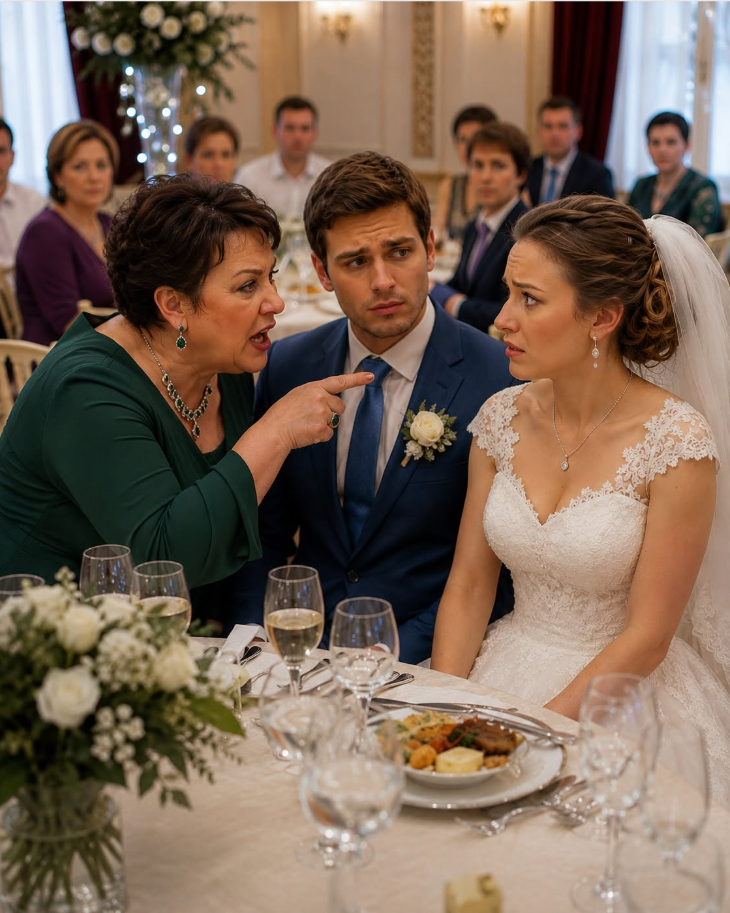
“Go on, Tanya, say thank you to my Pasha!” my mother-in-law, Rimma Gennadyevna, shouted across the wedding hall. “No other man would have looked twice at you. You’re an orphan—no family, no dowry, nothing at all. You should be grateful he married you!”
A few guests laughed.
Not because it was funny.
They laughed because nobody wanted to challenge the hostess on her son’s wedding day. Others looked down at their plates, pretending not to hear.
I sat quietly in my white wedding dress, doing my best to remain calm.
Under the table, my husband Pasha squeezed my hand.
“Mom, stop,” he said through clenched teeth.
“What?” she replied, throwing her hands into the air. “Did I say anything untrue? I’m just telling the truth. Tanya grew up in an orphanage. She has no relatives, no inheritance, no one behind her. My son is a good man who doesn’t care about those things. I’m proud of him!”
An uncomfortable silence settled over the room.
Most people expected me to cry.
Others probably thought I would run out of the hall in humiliation.
But I did neither.
I simply smiled.
Because while everyone at that table believed they knew my story, they only knew part of it.
Yes, I grew up in an orphanage.
Yes, I lost my father in a tragic car accident when I was six years old.
And yes, my mother died the following year, leaving me completely alone—or so I believed.
For years, the orphanage was my home.
It taught me lessons most children never have to learn.
I learned how to solve problems on my own.
I learned how to survive disappointment.
I learned that if I wanted a better future, I would have to build it myself.
While other children spent weekends with their parents, I spent mine studying, reading books, and dreaming of a life beyond the institution’s walls.
I worked hard.
I graduated with excellent grades and earned a place at university.
To support myself, I worked evenings as a waitress and spent countless nights balancing textbooks and work schedules.
Life seemed simple enough.
Finish my degree.
Find a good job.
Rent a small apartment.
Maybe one day start a family.
Then, when I was twenty-two years old, everything changed.
One afternoon, a well-dressed man appeared at my university dormitory.
He introduced himself as a lawyer.
His name was Valery Stepanovich.
At first, I assumed he had the wrong person.
But after confirming my name, he sat down and told me something that left me speechless.
“Tatiana Andreevna,” he said gently, “your maternal grandfather is alive. And he would like to meet you.”
For several seconds, I couldn’t respond.
Grandfather?
What grandfather?
I had spent my entire life believing I had no family.
That was when I learned the truth.
Years before I was born, my mother had a bitter argument with her father and left home. She moved away, married my father, and cut all contact with her family.
When my parents died, nobody knew how to find him.
And he had no idea I even existed.
For more than fifteen years, we lived separate lives, completely unaware of each other.
Then a chance discovery in old family records revealed my birth certificate and my connection to him.
A lawyer was hired.
The search began.
And eventually, they found me.
A week later, I was sitting on a plane to Yekaterinburg.
I was terrified.
Part of me expected the whole thing to be some elaborate scam.
But when I walked through the airport terminal, I saw an elderly man waiting for me.
He was tall and silver-haired.
And when he looked at me, I felt as if I were staring into a mirror.
We had the same gray eyes.
The same expression.
The same face shape.
The moment he saw me, tears filled his eyes.
“My girl,” he whispered, pulling me into an embrace. “Please forgive an old fool.”
That year changed everything.
For the first time in my life, I had family.
For the first time, I belonged somewhere.
My grandfather welcomed me into his world and spent every day teaching me everything he knew.
He taught me business.
He taught me responsibility.
He taught me how to read financial reports, manage employees, and make difficult decisions.
But most importantly, he taught me that a person’s value has nothing to do with money.
Character mattered more than wealth.
Integrity mattered more than status.
A year later, he passed away peacefully in his sleep.
The loss broke my heart.
But before he died, he made sure I would never be alone again.
He left me everything he had built during his lifetime.
His company.
His properties.
His investments.
And the responsibility that came with them.
I was only twenty-three years old.
A year later, I met Pasha.
When I finally told him the truth about my past and my inheritance, his reaction surprised me.
He didn’t ask about bank accounts.
He didn’t ask how much money I had.
He didn’t ask what he might gain from marrying me.
Instead, he smiled and said:
“I love you, Tanya. Not your money. Not your business. Just you.”
That was the moment I knew he was different.
That was the moment I knew I could trust him.
And that was why I married him.
So when my mother-in-law stood at our wedding and publicly humiliated me in front of the entire family, I didn’t cry.
I didn’t argue.
I didn’t defend myself.
Because she believed she was mocking a poor orphan with no future.
She had no idea who I really was.
And she certainly had no idea that a few years later, life would take an unexpected turn—and she would find herself needing help from the very woman she had once looked down on.