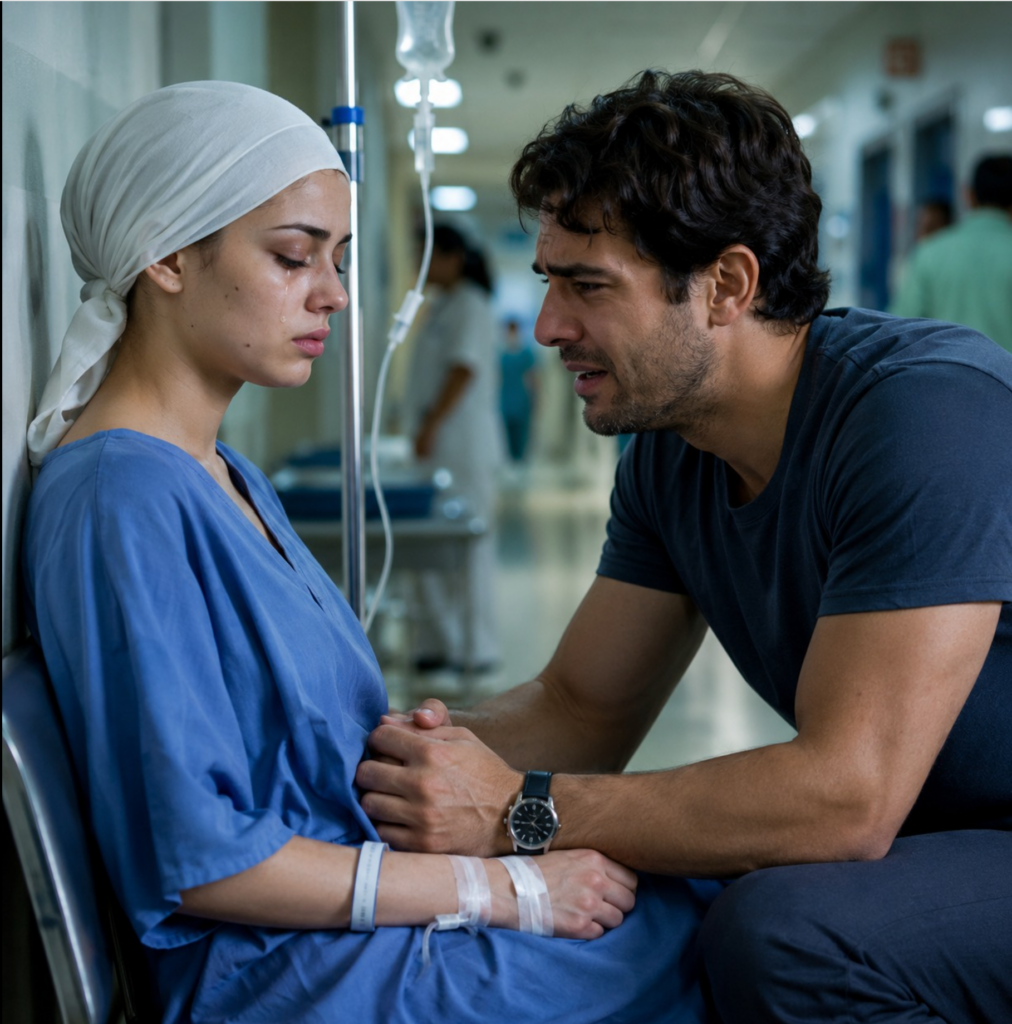
Ricardo’s legs trembled when he saw his ex-wife at the far end of the hospital corridor.
She was sitting alone.
Shaved head.
In an oversized, crumpled blue hospital gown, as if someone hadn’t dressed her body, but what little strength she had left.
And her gaze…
That gaze wasn’t emptiness.
It was something far worse: the look of someone who had already let go of the world, and only her body had remained here by mistake.
Two months.
That’s all that had passed since the divorce.
Two months since Ricardo signed the papers with a cold, mechanical movement that he believed at the time was a decision. A sign of maturity. Of strength.
Two months since Juliana walked out of the apartment in Vila Mariana, São Paulo, with two suitcases, a bag of medication, and a silence heavier than any spoken word. Even the elevator didn’t dare make a sound in her presence.
Ricardo was thirty-four years old, working at an insurance company near Avenida Paulista. The kind of man who arrives on time, answers precisely, and never shows when he is falling apart inside.
For five years, Juliana had been the center of his life.
Not his wife.
But the only place where he felt human.
She was the one who made coffee at dawn without asking anything, just placing the cup beside him. The one who waited with dinner even when she was no longer sure it was worth waiting. The one who smiled softly, as if trying to make the weight of the world bearable in a single gesture.
Then came the three years.
The three years when the child never came.
Two losses.
Two silent funerals no one ever spoke about out loud, but every wall remembered.
And something broke between them.
Not all at once.
Slowly.
Like a glass that doesn’t fall, but receives a new invisible crack every day.
Juliana stopped singing while cooking.
Ricardo came home later and later.
The sentences became shorter, the looks longer, but emptier.
And the silence…
The silence, over time, was no longer peace.
It became accusation.
Ricardo’s mother, Mrs. Conceição, was everywhere she shouldn’t have been.
With soups, rosaries, “well-intentioned” remarks.
— My son… a woman who doesn’t give you a family slowly takes your life away too.
Ricardo heard it, but didn’t stop it.
And that was the problem.
His sister Patrícia no longer even tried to be subtle.
Messages.
Whispers.
— Don’t bury your life with someone who is broken.
Ricardo deleted them.
But every night when he went home, Juliana sat by the window, staring at the street as if waiting for something that would never return.
And then the thought was born in him, the one he later feared remembering:
Maybe everyone is right.
On the day of the divorce, rain fell over São Paulo.
The water on the window tapped as if someone were impatiently knocking on a closed door.
It was a small argument that became the final drop.
A medical document.
A question Juliana didn’t want to answer.
And Ricardo said it.
— Juliana… maybe we should get divorced.
Not shouting.
Not in anger.
But tired.
And that was the worst part.
Juliana didn’t cry.
She just looked at him.
For long seconds.
Then said quietly:
— Did your mother finally win?
Ricardo froze.
— Don’t bring my mother into this.
Juliana nodded faintly, as if she were no longer arguing, only checking a long-known truth.
— I didn’t. She’s been living here with us for a long time already.
The divorce was quick.
Too quick.
Juliana didn’t ask for anything.
Only a box of photos.
Her documents.
And a coat Ricardo once called “too big” on her.
Then she disappeared from the apartment as if she had never truly lived there.
Ricardo moved into a smaller studio in Liberdade.
He told himself: this is freedom.
A cold bed.
Takeout boxes.
Silent TV shows.
And a phone he increasingly feared answering.
But peace never came.
Only silence that grew louder.
And work became the only thing he could still control.
Then, on a Tuesday afternoon, he visited a friend at Hospital das Clínicas.
A bouquet of flowers.
A bag of pastries.
An ordinary visit.
An ordinary moment.
Then, at the end of the corridor, he saw her.
Juliana.
And in that instant, everything he had been calling survival collapsed inside him, as if it had never been more than self-deception.
Because sometimes the worst thing isn’t what we lose.
It’s when we see it again.
And realize we never truly let it go.