During my night shifts in nursing, I began spending time with an elderly patient everyone else had already, quietly and unofficially, stopped noticing. No one said it directly, but it was obvious in the way visits were short, rushed, transactional. He had become part of the background noise of the ward.
We played chess, drank lukewarm coffee from paper cups, and talked about everything and nothing during the long, silent hours before dawn — that strange suspended time when hospitals feel like they belong to another world, and even the machines seem to breathe more softly.
The morning he died, he held my hand. And his sons arrived — and changed my life with a single sentence.
The hospital corridor smelled sharply of disinfectant, but there was something else underneath it: exhaustion, and a kind of quiet abandonment soaked into the walls.
It was 11 p.m. My third night shift that week. I pushed a rattling medication cart down the linoleum floor while my feet ached inside cheap shoes I had bought second-hand three months earlier because I couldn’t afford better.
The fluorescent lights buzzed overhead, casting everything in a cold, clinical white that never quite felt alive. I had been a nursing intern for six months, and most nights felt the same: invisible, exhausted, and constantly hungry in a way that had nothing to do with food.
I had eaten instant noodles four hours earlier, quickly between tasks that never really paused.
Room 412 was silent as I passed it.
Too silent.
I stopped.
Something made me pause at the door. Not a thought — more like a shift in the air, as if the space inside was holding its breath.
I opened the door.
Mr. Carter was sitting upright in bed, staring out at the dark city below. His thin hands were folded neatly over the blanket. He was 75, frail, and slowly dying from complications that no one spoke about anymore.
“It hurts,” he whispered.
His voice was barely there, but it filled the room completely.
“Mr. Carter?” I stepped closer. “Can’t you sleep?”
He turned toward me. His eyes were unexpectedly clear — not clouded by pain, but alert, thoughtful, almost aware in a way that felt heavier than illness.
“No,” he said softly. “Not tonight. I’ve been thinking too much.”
I glanced at my chart. I wasn’t assigned to his room. But the nurses responsible had already finished their rounds, moved on to the next patient, the next emergency, the next life that demanded urgency.
Mr. Carter wasn’t urgent. He was just… there. Waiting.
“My shift ends in an hour,” I said carefully. “Would you like some company?”
Something in his expression shifted immediately, like he hadn’t expected to be offered that.
“I would like that very much,” he said.
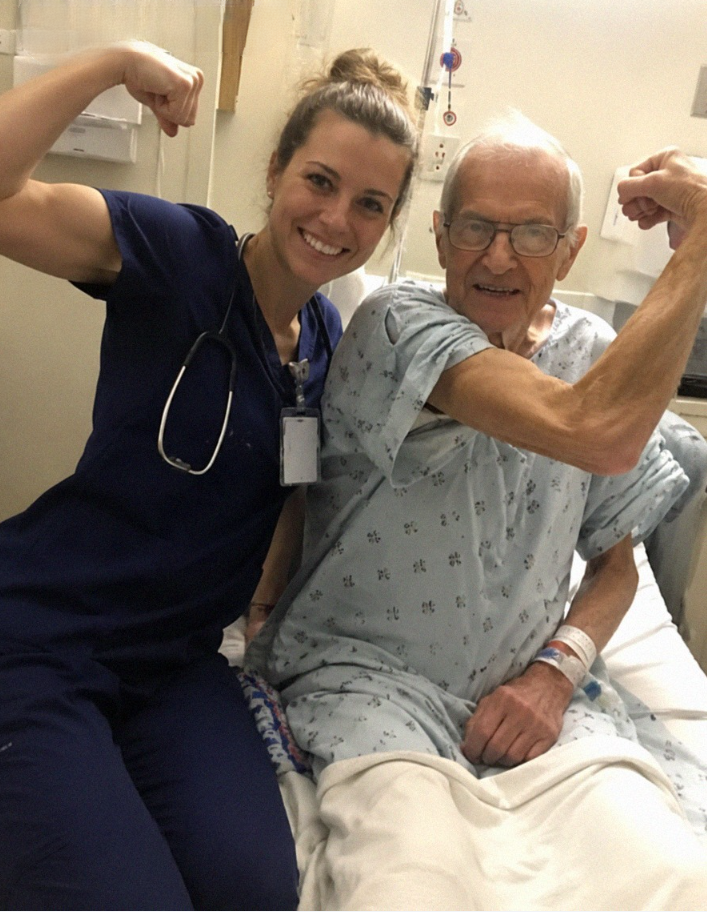
I pulled the visitor’s chair closer and sat down.
At first, we didn’t talk much. The silence felt steady, not uncomfortable.
Then he began asking questions — gentle ones. Where I was from. Why I chose nursing. Whether I had family nearby.
I answered honestly, as I always did. I told him my parents lived hours away, that I had moved to the city for school, and that I worked nights to afford tuition.
“That takes courage,” he said.
“It takes desperation,” I replied with a small, tired laugh.
“Sometimes,” he said quietly, “those are the same thing.”
Over the following weeks, it became a habit.
The other nurses noticed, of course. I stayed after my shift ended — sometimes thirty minutes, sometimes longer.
I brought him coffee from the staff room when he couldn’t sleep. We played chess on a worn board he asked me to bring from his apartment.
He always beat me, but I slowly learned.
He told me stories — about his childhood, travels, places I had only read about, and a fifty-year career running a company before retirement.
One evening I finally asked, “Why doesn’t anyone visit you?”
He was silent for a long time.
“People are busy,” he said at last. “They have their own lives.”
But there was something else beneath his words. Something deeper, more wounded.
I didn’t push further.
One afternoon, the door to room 412 suddenly opened.
Two men walked in — both in their forties, both wearing expensive suits.
His sons.
I recognized them from a photograph he had once shown me, though he had never mentioned they would come.
I stood immediately.
“I’ll just… give you privacy,” I began.
“What is this?” one of them interrupted, scanning my uniform and worn shoes.
“That’s Emily,” Mr. Carter said quietly. “She works here.”
The other son gave a faint, dismissive smile. “A nurse? She looks like she just graduated high school.”
Heat rose to my face.
“I’m a nursing intern,” I said evenly. “I’ll give you some space.”
“Yes, please,” the first one said coldly. “We need to discuss our father’s affairs.”
I left the room, my heart pounding.
His affairs. The word stayed with me like something unpleasant that wouldn’t wash off.
That evening, I almost didn’t go back.
But I did.
He was looking out the window when I entered.
“I hoped you’d come back,” he whispered.
I sat down in the dim light.
“Your sons seemed upset,” I said carefully.
“They usually are,” he replied, his voice hollow.
He didn’t explain further. I didn’t ask.
We just sat there in silence, the hospital humming around us — monitors beeping, distant footsteps, the steady rhythm of a place that never truly sleeps.
And time stretched.
Around 4 a.m., his breathing changed.
Slower. Shallower.
I pressed the call button, though I already knew.
A nurse came, checked his vitals, and looked at me with quiet understanding. She didn’t ask me to leave.
Just before sunrise, soft pink light slipped through the window.
And his grip on my hand loosened.
Not suddenly — but gently, like something that had been holding on finally allowed itself to let go.
His hand was still warm.
Two hours later, his sons arrived.
They found me still there.
I was sitting beside him, my hand resting on his chest where his heart no longer moved.
They said nothing.
Just stared.
Then I slowly reached into my pocket and pulled out two small handmade bracelets.
“He asked me to give you these,” I said softly.
The men froze.
“We… made these,” one of them said after a moment. “When we were children.”
And something in them broke open.
At the funeral, I stood at the back.
I didn’t expect to be called forward.
But one of the sons turned and looked at me.
“Please come up,” he said.
My stomach tightened as all eyes turned.
“Before he died,” the older son said, “our father left something for you.”
“I don’t understand…”
“He left everything to you.”
Silence fell.
“The house. The investments. Everything.”
I couldn’t breathe properly.
“That’s impossible. I barely knew him.”
The older son shook his head.
“No. He knew you. He saw you stay when you didn’t have to. He saw you bring him coffee at 3 a.m. He saw you sit with him when we…”
He stopped, shame crossing his face.
“When we stopped coming,” the younger son admitted quietly. “Years ago.”
My chest tightened.
“He wanted us to understand,” the older son said. “That love isn’t a transaction.”
“And that your kindness,” the younger one added, “meant more than anything he had left.”
Tears blurred my vision.
“I didn’t do it for money,” I said firmly. “I did it because he was alone.”
“We know,” the older son replied. “That’s exactly why he chose you.”
And in that moment, I understood:
that being seen doesn’t always happen loudly. Sometimes it happens quietly — by the one person who truly looks.