When the intercom rang at eight in the morning, I assumed it was the plumber. I had no idea that within minutes a fifteen-year-old boy would be standing at my door, returning something far more valuable than a lost item.
A loss that first seemed minor
The evening before, I had lost my bag. Not misplaced it somewhere at home, but truly lost it. Inside were all my documents, bank cards, keys, and two hundred euros I had just withdrawn to pay the plumber the next day. A bathroom issue had become urgent, and after days of waiting, I finally had an appointment.
That day had been exhausting: grocery shopping, the ATM, the pharmacy, a series of small errands that seem harmless individually but drain you completely when combined. In the evening I parked near my building, carried my bags upstairs, and only once I was in the kitchen did I realize the bag was gone.
My stomach tightened instantly. In my mind, the scene replayed itself: the bag left on the roof of the car for just a few seconds while I rearranged my groceries. Two seconds were enough for everything to go wrong.
Searching, panic, and a sleepless night
I ran back outside without even properly putting on my coat. The car roof was empty. I retraced my steps, scanning under parked cars, along the pavement, near drains, among wet leaves. Nothing.
On the way back, I already began calculating what awaited me: blocking cards, replacing documents, reorganizing my life, endless explanations and waiting. One careless moment had suddenly turned into a problem that stretched far beyond a single day.
The night was restless. I kept waking up, each time returning to the same thought: how quickly everything can disappear.
Sometimes a small loss begins as a simple inconvenience. Then it quietly turns into a heavy knot of anxiety that makes it hard to breathe.
The morning call that changed everything
The next morning at around eight, the intercom rang again. I automatically assumed it was the plumber and answered half-asleep.
“Good morning, madam. It seems I have something that belongs to you.”
I froze.
And then I ran downstairs.
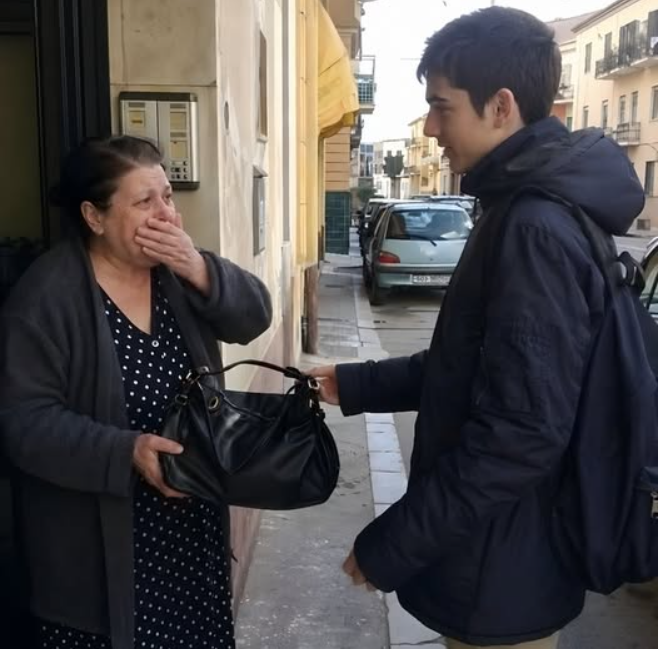
Outside the building stood a boy I had seen around the neighborhood before. Tall, thin, a backpack over his shoulders, a serious expression on his face. His features were still childlike, but there was something unexpectedly mature in the way he stood there. He looked about fifteen. In his hands was my bag.
He explained that he had found it on the street the previous evening, not far from where I had parked. He waited for a while, hoping someone would return, and then used the documents inside to find my address.
I took the bag carefully, as if it might break. I opened it in front of him. Everything was there.
– ID card and driver’s license
– bank cards and keys
– a small notebook with important phone numbers
– and the cash, still neatly inside
I could hardly believe it.
I wanted to thank him properly, to say something meaningful, but he only shrugged as if he had done something completely ordinary.
Then he quietly said that his mother always taught him: if you find something, you return it. No conditions. No expectations.
Meeting his mother
I asked if I could at least thank his mother. At first he hesitated, but eventually gave me their apartment number.
That evening I went upstairs with a box of chocolates.
A woman opened the door. Lucia. Tired, slim, but with warm eyes. The apartment was simple, yet clean and orderly — the kind of home held together not by things, but by care and effort.
When I explained why I had come, tears welled up in her eyes. She asked if her son had returned everything. When I confirmed he had, she quietly said:
“I don’t have much to give him. But I try to teach him what matters most.”
The boy stood beside her, slightly embarrassed but quietly proud.
Honesty is not always visible. But it can return something no money can buy: peace and trust.
What happened afterward
The next day I returned again, this time with an envelope. Not as payment, but as gratitude — for a choice that could have gone the other way, and no one would have ever known.
Lucia first refused, then became uncomfortable, then finally fell silent.
And then she cried. Quietly, restrained, like someone who had been strong for too long.
Five years later
Five years have passed since then. Matteo — that is his name — is now studying engineering.
Sometimes in summer he stops by to help in the garden or lift something I can no longer manage alone.
Lucia and I occasionally drink coffee together and talk about ordinary things: fatigue, exams, groceries, the small burdens of everyday life.
And every time I see Matteo, I think back to that morning.
Back then, I thought I had only lost a bag.
In reality, I had lost something far greater: my trust in people.
And it was a fifteen-year-old boy who gave it back to me — without asking for anything in return.
Sometimes a single honest act doesn’t just change a day. It changes an entire human story.