Gennady came home from work around half past seven. Nadia heard him take off his shoes in the hallway, hang up his jacket—and then not walk straight into the kitchen.
He stopped.
That pause always meant something.
Their daughter, Dasha, was sitting at the table with a textbook open, but she hadn’t been reading for a while. She heard it too—the silence in the hallway—and now pretended to study with the expression of someone preparing for bad news.
Gennady entered the kitchen without taking off his jacket. Nadia stood by the stove.
“Nad… we need to talk,” he said.
“Dinner’s in five minutes.”
“Now.” He pulled out a chair and sat down across from her, in the place where Dasha usually sat. “Sit.”
Nadia turned off the stove, wiped her hands, and sat down.
Eighteen years of marriage sat between them like a third person.
“I’ve been thinking,” Gennady began. “We’re spending too much. We need order. From next month, we switch to separate budgets. Each of us lives on what we earn. I’ll give you a fixed amount for the household—food,
utilities, essentials. Your personal needs too, but a small sum. Everything else is mine. I decide where it goes.”
He spoke calmly, as if reading a decision already made.
“I see,” Nadia said.
Gennady hesitated.
“You… agree?”
“And am I supposed to disagree?”
“Well… I thought you’d ask questions.”
“You’ve already decided,” she said quietly. “What’s there to ask?”
She stood up and turned back to the stove. “Wash your hands. Dinner’s ready.”
Dasha looked at her mother with wide eyes. Nadia gave a small, almost invisible shake of her head: quiet.
They ate in silence. Gennady kept glancing up, waiting for resistance, for an argument, for something. But nothing came. Nadia cleared the table, made tea, asked Dasha about her algebra test—everything as usual.
Only Gennady sat there, as if something had been taken from him, though he didn’t yet know what.
That night, Nadia lay awake staring at the ceiling.
Gennady slept beside her, calm, even breathing—the sleep of a man who believes everything is settled.
Nadia counted years in her head.
Eighteen.
She had married at twenty-four. Back then, Gennady was different—or maybe she only believed he was. He was decisive, confident, protective. “You don’t need to work,” he’d said. “I’ll take care of everything.”
So she let him.
Dasha was born. Nadia took care of her.
And somewhere along the way, “I’ll take care of everything” turned into a monthly allowance labeled “household money.”
No questions about whether it was enough. No interest in where it went. Just a transfer—and the assumption that everything was handled.
Anything beyond that required justification.
She remembered one conversation seven years ago. Dasha was ten. Nadia asked for money for a coat. Her old one had split at the seams.
“Six thousand for a coat?” Gennady had raised his eyebrows. “Seriously? Last month you overspent on groceries.”
“Meat got more expensive.”
“You can find something cheaper. Sales, markets. Why six thousand?”
So she did. She bought a cheap synthetic coat that didn’t keep her warm. She wore it for three winters. He never noticed.
Five years ago she enrolled in an online course—three thousand rubles. She wanted to learn image editing software.
“What do you need that for?” Gennady asked, genuinely puzzled. “You’re at home.”
She didn’t argue. She quietly took the money from household expenses, a little at a time, and skipped meat for weeks.
He never noticed.
Three years ago, she started her own project.
“Northern Stitch.”
Small at first—embroidery patterns, Scandinavian designs, handmade pieces. She worked at night while everyone slept.
Then orders came.
Then regular customers.
Then growth.
Last month, revenue exceeded two hundred thousand. Profit around one hundred twenty.
Gennady earned ninety.
And that night Nadia didn’t sleep—not from anxiety, but from a strange calm certainty.
He started this.
He said: everyone lives on what they earn.
Alright. Let’s see.
Monday morning, Gennady opened the kitchen cabinet.
His expensive ground coffee—the one always on the same shelf for years—was gone.
“Nadya!” he called from the hallway. “Where’s the coffee?”
“I didn’t buy it,” she answered calmly. “Separate budgets. I only buy what I need. I don’t need yours.”
He stood frozen, staring at the empty shelf.
Then he opened the fridge.
A note on the door, in Nadia’s neat handwriting:
Left side — Nadia and Dasha. Right side — G.
The left side was full. The right had a piece of cheese, mustard, and one egg.
He closed the fridge.
It was a joke. A demonstration. It would pass.
But it didn’t.
Days passed.
Food didn’t appear on its own anymore.
Laundry didn’t happen magically.
Groceries didn’t organize themselves.
Every small comfort suddenly had a person behind it.
Nadia.
And for the first time, Gennady began to see her work—not as background, but as labor.
One evening he couldn’t hold it in.
“Nadya… where do you get money for all this?”
“We’ll talk on Sunday,” she said. “Properly.”
“Why not now?”
“Because you won’t understand right now.”
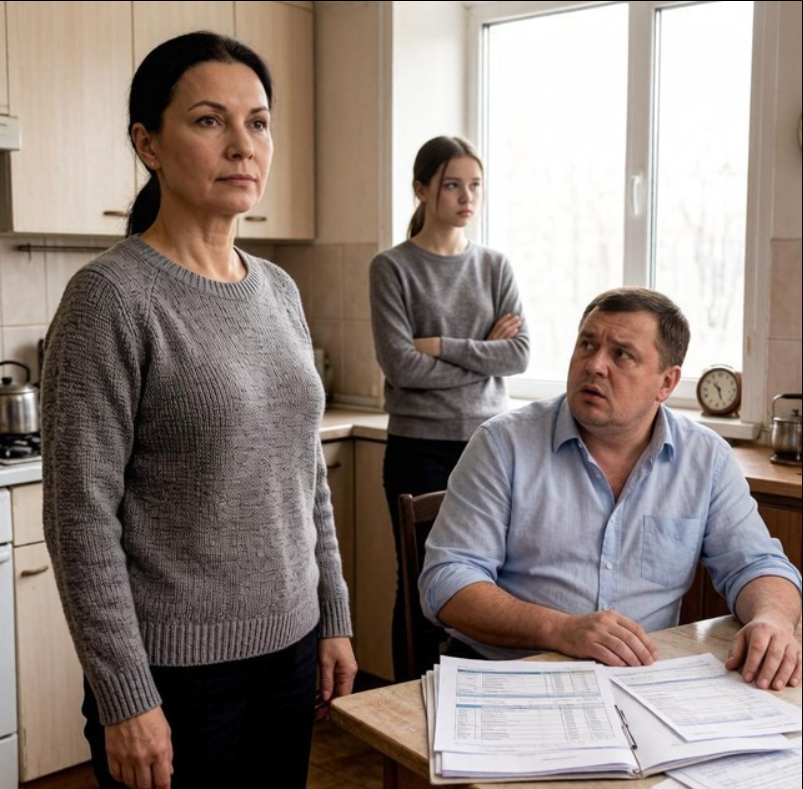
On Sunday, papers were laid out on the table.
Bank statements. Tables. Tax records. Orders. Numbers.
Gennady flipped through them slowly.
And something began to shift inside him.
Not suddenly.
Not dramatically.
But irreversibly.
“This… is all yours?” he asked.
“Yes.”
“You earn more than me.”
“About one and a half times. Sometimes double.”
Silence.
“When did this start?”
“Three years ago as a business. Six years of building it. Quietly. Carefully.”
“And you said nothing.”
“You never asked.”
Four words.
And they landed heavier than any accusation.
Dasha spoke:
“Dad… I saved for my own design course for two years.”
“Alone?”
“Yes. Mom taught me how to save.”
That hit harder than anything else.
Mom taught me.
Not him.
“I’m sorry,” Gennady said finally.
“For what exactly?” Nadia asked—not cruelly, just precisely.
And he couldn’t answer.
Because the list was eighteen years long.
Months passed.
Things didn’t magically become easy.
Gennady still sometimes spoke like a man used to deciding things alone.
But then he stopped himself.
Because Nadia would simply say:
“Gena.”
And that was enough.
One evening they worked together at the table—calculations, logistics, planning.
For the first time, Gennady saw what “embroidery business” actually meant.
“This isn’t a hobby,” he said quietly.
“No,” Nadia replied. “It never was.”
In spring, Dasha put her design certificate on the fridge.
Right where the old “left and right side” note had been.
Gennady looked at it for a long time.
Then he said:
“She did well.”
A pause.
“You both did.”
That evening Nadia was cutting vegetables.
Gennady stood in the doorway.
“For eighteen years I didn’t really see you,” he said.
“I know,” she said.
“And now?”
“Now you’re trying.”
Silence—not tense, but new.
Gennady looked at the old cracked wall clock in the corner.
He used to say it should be thrown away.
Nadia always said, “It still works.”
Now he understood.
Some things don’t need replacing.
They just need someone to finally look at them.