When Daniel Reeves filed for divorce, it didn’t feel like an ending. It felt like the floor of my life suddenly giving way.Twelve years.That’s how long we had been married—twelve years of shared bills, shared holidays, shared routines so ordinary they felt permanent.
Grocery lists on the fridge. Sunday mornings with coffee. A life built on the quiet assumption that we were solid.But in the months before he filed, something had shifted.Daniel stayed late at “work.” His phone was always face-down.
When I touched his shoulder, he flinched—just slightly, but enough to make affection feel unwelcome. I told myself he was stressed. I clung to that explanation because the alternative was too painful to face.
Our daughter Lily noticed the change long before I admitted it.She didn’t act out. She didn’t cry or demand attention. Lily watched. She listened. She absorbed the tension like a silent observer in a house where the air had grown heavy. Adults often think children don’t understand—but they see more than we realize.
The court date came faster than I was ready for.That morning, Lily insisted on coming with me.“I don’t want you to be alone,” she said quietly.There was something steady in her voice—something older than her ten years—that made me stop arguing.
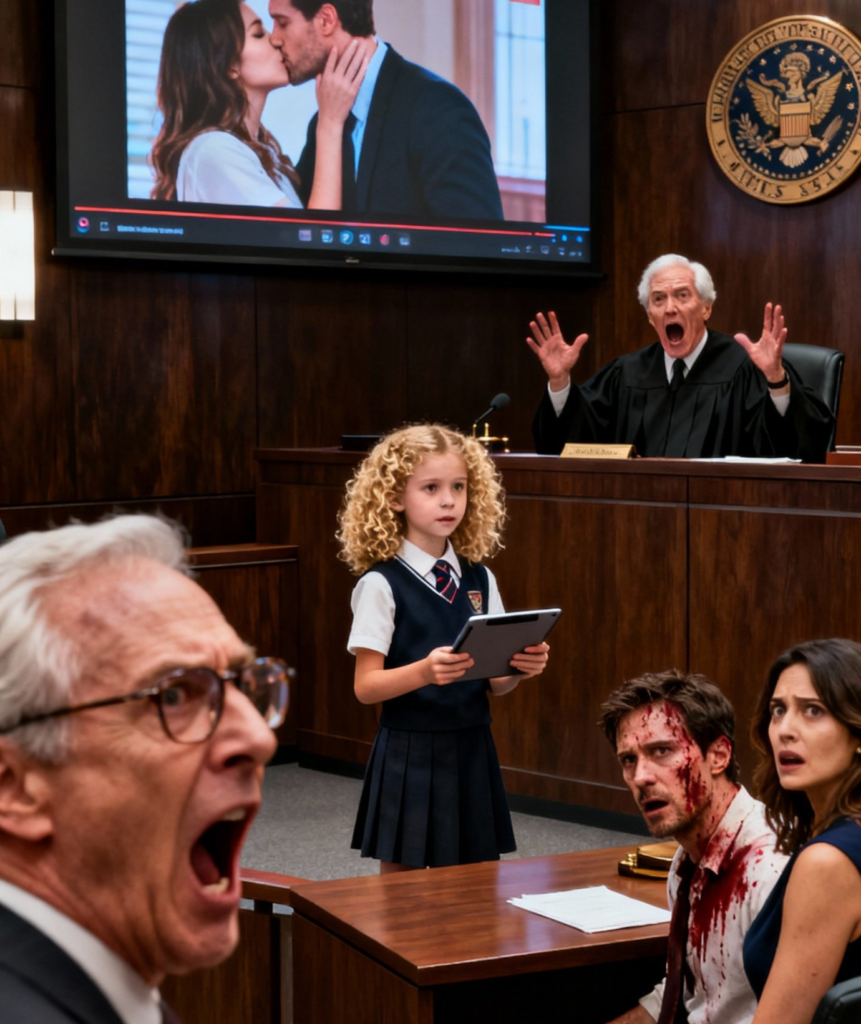
Inside the courtroom, Daniel sat beside his lawyer, calm and composed, never once looking in my direction. The judge began with the formalities: custody, property, visitation. Words like shared and joint floated through the room, sharp and empty.
Then Lily stood up.“Your Honor,” she said, her small voice clear, “may I show you something? Mom doesn’t know about it.”The room shifted. Papers stopped moving. Conversations died mid-whisper.
The judge studied her for a moment, then nodded. “If it’s relevant, you may.”Lily walked forward holding a tablet in both hands. My heart began to pound. I had no idea what she was about to do.
She pressed play.At first, the video shook—the unsteady recording of a child’s hands. Then the image focused.Our living room.Our couch.And Daniel.He was sitting close to a woman I had never seen before. Her hand rested easily on his chest. He leaned toward her. She laughed. Then he kissed her—slowly, comfortably, like it wasn’t the first time.
The courtroom fell into complete silence.Daniel’s lawyer froze. Daniel’s face drained of color.The judge leaned forward. “Mr. Reeves,” he said evenly, “would you like to explain what we’re seeing?”
Daniel stumbled over his words. “I—I don’t know when that was taken. It’s being taken out of context—”“I recorded it three months ago,” Lily said.Every eye turned to her.“Mom was at work. Dad told me to stay in my room.”
Each word landed heavy.“She came over a lot,” Lily continued. “Dad said she was just a friend. But friends don’t kiss like that.”My chest tightened—not just from betrayal, but from the realization that Lily had been carrying this alone.
Then she tapped the screen again.A second video played.Daniel sat at the kitchen table, speaking sharply.“Don’t tell your mother,” his recorded voice said. “You’ll confuse her. This is adult stuff. You don’t want to be the reason everything falls apart, do you?”
A gasp rippled through the courtroom.The judge’s expression hardened. “That,” he said slowly, “is parental manipulation.”For the first time, Daniel looked at Lily.She didn’t look back.After a brief recess, the judge returned with his decision.
Primary custody would be granted to me. Daniel’s visitation would be supervised until he completed counseling. The division of assets would be reconsidered in light of marital misconduct.But the ruling that mattered most didn’t come from the bench.
Outside the courtroom, as Daniel stood uncertain and silent, Lily slipped her hand into mine.“I didn’t want to hurt you, Mom,” she whispered. “I just didn’t want you to think it was your fault.”I knelt down and held her tightly, wishing I had understood sooner.“You didn’t hurt me,” I told her, my voice breaking. “You helped me see the truth.”
The weeks that followed weren’t easy. Divorce never is. There were quiet nights, difficult conversations, therapy sessions where I learned just how much children carry when adults try to hide reality.
But slowly, something changed.Lily laughed more.She slept through the night.She stopped studying my face, as if waiting for something to break.One evening, in our smaller but peaceful apartment, she looked up from dinner and said softly:
“Mom… now everything feels honest.”That’s when I understood.The truth didn’t destroy our family.The silence did.And the bravest person in that courtroom wasn’t the judge, or the lawyers, or anyone speaking for the record.It was a ten-year-old girl who refused to protect a lie.