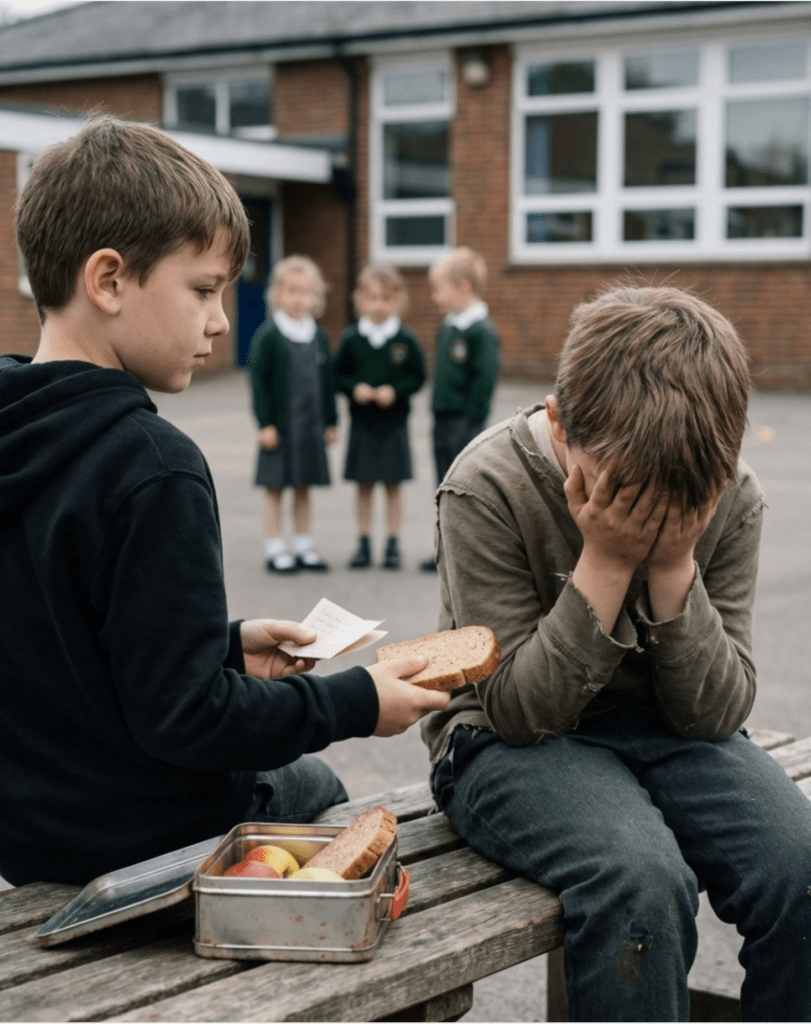
I picked the note up slowly, milking the moment.The schoolyard buzzed with anticipation. A circle of students leaned in, hungry for entertainment. I lived for that sound — the low hum of laughter waiting to explode. It was power. And power felt good.
“Let’s hear today’s masterpiece,” I announced, unfolding the wrinkled paper like I was revealing a grand prize.I cleared my throat dramatically.“My son,Forgive me. Today I couldn’t afford cheese or butter…”
A few snickers floated through the air.“I skipped breakfast so you could have this piece of bread…”The breeze shifted. The laughter thinned.“It’s all there is until I get paid on Friday.Eat it slowly so it fills you up more.”
My voice was no longer playful.“Study hard. You are my pride and my hope.I love you with all my heart.—Mom.”The final word barely escaped my lips.Silence fell — heavy, suffocating silence. Even the birds seemed to pause mid-song.
Lucas stood in front of me, small and shaking. His fingers covered his face, but they couldn’t hide the tears slipping through. His shoulders trembled as if he were trying to hold himself together with sheer will.
I looked down.The bread lay on the concrete — pale, dry, slightly cracked along the crust. It had landed beside a muddy sneaker print. Just minutes ago, I’d called it trash.But it wasn’t trash.It was warmth that never reached a mother’s stomach.
It was hunger disguised as love.It was sacrifice.Across the courtyard, my lunchbox rested on a bench — smooth Italian leather, dark and polished, my initials pressed in gold. Inside were layers of abundance: ciabatta sandwiches stuffed with roasted vegetables and imported cheese,
a chilled bottle of mango juice from Spain, chocolate wrapped in gold foil. It smelled faintly sweet when opened.A housekeeper packed it every morning with quiet efficiency.My mother probably didn’t know what was in it.
She didn’t know what was in me either.My name is Ethan Walker.My father shook hands with governors and appeared on television screens. My mother owned luxury spas where chandeliers glittered and fountains whispered in marble lobbies.
I wore limited-edition sneakers before anyone else. My phone was always the newest model, always upgraded.I lived in a mansion with ceilings so high my voice echoed if I shouted.But no one was there to hear it.
At school, I filled that emptiness with noise.And Lucas Miller was my favorite target.Lucas — the scholarship kid.His uniform was faded from too many washes. The sleeves were slightly short, exposing wrists that looked too thin. His backpack sagged at the seams.
His brown paper lunch bag was always wrinkled, stained with oil spots that told stories of simple meals.Every recess, I performed the same ritual.I’d snatch the bag from his hands. Jump onto a table. Raise it high.
“Let’s see what the charity case brought today!”Laughter would ripple outward.Lucas never fought back. That made it easier. He just stood there, eyes glossy, jaw tight, enduring it like bad weather.
I would spill his food out dramatically — a bruised banana with darkened spots, cold rice clumped together, sometimes nothing more than crackers wrapped in a napkin.Then I’d toss it in the trash and walk away to buy pizza with my unlimited cafeteria card.
But that Tuesday, the bag felt nearly weightless.It barely rustled when I grabbed it.“What’s this?” I sneered. “Air for lunch?”Lucas reached out quickly. “Please, Ethan. Not today.”His voice cracked — soft, urgent.
I ignored it.The bag turned upside down.One piece of bread fell onto the pavement.And the folded note.I made my joke about breaking teeth.Then I read the words that stripped the humor from my mouth.
Standing there, reading a mother’s apology for not being able to afford butter — something inside me shifted, like a crack running through glass.My chest felt tight. My ears rang.My stomach, always comfortably full, suddenly felt heavy.
I bent down slowly. The concrete was warm under my palm as I picked up the bread. I brushed away dust carefully, almost reverently. I placed it back in Lucas’s trembling hands along with the note.
Then I walked to the bench, lifted my untouched lunchbox, and carried it back.The leather felt smooth. Expensive. Pointless.I set it on his lap.“Trade with me,” I said quietly.No sarcasm. No audience voice.
Just me.The bell rang sharply in the distance, but no one moved for a moment. The world seemed suspended.That day, I didn’t taste my food.I tasted regret.And it lingered.The next morning, when someone shoved Lucas into a locker, the metal clanged loudly.
Without thinking, I stepped between them.“Don’t,” I said calmly.It wasn’t loud. It didn’t need to be.The hallway quieted.I stopped sitting with the crowd that thrived on humiliation. They laughed at me for a week. Then they stopped noticing me.
I began sitting with Lucas instead.At first, he barely spoke. His eyes held caution, like a stray animal waiting for the trap to spring. Trust is fragile when it’s been crushed repeatedly.But I showed up.
Every day.Shared food. Shared silence. Shared homework.One afternoon, I followed him home — not to threaten, but to understand.His house leaned slightly to one side. Paint peeled in long strips. The front steps creaked under my weight.
His mother opened the door. Her eyes were tired but gentle. When she recognized me, her expression tightened — protective, wary.“I’m sorry,” I said immediately.The words felt small against years of cruelty.
She studied my face.“I just want my son to feel safe,” she said softly.“He will,” I promised.And this time, I meant it.Years later, I still remember that piece of bread.Its drynessIts simplicity.Its quiet power.
Because in that single slice was more love than all the luxury in my house.And I learned something that day no expensive education had ever taught me:Wealth can fill a table. But only compassion can fill a heart.