Margarita slowly adjusted her gold bracelet—just enough for it to chime softly and catch the light of the crystal chandelier. She shifted her shoulder slightly, and the brocade of her dress flared, as if reminding everyone who held the upper hand here.
Conversations at the tables faded into silence. She knew how to command it. Money, years of practice, and an innate confidence in her own superiority always did the trick.Anna shrank as if struck by a cold draft.
She knew—now. She had seen it coming all evening: the way her mother-in-law kept casting sidelong glances at her mother, whispering to her friends while pointing at Vera’s gray suit, the way she grimaced when Vera picked up her fork, as though poverty were contagious.
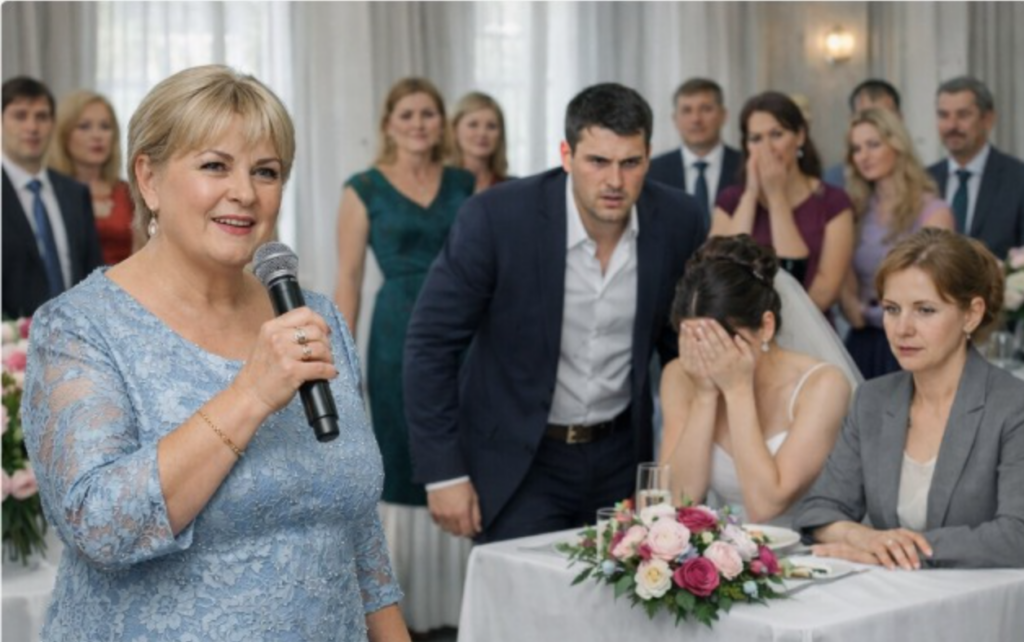
“Mom, please…” Andrei said quietly.Margarita didn’t hear him. Or pretended not to.She took the microphone.“Dear guests,” her voice was sweet, like liqueur, “I would like to say a few words about my son’s choice.”
A silence fell over the room—the kind that comes just before a thunderclap.“I had, of course, imagined a different daughter-in-law. Someone from our circle. With the right upbringing, status, and opportunities. But as they say, the heart cannot be commanded.

He fell in love. With a simple girl from a simple family. Well… it happens. We will manage.”Vera sat at the edge of the table, her back straight. She did not raise her eyes. Her hands lay calmly, evenly, without fidgeting—the hands of someone long accustomed to self-control.
“But now,” Margarita continued, savoring the pause, “we will have to support not only the newlyweds, but all their relatives as well. Because when your mother has spent her entire life ladling soup in a school cafeteria, one can hardly expect a dowry, wouldn’t you agree?”
Someone chuckled softly. Others hurriedly lowered their eyes to their plates.Margarita stepped forward.“Just look at her. She couldn’t even afford a decent suit. Apparently, a cook’s salary doesn’t allow for much.”
Anna jumped to her feet. Her chair crashed loudly to the floor. She ran out of the hall, unable to see where she was going. Andrei rushed after her. But Margarita could no longer stop herself.“At least her daughter has pulled a winning ticket now,” she sneered.
“She won’t have to scrub pots until retirement like her mother. She’ll live in comfort. At our expense.”The room was so quiet that one could hear someone awkwardly shifting a chair.Margarita placed the microphone back on the table. Satisfied. Certain she had put everyone in their place.
Vera slowly stood up.Without haste. Without tears. She carefully folded her napkin and placed it beside her plate. Then she looked at Margarita.“Thank you for your honesty.”Her voice was soft, yet carried clearly—the way people speak when others are used to listening to them.
“I always taught my daughter that honest work is not a disgrace. For thirty years, I fed children. And I am not ashamed of it. But an empty heart is a poverty no amount of money can cure.”Margarita smirked, but Vera did not let her interrupt.
“My husband, Nikolai, passed away seven years ago. He was a builder. You’re right about that. What you don’t know is what kind of man he was.”At one of the tables, a man in a dark suit straightened abruptly.
“Kravtsova?.. Vera Nikolaevna Kravtsova?” he breathed.“Yes.”“My God… I worked with Nikolai Sergeyevich. He was a legend. The entire city knows about your foundation. The children’s hospitals. The projects.”
Margarita went pale, gripping the edge of the table.“After my husband’s death, I inherited everything,” Vera continued calmly. “The business, the accounts, the properties. But sitting at home counting money was never my path. My husband despised idleness. So I stayed where I feel useful.”
People approached Vera. Handshakes. Respectful looks.“I’m sorry—I didn’t recognize you right away…”Margarita stood frozen, as if glued to the floor.“Margot…” a friend whispered. “You rent space in the Riviera complex, don’t you?”
“Yes…” she forced out.“That center belongs to the Kravtsova Foundation…”Margarita clutched the back of a chair.“You… you could destroy me…” she whispered.“I could,” Vera replied evenly. “With a single phone call. But I won’t. Because I’m not like you.”
She turned to Anna and Andrei.“Go. This is your day.”Margarita sank into her chair. Around her, it felt as though a void had formed.Later, Andrei approached her.“Mom, are you satisfied?”“I didn’t know…” she whispered.
“You didn’t know she was wealthy. But you knew she was human. And that wasn’t enough for you.”He walked away.Vera was the last to leave the hall. At the door, someone stopped her.“Why did you stay silent all this time?”She looked back into the room, where Margarita sat alone.
“Because I needed to see who she really was.”Outside, the air was warm. Vera dialed a number.“Tomorrow, transfer everything to the children.”She walked down the tree-lined path—without guards, without glitter.And in the restaurant, Margarita finally understood: she hadn’t lost money.
She had lost her son.And that emptiness could no longer be filled with anything.