– Why are your eyes so quiet, Mr. Vale?Like a candle whose wax has melted away completely, Graham Vale remained motionless in his heavy leather chair.The light from his laptop reflected off the flawless marble floor of a dining room set for twelve—but only one place was ever served.
Every night he dined here, alone, in his villa above the city. Silent. Mute. Cut off from all life.Graham was a multimillionaire, a titan of the healthcare industry, yet he carried a secret that even the expensive walls could not betray: pancreatic cancer, stage four. Four months—maybe less.
No one knew. No one was ever meant to know.But on an ordinary Friday afternoon, the front door opened to something that had no business being here.A shy cleaning woman named Lena Ortiz, hand in hand with her three-year-old daughter, Mia.
The daycare was closed. No family nearby. No backup plan. It was her first day on the job, and any absence would have been disastrous.Graham barely looked up—until he heard it:A child’s laughter, clear as glass, bouncing off the marble floors, dancing through the air like sunlight through a dome.
Days later, Mia suddenly appeared in his office, eyes wide, without a trace of fear.– You’re sad, she said, as if she were merely describing the weather.Her words struck harder than any medical diagnosis.Soon she began leaving small drawings on his desk:
stick figures holding hands, clumsy but full of life.And Graham found himself anticipating her quiet footsteps in the hallway, like a child secretly listening for a sound.He accidentally bought strawberries.He left doors open—by mistake.
And one evening, for the first time in years, he did not eat alone.His villa was a masterpiece of solitude: Italian marble floors, museum-quality artifacts, a heated swimming pool that was never used. Yet everything felt like a mausoleum.
Graham moved through the halls like a shadow, careful not to disturb the silence he had cultivated over decades.The corridors were too long. The rooms too large. Every echo reminded him that success had given him space, but stolen warmth.Mornings he swallowed pills to postpone the inevitable.
Then he put on his suit, as if he still controlled everything.Chemotherapy made his hands shake, his skin pale, his appetite vanish.And yet he appeared at the office, signing papers, pretending the future still belonged to him.Work had always been his shield.
As long as the numbers balanced, as long as contracts were signed, he didn’t have to feel the empty pain in his chest.The only constant presence was Mrs. Caldwell, his housekeeper for decades.
Efficient. Calm. Professional.They exchanged hardly any words—just enough to function, never enough to feel close.
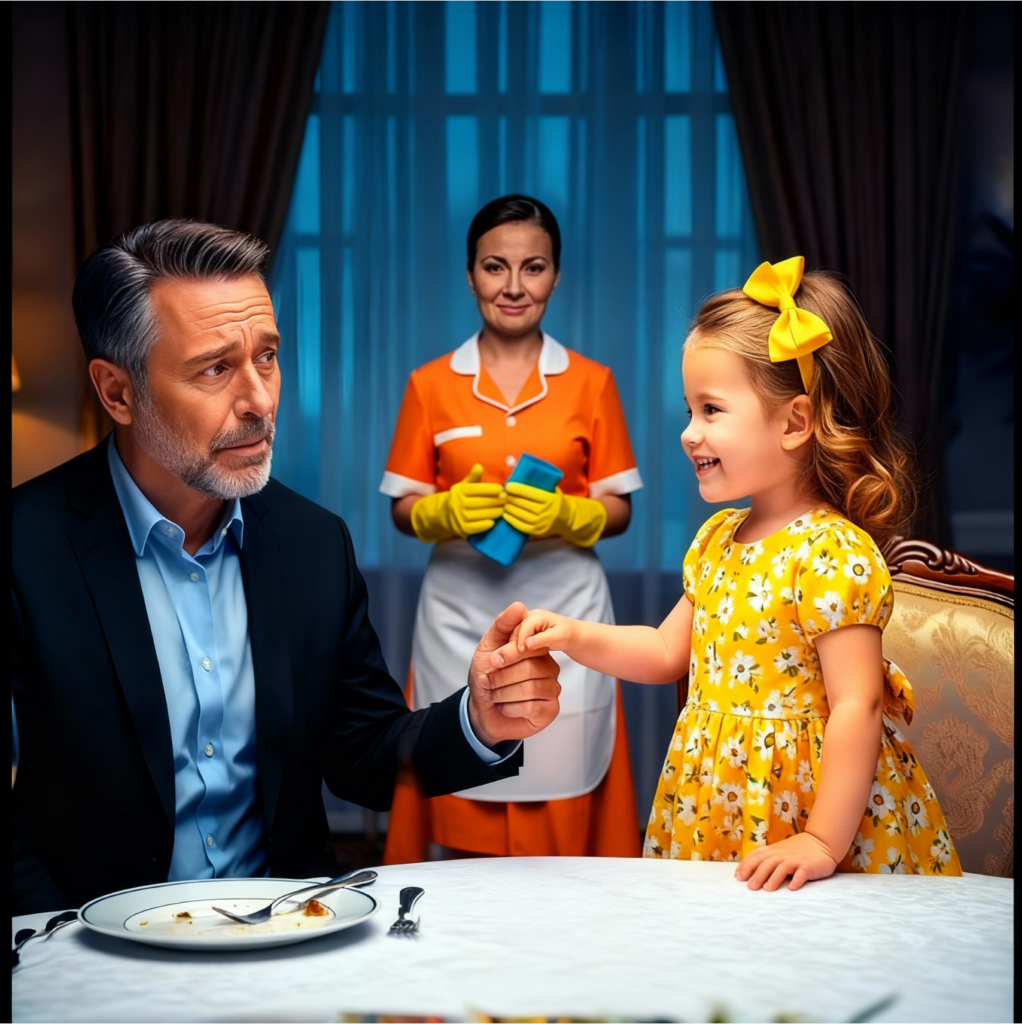
Graham liked it that way. No questions. No sympathy. No reminders that he would die alone.Evenings he sat at the head of the dining table, a steak in front of him whose taste had long vanished.Eleven empty chairs stared at him like unanswered questions.
When was the last time laughter had echoed here?When had anyone asked how his day was—and actually cared to know?The villa was not a home. It was a monument to all that he had sacrificed.Yet, among the ticking clocks and cold porcelain plates, Graham recognized a truth more terrifying than cancer:
He had not only postponed his life.He had erased it.And now the silence he had clung to began to crumble.Small steps. Colored-pencil drawings. A voice brave enough to say what everyone else feared.The disruption began politely, almost timidly—like a crack in a wall that hadn’t been touched in years.
One Thursday morning, Mrs. Caldwell appeared in his office. For the first time in fifteen years, her voice trembled. An accident, a sprained ankle, two weeks of rest. Graham nodded emotionlessly: a replacement would be arranged. It meant nothing to him.
But he didn’t realize that this “yes” had opened the door to something that could save him.The next morning, unfamiliar voices sounded through the villa.One nervous, the other tiny.At first, he ignored them, absorbed in spreadsheets that now seemed meaningless.
Then the smell of freshly brewed coffee drifted through the halls.Real coffee. Hot. Alive.And finally, a sound that made him freeze:A bright, unfiltered child’s laugh, completely out of place.He followed the sound to the kitchen. Lena stood stiffly at the sink, next to her a small girl in a faded pink dress,
humming, clutching a rag doll with button eyes.Mia looked at him—fearless.Curious, probing, like examining a puzzle rather than a man.Lena apologized quickly, explaining the closed daycare, her desperate situation, the job she urgently needed. Graham listened silently, ready to send them away.
But then Mia tilted her head:– You look sad.Her words struck deeper than any diagnosis.Graham muttered that they could stay as long as there was no chaos. But behind him, Mia whispered:– He’s not scary. He’s just empty.And in that moment, the silence Graham had built his life upon began to crack.
One small voice after another.Mia didn’t belong here—and precisely for that reason, she transformed the villa.Her laughter echoed through the marble halls, a sound that had never existed before.She sat on the kitchen floor, paper and broken crayons scattered around,
drawing giant suns, people holding hands—people Graham had never thought he could be part of.Every line a quiet rebellion against the silence he had revered.One afternoon, while Lena cleaned the bathroom upstairs, Mia padded down the long hall. Her steps were barely audible.
Graham sat in his office, staring past the numbers, feeling the ache in his bones, watching time slip through his fingers.He only noticed her when she spoke:– Hello.He looked up, startled.
She stood there, hands behind her back, the seriousness of a small being larger than it ought to be.
Before he could ask her to leave, she spoke again, softly but firmly:– You’re sad.Graham wanted to deny it.But Mia shook her head.– Your eyes have gone out. Like a candle when the wax is all used up.The words pierced him—not painfully, but truthfully. No adult had ever dared to say it.
The next day, she brought him a drawing: a crooked house, a little girl, a woman, and a man standing lonely beside them.– That’s you, Mia said. Because you live alone. But I saw you.Graham studied the paper, hands trembling.He quietly placed it in the same drawer as his medical reports.
Life now rested beside death.From that day on, the villa began to change.Graham left doors open, awaited footsteps, listened for laughter.And for the first time in years, he felt something stir: fragile, terrifying—but alive.