Blood Debt Beneath the Arizona Sun.The Buffalo Scout, the Abandoned Apache Daughter, and the Alliance That Split the FrontierThe Arizona sun showed no mercy.It pressed down like a sentence already passed, bleaching bone, truth, and memory until nothing could hide.
Heat shimmered across the desert in violent waves as a lone rider cut through the mirage—bleeding, hunted, and worth a thousand dollars to the wrong men.Jack Callaway sat heavy in the saddle. Blood soaked his shirt at the shoulder, dark and sticky, every pulse reminding him how close death rode beside him.
His eyes never stopped moving, tracking ridgelines that had swallowed entire patrols, because three bounty hunters already lay dead behind him at Rattlesnake Pass—and more would come.They always did.
Those men had chased the reward with confidence, rifles gleaming, mouths full of jokes. None of them understood what war carves into a survivor—especially a scout trained to read dust like scripture, silence like warning, and ambush like fate.
Ten years earlier, Jack had ridden with the 10th Cavalry—the Buffalo Soldiers. Men forced to prove their worth twice: once in battle, once in a country that never wanted them wearing blue. Discipline had kept him alive then, burned into his bones, taught through blood and long marches beneath hostile skies.
That same discipline destroyed him.When an officer ordered him to guide troops to an Apache camp—one filled with women and children—Jack refused. Some lines, even war has no right to cross.
The Army named him traitor.The frontier called him outlaw.The posters called him dead or alive.Jack might have kept running if Silas Reed hadn’t decided to hunt him like sport.Exhaustion changed everything. A man can flee only so long before he turns around and decides the chase ends—one way or another.
Jack became the predator not out of pride, but because he was tired of being prey.Then the desert played its cruelest hand.Beside a dried creek bed lay a dark shape half-buried in dust—a young woman, broken and unmoving, her black hair spilled like ink across the sand. Jack’s hand dropped to the Colt at his hip. Mercy got men killed out here.
But her breathing—shallow, uneven—pulled him closer. The unnatural angle of her legs told the truth no lie could hide.She was Apache. Silver and turquoise marked her wrists and throat. She couldn’t have been more than twenty. Someone had left her to die—the oldest crime in the book of survival.
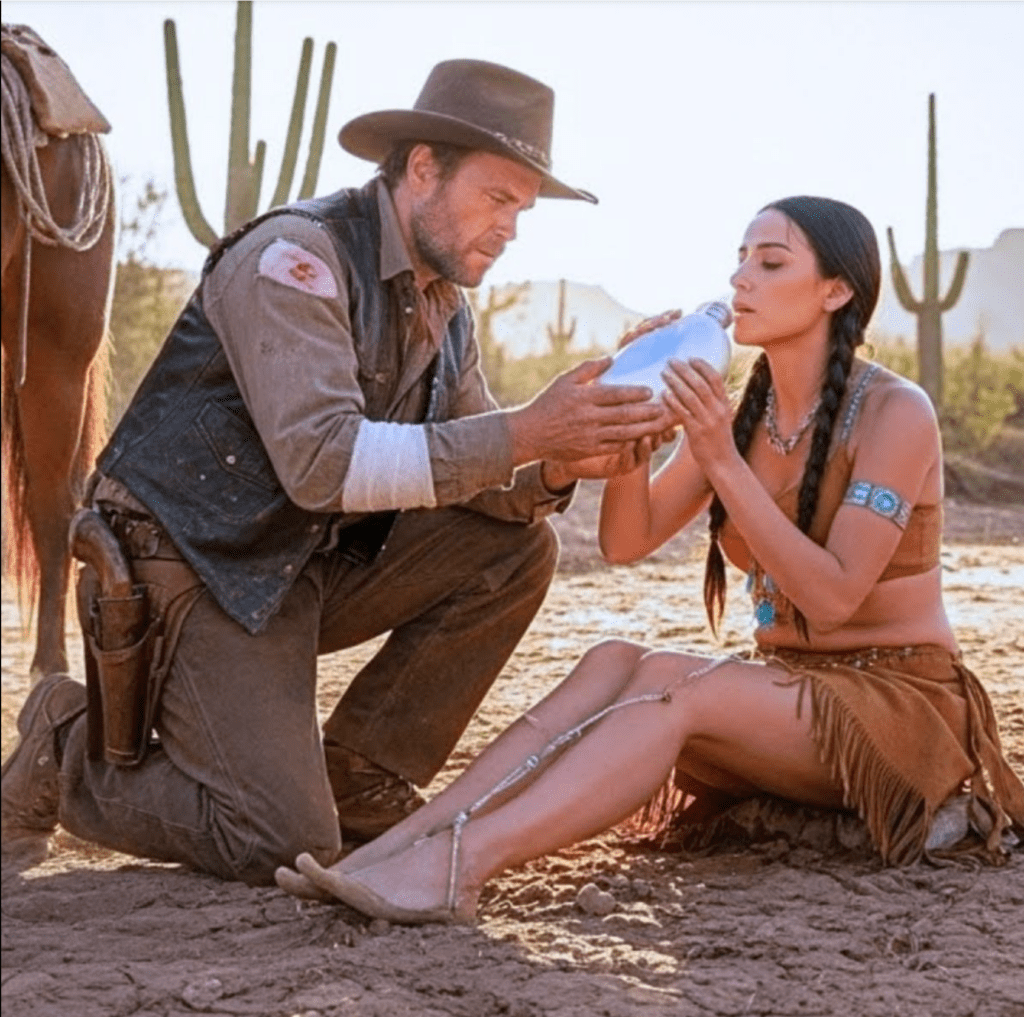
Jack whispered the sensible choice: ride on. Let the desert finish what people started.Then he did the unsensible thing—the kind that ruins reputations and saves souls.Pain flared as he dismounted and knelt beside her. After enough killing, the weight of one abandoned life can feel heavier than a gun belt.
Her eyes snapped open, burning with hatred. She spat words in Apache he didn’t understand. Still, he offered water. Thirst, at least, speaks a universal language.“Nia,” she said at last, barely audible.
“Jack Callaway,” he replied—realizing too late he’d just given a wanted man’s name to a girl with every reason to wish him dead.Night found them hiding in an abandoned miner’s cabin—a crooked sanctuary of rotting logs and sharp shadows. Jack’s old habits returned as he checked angles, exits, blind spots. Survival was muscle memory.
Nia’s injury was worse than he’d hoped. Her spine was damaged. Her legs didn’t move. The wounds were days old—proof this wasn’t an accident, but a sentence carried out slowly.“Your people left you,” Jack said.
The words struck like flint.“The tribe cannot slow,” Nia answered in broken English. “Cannot carry weakness. Cannot live if it does.”The argument that followed could have split the cabin in half. Jack called it wrong. Nia called it survival. Both spoke with the certainty that forces listeners to choose sides.
She treated his wound with crushed herbs and steady hands. Jack wondered if it was medicine or poison. Her faint smile suggested the desert didn’t care either way.They put each other on trial that night. Jack confessed to killing the captain who ordered slaughter. Nia weighed whether a white scout could possess honor at all.
Dawn arrived with dust on the horizon—five riders. Loose formation. Not soldiers.Bounty hunters.Jack’s perimeter traps sang as tin cans rattled warnings into the air. Nia discovered a hidden hatch beneath the floor, and together they waited in suffocating darkness as boots thudded overhead and their names were spoken like promises.
The trap bought them seconds. Seconds mattered.They fled north toward the mountains, chasing rumors of Apache regrouping. Hope died quickly. A spring they reached was nothing but a graveyard—Apache scouts and white attackers scattered together, faces frozen in accusation.
Among the dead lay a wanted poster bearing Jack’s face.Who was hunting whom?The Apache?Jack?Or simply anything that moved?Stone Bear’s camp rose from the hills like a challenge. Rifles came up the moment Jack appeared. Blood would have followed if not for Nia’s desperate cries.
Stone Bear offered a bargain that split morality down the spine: help the Apache fight Rangers and bounty hunters—then leave forever. Gratitude, he said, could exist beside distrust when survival demanded it.
Three days later, gunfire shattered dawn.Jack’s Winchester spoke in measured rhythm as Apache warriors flanked the ridge, turning ambush into chaos. Then Silas Reed emerged through the smoke—two revolvers blazing, cruelty perfected through repetition.
Justice screamed that morning. Some would say Jack started this war by killing Reed’s brother. Others would call it accountability finally answered.Through the smoke, Jack saw Nia—inside a shelter, rifle in her hands. Not helpless. Not abandoned. Daring the world to call her a burden again.
When silence finally fell, the frontier had its newest scandal: a Buffalo Soldier scout fighting beside Apache against Rangers and hunters alike.Hero.Traitor.Outlaw.The story spread because it asked a question the frontier—and the modern world—still can’t escape:When survival demands cruelty, who gets to define honor?