I thought that hiring a young caregiver for my 82-year-old mother would give me a little peace. A moment to breathe, to rest, to think – I reassured myself. I imagined someone would be there with her, watching over her. But the strange rhythm of those wild walks on a weekend morning,
and a few seconds of the doorbell recording, quickly showed me that something was happening between them that neither of them dared to speak aloud. Something no one would have dared to point out right in front of my eyes.I’m 58. Married for 33 years, raised three children,
survived many challenges in life, yet in this moment, I felt as if my life had simultaneously shattered and slipped into some other, unknowable dimension.I used to think that after raising children, life gradually calms down. In reality, the noise just changes. No longer do I hear:
“Mom, where’s my bag?” Now another voice emerges: “Mom, have you thought about long-term health insurance? Or a healthcare power of attorney?”I teach English in a high school. I live in a world of cafés, teenage dramas, and essays, where symbols often exist only on paper.
My husband, Mark, is an electrical engineer – steady, practical, the type of man who comes to fix the dishwasher at 10 p.m. and wakes at 6 a.m. to prepare breakfast. We seemed to be moving toward a “quiet haven,” hoping that some salvation awaited our peace.
Then came my mother.She is 82. Mentally sharp, capable of cutting anyone down with a single, well-placed word, but her body is gradually failing her. In January, she fell in the kitchen and fractured her spine. The woman who used to mow her own lawn and control everything now sat in the armchair by the fireplace,
counting painkillers for hours.My father died unexpectedly at 73 from a stroke. In those moments when I had been too strict grading papers, I had already realized he was gone. He had worked his entire life, leaving my mother enough wealth – land, stocks, a house she had lived in for 40 years.
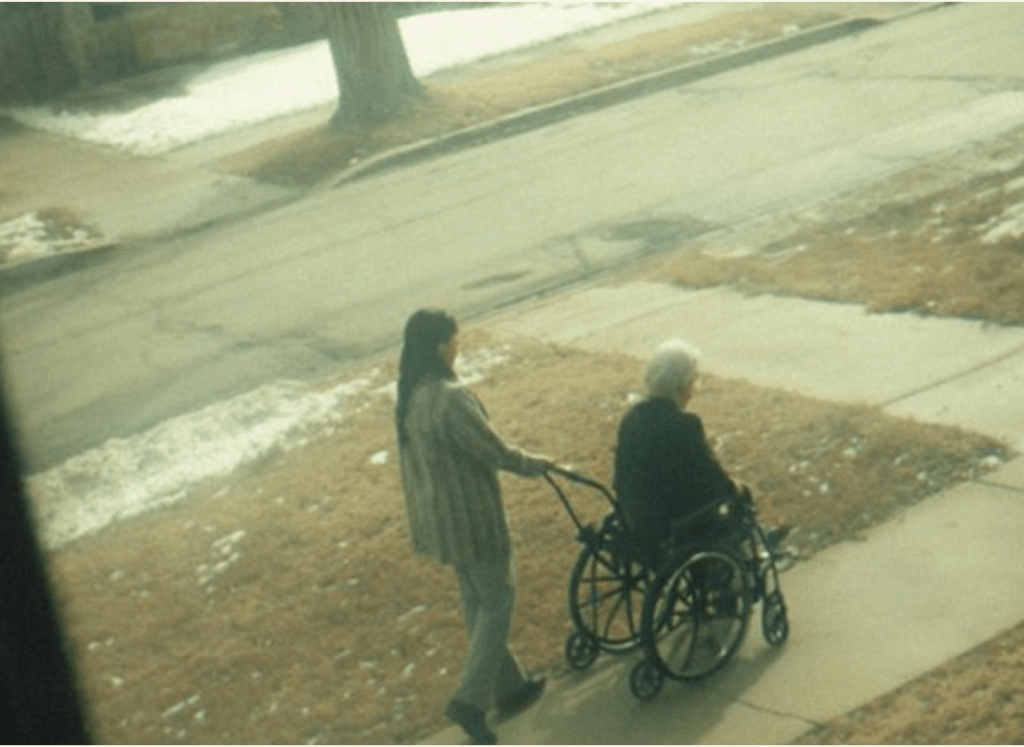
In our small town, everyone knew she was rich, yet she curiously picked the cheapest oatmeal in the store.After the spinal fracture, the hospital social worker gently suggested hiring a caregiver. Mark and I couldn’t always be available; our own lives and our children’s lives needed attention.
My mother didn’t need constant supervision – just someone to help with daily movement, medication, meals, and safety.That’s how Alisa arrived.26 years old, gentle smile, calm voice, light-blue uniform, sneakers – all signs she was ready for the job. She brought a thick folder,
sat at the kitchen table, and extended her hand.“I’ve prepared a sample care plan based on your mother’s medical documents,” she said. “We can fine-tune it together moving forward.”My mother’s eyes lit up. “Seems like she’s organized,” she whispered later. “I like her.”
Alisa asked smart questions, listened attentively to my mother, didn’t force anything, didn’t act childishly. Her references were clear. She lived fifteen minutes away and had a certified nursing qualification. It felt like our prayers had been answered.
The first weeks were perfect. Real, wholesome meals, medications correctly administered, physical therapy done carefully so that my mother didn’t get dizzy or uncomfortable. The neighbors liked her, and most importantly, Alisa’s energy was clean – she even dusted the tops of picture frames,
likely untouched for the last twenty years.But something changed.The first signs were slow. After walks, my mother seemed tired, her face wore a heavy, forced smile, and her heart carried something heavy.“How was your walk?” I asked.
“It was good, dear,” she said.But the words repeated themselves, every week in the same tone. By the fourth or fifth walk, I felt a strange knot in my stomach.It became clear that something serious was happening. One week, when they returned, I saw Alisa’s hand resting on my mother’s hip,
her eyes red and swollen. Not just tired, but exhausted.“The walk wore me out,” my mother whispered, heading straight to her room.Alisa looked at me with a calm smile. “Everything went fine. We went slowly.”Mark was already in bed. I sat with a cup of tea and opened the app to check the doorbell video.
The scene on the recording washed over me: my mother’s voice trembling, Alisa’s voice calm, low.“She’s not ready yet,” Alisa said. “We need to wait a little.”“No, enough waiting. She deserves to know,” my mother told her daughter.
The recording ended.Life had fractured in a way I couldn’t have foreseen. Yet now I feel that not every crack signals the collapse of the world – sometimes a crack simply gives someone the chance to enter.