The first morning Norah arrived, her steps were almost silent on the marble floors, a hush that seemed to bow before the weight of the house. She knelt beside Arya’s bed the way one kneels for something fragile and scared.
Arya stretched out the tiny fingers she could muster, brushing them against Norah’s knuckles—a contact so light it might have gone unnoticed. Yet in that instant, something unspoken sparked between them, a fragile tether of recognition.
Rowan, standing in the doorway, felt his face slacken, a pulse of something he hadn’t felt in years: the ache of being truly seen. “You can start Monday,” he said after a brief but precise conversation, the kind that cataloged assets, risks, and value.
“We’ll pay—” “Not for me,” Norah said softly. “For her.” Her smile carried no pretense, no plea. Just honesty. Rowan hired her because he trusted what had ignited in his daughter’s eyes when they met Norah’s.
Norah took up residence in the modest, book-lined nanny’s room and began the meticulous, patient work of noticing what others overlooked. She observed patterns: how Arya’s color drained when lying in bed, only to return, faintly, when Norah wheeled her through the sunlit walled garden;
the tremors that ran through her small limbs upon waking, as if from nightmares; the uneven rhythm of her breathing at certain hours. No matter how clean the room appeared, it retained a heaviness the others did not.
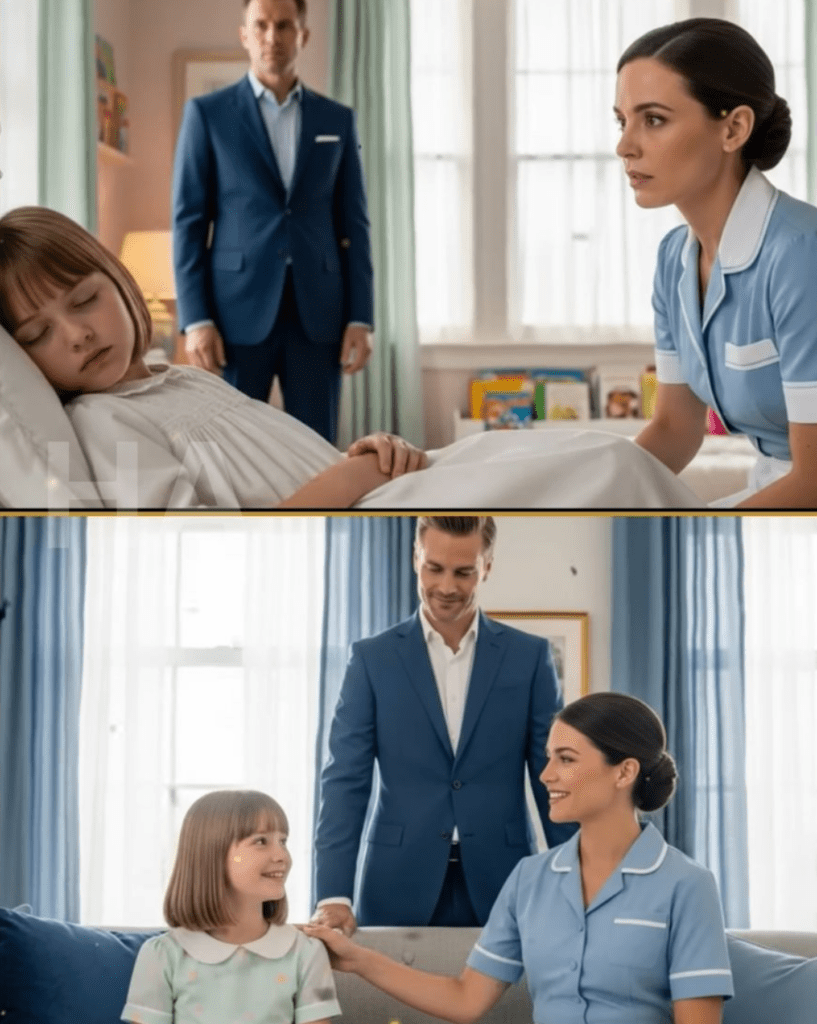
Norah told herself these were the small attentions that belonged to a nanny’s heart: a quiet ledger of observation that, when woven together, became intuition. She changed the sheets, even when they seemed unsoiled; pulled curtains wide to welcome sunlight; removed wilted flowers whose petals carried grief; rearranged toys and trinkets with a subtle precision.
Yet Arya’s fragility persisted. “Maybe another specialist,” Rowan suggested one day, perched on the arm of Arya’s bed, trading hope for a new consultation. “And if there isn’t?” Norah asked gently. “Have you tried… looking under the bed?” Rowan stared.
“Under the bed?” “Children tuck away things,” she said. “Sometimes fears. Sometimes… what makes them sick isn’t something medicine can touch.” He nodded, not fully believing her, but the alternative—doing nothing—felt unbearable.
When she finally reached beneath the bed, dust and lost ribbons gave way to an old wooden chest. Time had cracked it along a seam; varnish peeled; a faded ribbon clung to its latch. Inside, the contents were meticulously arranged:
a black-and-white photograph of a stern woman, a rusted locket, dried herbs, an old rosary, and brittle parchments that hissed under her fingers. Norah held it up to the light. The photograph was of Maureen Volmont—Rowan’s late mother-in-law, a woman who ruled with fear and scorn, whose wrath had lingered long after her death.
When Norah lifted the rusted locket, Rowan’s face went pale. “She used to… place things,” he muttered, voice raw. After Ellen’s death, his wife, Maureen had attempted protective charms for the infant Arya. But in grief, anger, and rationality, Rowan had cleared the house of superstition.
He had assumed the staff obeyed. “Someone replaced them,” he said now. “But who? And why?” Norah studied the parchments—careful symbols, strange scripts, faded ink. A recipe? A plea? They were layered with intention, yet foreign in their purpose.
She placed them beside Arya, sunlight pooling across the child’s pale, fragile face. “You should sleep elsewhere tonight,” Norah said, not asking permission. Some urgencies did not wait. That night, Arya slept in the guest room, her breath steady, hands relaxed.
For the first time in months, the child was free from tremor, from shallow gasps. Norah remained nearby, vigilant yet calm. Days passed, and Arya bloomed in small increments: pink returning to her cheeks, laughter spilling over goldfish ponds, small walks through the garden with Norah’s guiding hand.
Rowan abandoned consultations. Hope became a quiet presence, not a contract. But peace was fragile. “Someone did this on purpose,” Rowan said, brittle and measured, holding the photograph. “Not protection. Malice.” Norah sought quietly, asking questions of staff and servants.
The house had a thousand small, shifting loyalties; no one admitted interference. Only Tomas, the gardener, offered hints: a younger housekeeper named Lila had carried parcels for Maureen’s rituals, perhaps unaware of their dangerous potential.
Norah discovered Lila months later, in a laundromat by the docks, folding sheets with care, a baby cradled to her chest. “Why?” Norah asked softly. “I thought I was helping,” Lila whispered. “I didn’t know it would make her sick. I acted alone.”
“You didn’t mean harm,” Norah said simply. “But it happened. You can help fix it.” Lila returned to the house humbly, learning new ways to care without tethering. Arya thrived, petals of her spirit unfurling gradually, each morning warmer than the last.
The chest’s dangerous elements were archived; the household reshaped itself, learning to move with openness and attentiveness. Rowan learned presence, patience, and humility. Norah remained the quiet force who knelt, looked, and acted. Years later, at Arya’s graduation, she introduced Norah to her friends as “my Norah,” a title of reverence and love.
Rowan watched, realizing the wealth of presence outweighed all the fortunes he had amassed. The chest, the papers, even Maureen’s shadow became a lesson: small acts of courage—kneeling, looking, seeing—could restore life where wealth and power had failed.
The house no longer whispered secrets. It sang with care, laughter, and attention—the quiet, ordinary miracle of being present.