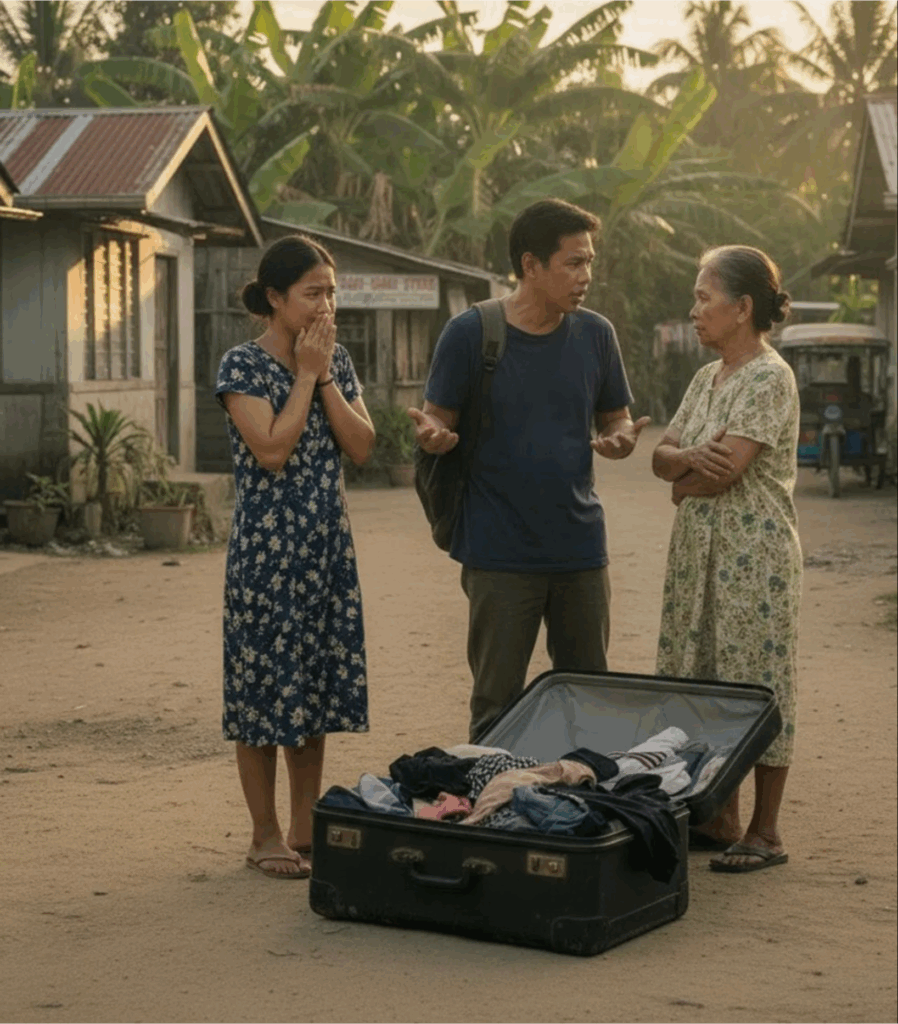
For years, she made me feel that I would never be good enough for her son. So I assumed that after her death, she would forget about me. But an unexpected condition in her will changed everything.They say funerals bring out the best and the worst in people. In my case, it was mostly the worst.
It was a gray Tuesday morning, and I stood at the entrance of the church, arms crossed, while an endless stream of black coats and solemn faces passed by. My husband, Eugen, stood silently beside me, tense, eyes fixed on the casket as if trying to hold every moment for eternity.
Since his mother’s death a week ago, he had barely spoken. I couldn’t blame him. Grief weighs heavily, and his was quiet, suffocating, like an invisible anchor.His older brother, Mark… that was a different story. He stood in the front row, dabbing at the corners of his eyes with a monogrammed handkerchief,
yet he couldn’t hide his smug grin. You could almost see the calculations going on in his mind: stocks, bonds, the Connecticut estate, Susanna’s carefully curated collection of antiques.I wanted to feel something. Not grief—that had long gone—but at least a pang, a prick of the heart. Something that would touch me.
I searched for a moment, a memory of Susanna, where she might once have been kind to me. But it was like trying to draw warmth from stone.From the moment we first met seven years ago, she had made it clear I wasn’t welcome. I remember that first dinner vividly:
sitting at her massive dining table with a cup of chamomile tea in hand, her sharp words cutting through the room:“You will never be part of this family, Katja. Truly not.”At the time, I thought she was just trying to protect her son. But her hostility never ended.
She even tried to dissuade Eugen from marrying me the night before our wedding. That was Susanna.“I just don’t understand why she hated me so much,” I whispered to Eugen as we left the church.He didn’t look at me immediately. “She had a hard time with everyone, Katja. It wasn’t just you.”
I nodded, though we both knew it wasn’t entirely true. Being difficult was her norm. But with me, it always felt personal. As if I embodied everything she feared.And now she was dead. On the drive home in the black car, I forced myself not to speak ill of her.
She was gone. Whatever hostility had flowed between us—was gone with her.Three days later, the phone rang.“Mrs. Carter? This is Alan, Susanna’s lawyer. We would like to invite you to the reading of the will on Friday at 11 a.m.”I blinked. “Me? Are you sure? Usually only family is invited.”
“You are mentioned in the will, Mrs. Carter. Your presence is required.”I hung up, more confused than anything else. I didn’t want to go. Why should I? Susanna had never considered me family. I was an unloved daughter-in-law. But Eugen wanted to attend.
When I told him about the call, he gently placed his hand over mine:“Come with me. Please.”The lawyer’s office was in one of those glass towers downtown, with too many elevators and a receptionist who looked like she had just woken up. We were led into a conference room with a long,
polished table and soft leather chairs. Mark was already there, loudly talking on the phone about his golf plans.I sat next to Eugen, hands clasped in my lap. Alan, a slightly stooped man in his sixties with a calm voice, opened a thick folder and cleared his throat.
“The will of Susanna will be read,” he began, “in the presence of immediate family and all concerned parties.”Mark seemed unable to sit still with excitement. I could almost see the dollar signs flashing in his eyes.The first part was dry: legal formalities, funeral instructions, charitable donations.
Then Alan paused, looked around, and continued:“And to my daughter-in-law Katja…”I didn’t process it immediately. Wait. What?Alan repeated it slowly and clearly:“All assets, her estate, and her millions go to Katja.”Silence. At first, I thought maybe he meant another Katja.
But then I felt the gazes on me.Eugen turned to me, eyebrows knit. Mark leaned forward, his face turning incredulous red.“What did you just say?”Alan remained calm. “The fortune goes entirely to Mrs. Carter, that is, to Katja.”My heart raced. My name. Not just any name—mine.
And then the blow. Alan raised a hand:“There is a condition.”My stomach twisted. A “condition”?“What kind of condition?” I asked, hesitantly.Alan opened a page, expression unreadable:
“It is in a sealed addendum, which I will now open.”
Dead silence. I heard Eugen breathe heavily; his hand found mine under the table, our fingers tightening.When Alan opened the document, I gasped:“The condition is that Katja must adopt a specific child. Only then will the inheritance pass to her.”
“I have to adopt a child?” I whispered, unbelieving. “A specific one?”“Yes,” Alan said plainly.Mark snorted. “This is ridiculous. Why her? Why not us?”Eugen said nothing, his face pale.My hands trembled as I opened the folder. A photo immediately caught my eye:
a little boy, about five years old, soft brown hair, a smile that didn’t quite match his tired eyes.His name was Boris. He lived with a foster family on the outskirts of town.“What does this child have to do with Susanna?” I murmured.
Alan shook his head. “No explanation. Only instructions that the adoption must be completed within four months. Otherwise, the estate will go to charity.”Eugen stormed out of the room as if he might shatter.I didn’t follow immediately. Instead, I took the folder and drove to the foster family’s address.
The little boy, just like in the photo, appeared. Messy socks, a toy truck in his hand. When he saw me, he smiled shyly:“Hi.”“Hi, Boris. I’m Katja.”My heart clenched. A child whose life Susanna had quietly protected for decades.
As I was about to leave, the foster mother handed me an envelope. “Susanna wanted you to have this, but only if you came alone.”I opened it in the car. Susanna’s handwriting: sharp, precise.Inside, it said that Boris was Eugen’s son—a child Eugen had refused five years earlier
—and that Susanna had chosen me because she knew I could give love where he had failed.Tears ran down my face. For the first time, I felt more than grief or anger. I felt life. I felt purpose.Two months later, I filed for divorce. Four months later, I adopted Boris.
And for the first time, I felt whole.I had found maternal happiness. I had found peace.And strangely… gratitude for the woman who had once hated me. Because in the end, Susanna had given me the greatest gift of my life: my son.