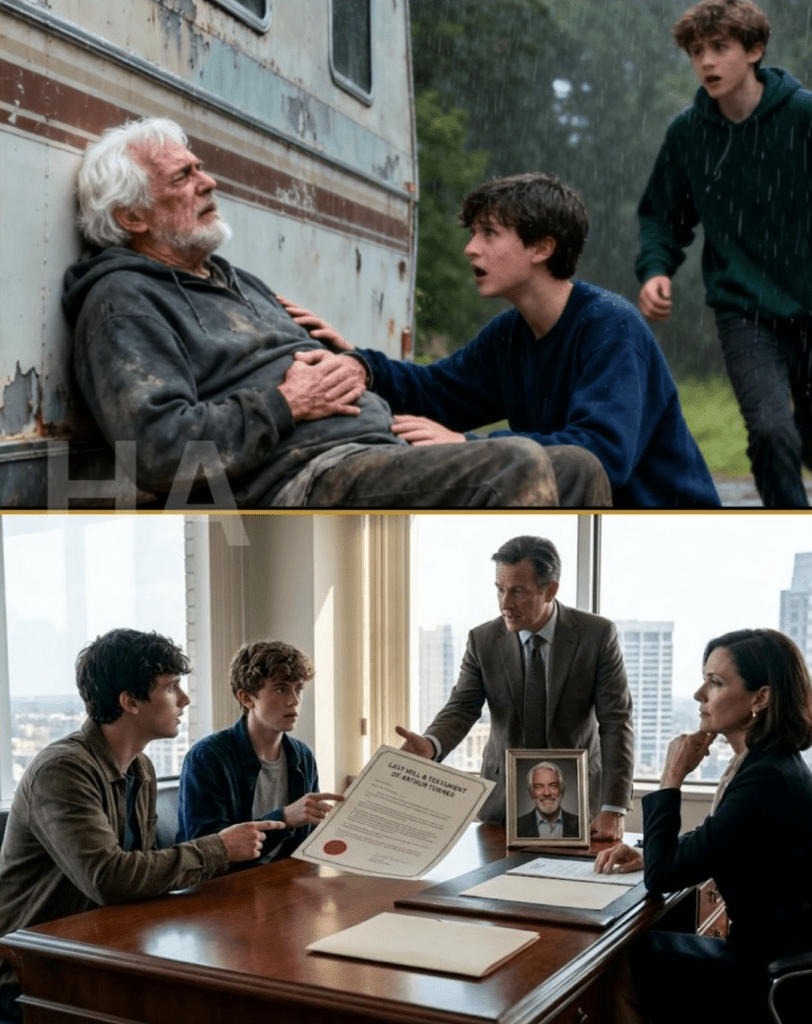
They followed him around a bend, wading through overgrown grass and puddles that reflected the gray sky, until they reached a rusted trailer leaning precariously to one side. Its windows were crudely patched with cardboard, the roof sagged under years of neglect, and the door clung to its hinges as if by sheer will.
“You… live here?” Mason whispered, disbelief etched across his face. Mr. Turner nodded, cheeks flushed with embarrassment. “I’m sorry you had to see it like this.” “You don’t need to be sorry,” Ethan said softly, a calm steadiness in his voice.
“I wanted… to repay you,” the old man stammered, fumbling for his wallet. It was empty—no bills, not even a single coin. With trembling hands, he picked up a lone apple from the battered table inside and extended it toward them. “It’s all I have.
” Mason shook his head. “We didn’t help you for this.” Ethan gently placed the apple back on the counter. “Keep it. You might need it more than we do.” The old man’s eyes glistened. And in that moment, none of them knew just how far this tiny gesture of kindness would echo—returning to them in ways they could never imagine.
The Visits The next morning, the boys met at the same road. “You thinking what I’m thinking?” Ethan asked, excitement sparking in his eyes. “Yeah,” Mason said. “Let’s do it.” Pooling their saved lunch money, earnings from odd jobs, and the few dollars their mothers had insisted they keep for emergencies,
they bought groceries and basic supplies: rice, canned vegetables, bread, and scraps of fabric to patch the windows. Mason borrowed tools from his neighbor’s shed. That afternoon, they knocked on Mr. Turner’s door. The old man cracked it open cautiously.
When he saw the drenched boys, arms heavy with groceries, he froze. “W-What is all this?” “Just a few things,” Ethan said awkwardly. “For your trailer,” Mason added. “And for you.” The bags were overflowing, handles straining under the weight.
“I… boys, I can’t accept—” “Yes, you can,” Mason said, grinning. “We brought too much food. We’ll get in trouble if we take it back home.” It was a small lie, but it felt necessary. Tears welled in Mr. Turner’s eyes. “Why… why would you do this?” “Our grandma always said,” Ethan whispered, “‘Love isn’t love unless you give it away.’”
The old man pressed his lips together, trying to steady himself. “May I… may I hug you?” The embrace was tentative but full of gratitude. That day became the first of many visits. Twice a week, sometimes more, the boys returned.
They patched the trailer, fixed the roof, replaced the cardboard with real glass Ethan salvaged from a junkyard. Mason dug a small drainage ditch so the home wouldn’t flood. Sometimes they cooked together. Other times, they simply talked.
Mr. Turner told stories—not about money, which he had little of, but about life, mistakes, regrets, and lost opportunities. “You know,” he said one evening, “a great man does the right thing… even when no one is watching.” Mason grinned.
“Sounds like a quote you stole.” “No,” Turner chuckled. “That one’s mine.” Ethan asked quietly, “Were you a teacher?” “No,” Mr. Turner said softly, almost ashamed. “But I wish I had been.” They laughed, they listened, they learned.
Slowly, Mr. Turner wasn’t just a lonely old man anymore—he was family. The Disappearance Spring arrived, bringing thawed soil and blossoming trees. Ethan and Mason approached the trailer with their usual cheer, a basket of fresh fruit swinging between them.
“Mr. Turner?” Ethan called. “We got strawberries today!” No answer. Mason knocked again. “Mr. T? You in there?” Silence. When Ethan pushed the door open, the trailer was empty. No blankets, no clothes, no food. The air was cold, stale. “Where… where did he go?” Mason whispered.
They asked neighbors. Searched the woods. Checked the hospital. Called the police. No one had seen him. “He’s old,” one officer said flatly. “People wander sometimes.” “But he wouldn’t leave without telling us!” Ethan shouted, fury and fear lacing his voice.
Days turned into weeks. Hope faded. Even when everyone else gave up, the boys still visited the empty trailer, sometimes leaving food on the step, sometimes just sitting in silence. He never returned. The Call Two years passed. The boys turned eighteen.
They graduated high school with honors but had no money for college. Ethan worked at the grocery store; Mason coached Little League on weekends. They still passed the old trailer sometimes. It remained empty, quietly shrinking into the earth.
Then one morning, Ethan’s phone rang. “Hello?” “Is this Ethan Wells?” “Yes.” “My name is Jonathan Reed. I’m the attorney for Mr. William Turner.” Ethan froze. “Mr. Turner? You found him?” “I’m afraid…” The lawyer hesitated. “Mr. Turner has passed away.
I need you and Mason to come to my office.” The world tilted on its axis. They told Mason. Both boys sat in stunned silence, grief rising like a tidal wave. Later that afternoon, they entered a small law office. A man in a suit greeted them. “Ethan. Mason.
Thank you for coming. Please, sit.” Jonathan Reed placed a sealed envelope on the table. “I’m sorry to tell you… Mr. Turner died two weeks ago. He’d been sick for some time.” Ethan swallowed. “He never told us.” “He didn’t want to worry you.”
The lawyer slid the envelope forward. “He left this for you.” Ethan’s hands shook as he opened it. Mason leaned in. Inside was a letter, written in careful, trembling handwriting: “My dear Ethan and Mason, If you are reading this, I am gone.
I am sorry for disappearing. I did not want you to see me suffer. For most of my life, I lived with wealth but without love. My family cared only for money, not for me. I left it all behind, choosing a simple life in that trailer. Loneliness was my companion… until you came.
You brought me groceries, laughter, warmth, and dignity. You made an old man feel human again. You became the grandsons I dreamed of but never had. I leave you what I can. Use it to chase the life you deserve. With all my love, William Turner” Ethan wiped his tears.
Mason whispered, “We didn’t do this for money.” “I know,” the lawyer said. “That’s why he trusted you.” He opened a folder. “Mr. Turner left each of you $150,000.” Ethan gasped. Mason’s jaw dropped. “That’s impossible,” Mason said. “He was poor.”
“Not entirely,” the lawyer explained. “He abandoned his wealth but kept a portion in trust. Enough for college. He wanted you to become the teachers you dreamed of being.” Silence fell. Then Ethan said softly, “We’ll make him proud.”
Three Years Later Brookdale Community College’s auditorium overflowed with families and students. Graduation caps dotted the room like black petals in the sunlight. Among them, side by side, were Ethan and Mason—now twenty-one, stronger, calmer, but with the same gentle spark in their eyes.
As they crossed the stage to receive their teaching credentials, a warm sensation filled the air. Something familiar. Something like a blessing. After the ceremony, they drove to the old forest road. The trailer still stood, slowly surrendering to time.
Ethan placed a hand on the rusted door. “We made it, Mr. Turner.” Mason smiled through tears. “Hope you’re watching.” They left a bouquet of wildflowers on the step and walked away, quietly, peacefully. Five years later, Mr. Turner’s name returned—not in grief, but in celebration.
The boys, now beloved teachers at Brookdale High, created The Turner Scholarship Fund for underprivileged students. Each year, it helped someone in need. Someone like them. Someone who needed a little kindness. One evening, as Ethan locked his classroom, a nervous freshman approached.
“Mr. Wells? Did you really start a scholarship for people like us?” “Yes,” Ethan said gently. “Because someone once believed in me… when he didn’t have to.” The student asked, “Why?” Ethan smiled. “Because a great man does the right thing… even when no one is watching.”
And so Mr. Turner’s words lived on. Across years. Across lives. Kindness had become woven into the very heart of Brookdale. All because two boys once stopped in the rain… to help a stranger who became their family.