The cake was a three-tiered monument to everything my mother valued—perfection, presentation, public applause. Pink rosettes spiraled up the sides like delicate armor, frosting sculpted with the meticulous care of a master artisan. Across the glossy blue top, letters spelled out, “HAPPY 10TH BIRTHDAY,
REED!” in a way that demanded admiration, attention, approval. Every eye in the barn followed as my mother set the cake down on the table. Everyone, that is, except Finley. She stood near the end of the line, small and patient, clutching her plastic fork like it could shield her from the world.
She was trying so hard to exist in a space that had never really made room for her, to breathe among the smiles and camera flashes that my mother seemed to scatter like confetti. Her shoulders tensed slightly, and I could see the way she shifted from foot to foot, as though the very act of standing there was an achievement.
Mom picked up the knife, her fingers curling around the handle with the same precision she used when pruning rose bushes. One slice for Reed, who beamed as the camera shutters clicked. One for Daisy. One for Colin. One for Spring. Then the other cousins. The neighbors. Kids from school.
The knife glided through frosting and cake alike, each cut ceremonious, deliberate. Her hand was so steady, so unyielding, that it might have been carved from the barn’s own timber beams. Finley’s eyes followed the movement, bright with hope. She waited. She clutched the plastic fork as if sheer will could make her included.
I saw it before it happened. That subtle flick of my mother’s gaze to Finley, the way it slid away so quickly. The tension in her jaw. The cold, mechanical click of her eyes—the moment when indifference became a weapon. She skipped my daughter’s plate.
Simply lifted the knife and angled her wrist toward the next child in line. “She shouldn’t be here,” she said. Five words, soft and flat, but sharp enough to slice through the air, through the barn, through the fragile hearts of everyone standing in that line. The words fell, and the barn went silent.
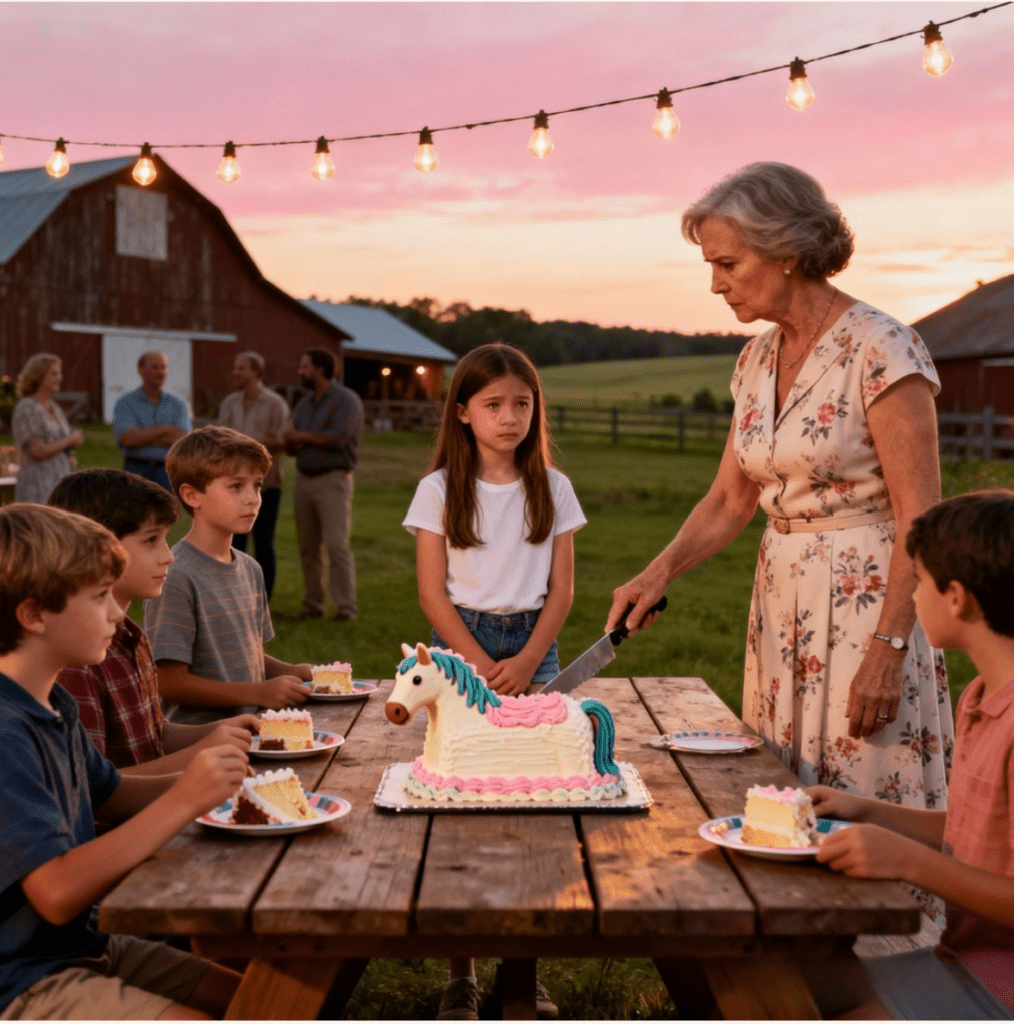
The kids froze mid-sugar-frenzy, their laughter and excitement evaporating. Even the horses outside stomped as if they sensed the shift, the tremor of cruelty that rippled through the moment. Finley’s face crumpled. Her small body sagged under the weight of nine years of hope,
nine years of believing that being good, being kind, being patient, would someday be enough. I didn’t think. I didn’t breathe. I just moved. I took her trembling hand, gently slid the fork from her fingers, and whispered, “Come on, sweetheart.
” She let herself be guided, fragile as spun sugar, and we walked past the hay bales, past the glowing string lights that flickered in mock celebration, past the people who pretended not to stare, past my father, whose face fell into something like guilt but not nearly enough to stop us.
I didn’t look back. Not at my brother. Not at the cousins. Not at the barn. Not at the woman who decided, in a single breath, that my daughter—my brilliant, gentle-hearted Finley—didn’t belong in her family. Outside, the sunlight struck us like a benediction.
Warm and forgiving, it wrapped around us, a shield against the bitterness that lingered inside the barn. I buckled Finley into the car, her cheeks streaked with tears, her breath hiccupping in uneven waves. “Did I do something wrong?” she whispered, her voice tiny and uncertain.
“No,” I said, steady even as my chest felt like it might shatter. “You didn’t do one single thing wrong.” We drove away in silence. The barn receded in the rearview mirror, shrinking to nothing but a memory, a place where cruelty had masqueraded as tradition.
The sky over Boise stretched wide and forgiving, an expanse of blue that promised safety beyond our immediate world. By the time we reached the city limits, Finley had fallen asleep, her hand still clutching the stuffed horse on her lap, and I felt a strange, aching relief.
I didn’t cry until I pulled into our parking lot. The night had been a blur of movement and whispered reassurances, but now the dam broke quietly inside me, tears soaking into the upholstery, into the soft curls of her hair as she slept. The next morning, my phone buzzed.
Her name lit the screen. Mom. I let it ring. Once. Twice. On the third ring, I answered. “Heather,” she said, voice tight and brittle, the way it always sounded when she realized her control had slipped. “Please… don’t do this.” I glanced down at Finley, curled beneath her galaxy-print blanket on the couch.
Something inside me locked into place, unyielding and absolute. “Oh,” I said softly. “I’m not doing anything.” For the first time in my life, I truly meant it.