At sixty-seven, Gail finally carved out a slice of peace for herself. After decades of labor, loss, and quiet endurance, she had escaped the relentless chaos of Chicago for a Montana ranch. Sixty acres of rolling grass, wildflowers, and stubborn horses,
punctuated by a red barn and a white farmhouse, became her sanctuary. It was the life she had dreamt of: mornings filled with birdsong and the smell of fresh hay, afternoons spent repairing fences or riding across open fields,
and evenings watching sunsets stretch across the sky like molten gold. Here, grief had room to breathe, and she had space to grieve without judgment or interruption. Here, she had control. Here, she was free.
Then Scott called. Her entitled son’s voice crackled through the phone, carrying the unmistakable arrogance that had defined his adulthood. Without asking, without consulting, he told her that he, his wife Sabrina,
and eight of Sabrina’s relatives would be descending on her ranch for a weekend “family gathering.” And if she found it too much, if she couldn’t “handle it,” he suggested she abandon her sanctuary and return to the city. Chicago.
Like the city could soothe the wounds of decades of loss, like the skyscrapers and traffic would somehow erase the years of hard work and memories carved into every corner of her land.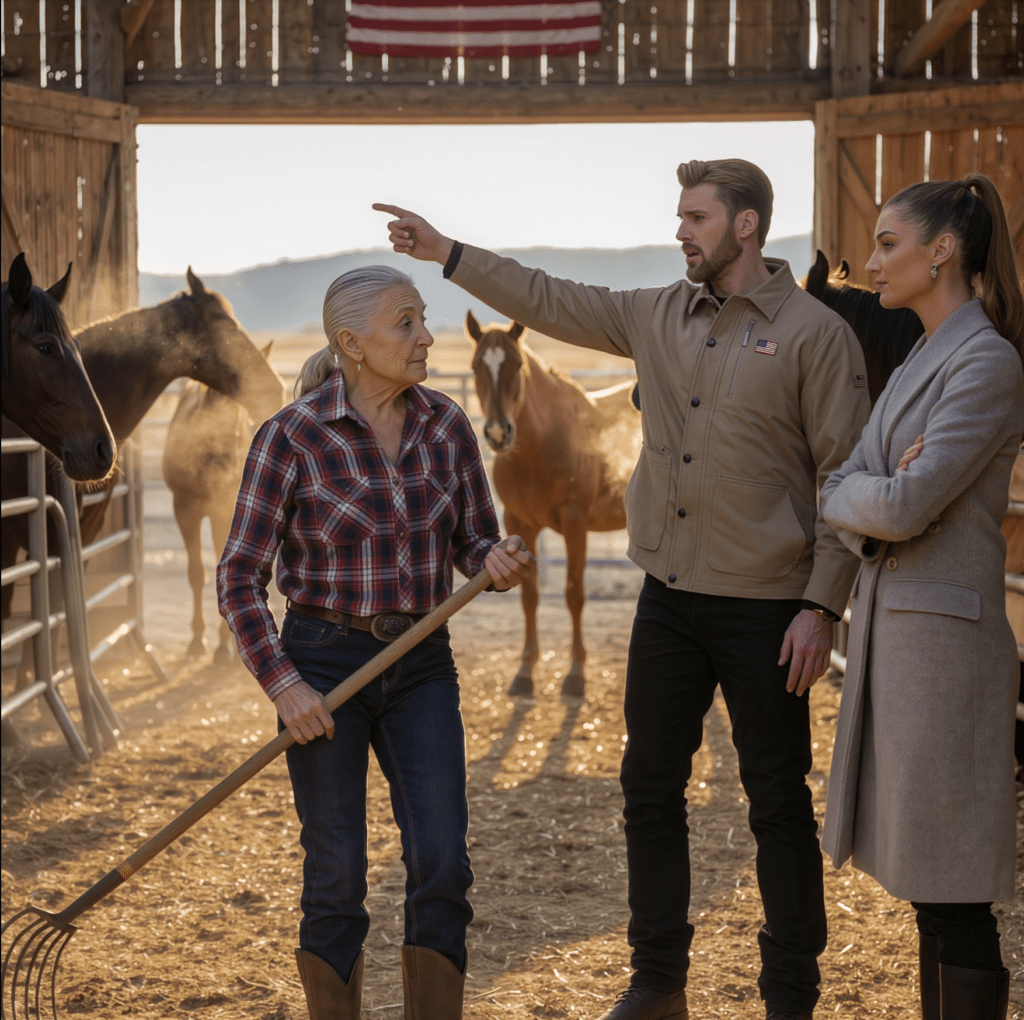
The words struck her like a slap, and the heat of indignation boiled through her veins. Years of being underestimated, ignored, and belittled had taught her patience, but not passivity. She would not be bullied on her own land. Not now. Not ever.
Gail spent the next two days plotting with the meticulous precision of a woman who knew her property better than anyone. She invited her best friend Ruth to the Four Seasons in Denver, promising them both a weekend of champagne,
laughs, and a front-row seat to chaos. Then she turned her attention to the ranch. Everything had to be perfect—just not in the way Scott expected.
She stripped the guest rooms of luxury linens, replacing them with scratchy blankets that squeaked when tossed aside. The thermostat, normally a silent guardian of comfort, was rigged to make the temperature swing unpredictably.
The pool, meant for sun-soaked leisure, was transformed into a murky swamp, complete with frogs that croaked their disapproval at any human intrusion. And the house’s final surprise: the three horses were released from their paddocks and allowed to roam freely,
their hooves clattering against polished floors, their nostrils sniffing at every corner like inspectors of chaos.
When everything was set, she and Ruth drove away, settling into the plush embrace of the Denver suite with glasses of champagne in hand. They watched as Scott and his entourage arrived, stepping onto her property as if entering a five-star retreat.
Designer shoes sank into thick mud. Expensive jackets brushed against hay and manure. They shrieked when the horses wandered into the living room, tipping a vase or two in their path. The Wi-Fi, locked behind a password only Gail knew, rendered smartphones useless. Their panic was cinematic.
Sabrina screeched when she realized the pool was no longer a crystalline oasis but a green, frog-infested mess. One of the relatives, a man whose shoes had cost more than Gail’s first car, slipped into the mud, letting out a wail that echoed across the fields.
The chaos was perfect, orchestrated with the skill of a conductor leading a symphony of disaster.The next morning, the crescendo began. At 4:30 a.m., Gail’s pre-programmed rooster alarm shattered any remaining illusions of serenity.
The sleep-deprived guests stumbled from their beds as hungry horses, pigs, and an aggressively loud rooster demanded breakfast with all the authority only farm animals possess.
A laminated note on the counter welcomed them to “real ranch life” and instructed them to feed the livestock before thinking of coffee, showers, or complaining.
Meanwhile, Gail sat at a marble table in Denver, savoring croissants, coffee, and the rare delight of feeling utterly untouchable. The city could wait. The guests could panic all they liked. She had reclaimed her peace.
By mid-morning, Scott came to her, shoulders slumping, eyes filled with the dawning horror of understanding.He flinched as if she had slapped him.The room fell silent except for the soft hum of the air conditioner—the quiet sound of comfort returning to its rightful owner.
“Mom…” he whispered, almost pleading.“No.” Gail raised a hand, stopping him cold. “You don’t get to ‘Mom’ your way out of this.”
He looked down, shoulders curling inward, a posture she recognized all too well—the same one he had as a boy when he’d lied about breaking a neighbor’s window. But he wasn’t a boy anymore. He was a grown man who had tried to break his mother.
“I messed up,” he admitted finally.“Correct,” she said, her voice steady, unflinching. “Spectacularly.”He swallowed hard. “I didn’t understand. I… didn’t want to. I thought this place was some sentimental project you were clinging to.
I didn’t realize how much work it takes. How much Dad carried. How much you carry. I thought it was too much for you.”“It is too much sometimes,” she said, folding her arms. “But it’s my too much. My home. My life. My joy. My grief. My work. My peace. Not yours to sell.”
Tears glimmered in his eyes. “I’m sorry.”This time, he meant it. For the first time in years, his apology carried weight.Gail nodded once. “Good. Now the real question is what you’re going to do about it.”
Behind him, the rest of the family stood like guilty statues, dusty, smelly, exhausted—and finally quiet. Blessedly quiet.“You’re all welcome here,” she said, sweeping her gaze across them, “but as guests. Not colonizers. And certainly not consultants.”
No one dared move. No one dared breathe too loudly.“Well,” she said, clapping her hands, “coffee’s almost ready. Showers are down the hall. Fresh towels too—if you don’t mind folding them yourselves. And once you’re cleaned up…”
They waited, suspended between hope and dread, unsure if she meant punishment or mercy.“…you can help me fix the mess.”Madison blinked. “What… mess?”Gail gestured broadly at the chaos: muddy floors, manure, tipped vases, panicked animals.
“The mess you made. The mess you didn’t understand. The mess you tried to claim without earning.”Scott nodded slowly. “We’ll help.”“Good,” Gail said. “Because after everything you’ve put this place through, you owe the ranch at least one day of honest work.”
“And after that?” he asked quietly.“After that,” she said, pouring the first mug of hot coffee, “we’ll see.”He accepted the mug as if it were a sacred offering. Outside the window, Napoleon the llama stared in, unblinking, as if judging the universe itself.
“Does the llama have to stay?” Patricia asked weakly.“Yes,” Gail said without hesitation. “He’s learned how to ride the mechanical bull. That earns him certain privileges.”
For the first time in days, someone laughed. Actually, everyone did. Even Gail. The tension broke like a fever, evaporating into the warm Montana morning.
But she wasn’t done. Not yet. Growth requires effort. Redemption is hard. Consequences are labor-intensive. And ranch life—true ranch life—teaches all three.She let them sip coffee, savoring the lessons learned the hard, dusty, llama-assisted way.
Because, after all, she was a fair woman. And she always finished what she started.