🎶 Elegy of an Invisible Star
In the Luminous Halls of the Summit Academy, an elite school perched atop the city’s affluent heights, Élisa Lemaire’s life flowed in a silent, exhausting cycle. A “ghost” scholarship student in a world reserved for the children of billionaires, she was both pupil and caretaker.
At 5:00 a.m., her voice rose in the shadows of the empty auditorium. At 7:00 p.m., she scrubbed floors, invisible to every eye. Her silence, her armor, nourished by her mother’s mounting medical debts, seemed impenetrable.But one word too many, uttered on a Tuesday morning, cracked that armor.
The scene unfolded during Advanced Music Theory class, in a sunlit room. Students, adorned with the nonchalance of the very wealthy, dissected complex compositions. At the back row, Élisa, in her patched uniform, tried to make herself as small as possible.
Mme Évelyne Cartier, head of the department, pointed to the screen projecting “Der Hölle Rache,” the furious aria of the Queen of the Night from Mozart’s The Magic Flute.“This,” she said, sharp as a blade, “is the pinnacle of coloratura soprano. Few professionals can truly master it.”
A hand went up—Charles de Beaumont, heir to “Beaumont Finances.” Tall, arrogant, his name engraved in gold letters on the new gym.“Madame Cartier,” he said, honeyed and lazy, “let’s be serious. No high schooler can sing this. It sounds like a cat in a blender.”
The class erupted in mocking laughter. Élisa felt her blood freeze. But a soft, firm voice rose from the back.Twenty-four pairs of eyes turned. Élisa felt her face burn. She had spoken before thinking.Charles frowned. He didn’t know her name. To him, she was only “the girl who wipes tables.”
“Excuse me?” he said, cruelly amused.“This is not a scream,” Élisa repeated, throat tight but voice clear. “High Fs are not noise—they are the pure rage of the Queen. They must cut, they must hurt.”A heavy silence fell. Mme Cartier regarded her with boredom. Charles straightened, a spark of challenge in his eyes.
He grabbed an old scorebook, tore a page, and tossed it onto Élisa’s music stand like a verdict. The notes seemed impossible, a nightmare for any voice.“Very well,” he sneered, “since you know fury… sing this for the Founders’ Day Competition. In front of the entire school. And I will marry you.”
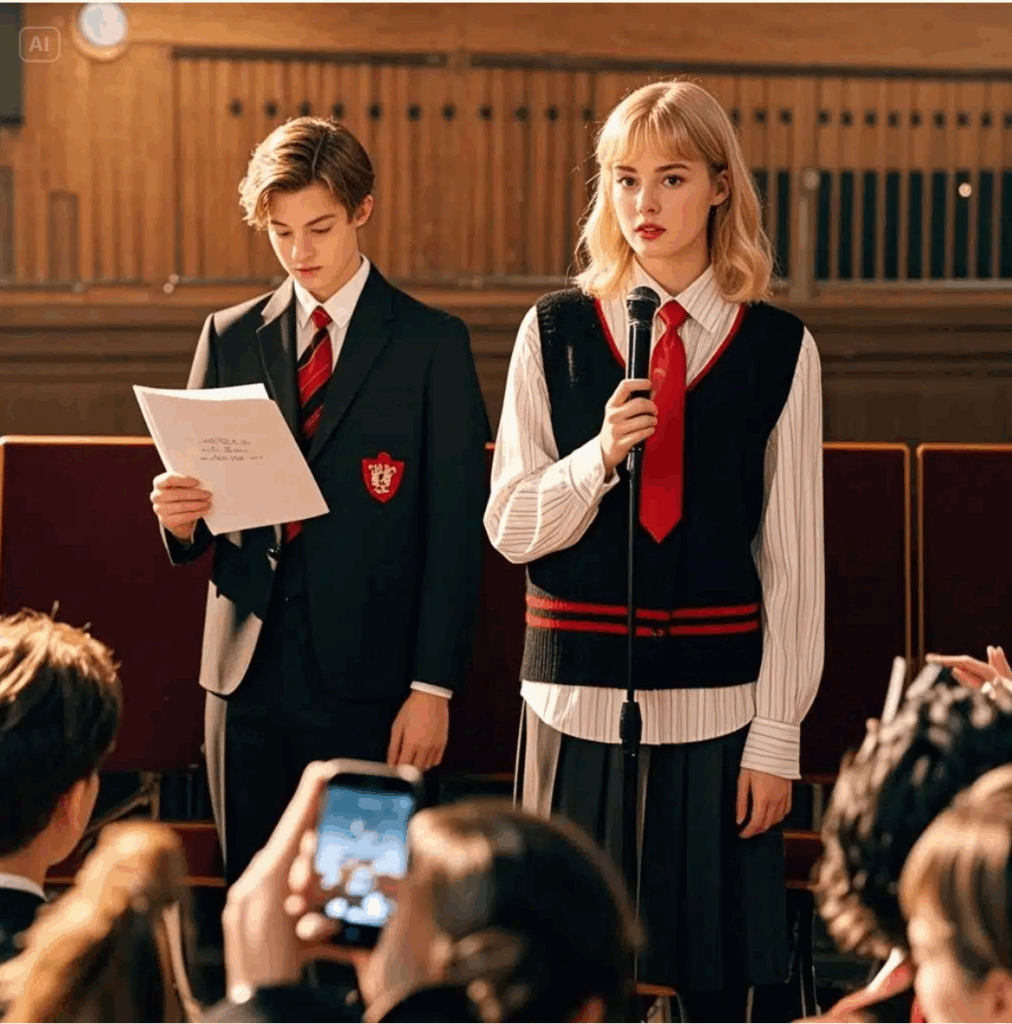
The room exploded. Phones raised, ready to capture the humiliation. Élisa looked at the impossible notes: “Elegy for a Fading Star.”In her small apartment above a dry cleaner, Élisa relived every moment. The chemical smell of the laundry, her mother Sarah’s tired body, the piling medical bills…
The alarm rang at 4:30 a.m. By 5:00, the empty auditorium was her sanctuary. There, her voice, passed down from her grandmother Rose, a former provincial opera singer, made her feel alive.But that night, the “Elegy” score burned in her hand. Humiliation and rage intertwined.
She remembered her great-grandfather, Sergeant Lemaire—a hero. And Rose’s words: “Your voice is a gift, Élisa. Don’t let it be caged.”A cold fury, ready to erupt, surged within her. He thinks I will fail? Very well. She turned on her lamp and deciphered every Hungarian note.
The next day, the competition announced the Patron’s Scholarship—four years at Juilliard. A way out for her, for her mother, for her life. But she needed a professor’s signature. Mme Cartier? Impossible. Only Mr. Dubois remained, an old teacher in the basement, surrounded by dusty vinyls.
“Sing this,” he said after she explained her need. At 5:00 a.m., the empty auditorium became her realm once more. Her voice, raw and powerful, made Mr. Dubois shiver. “How long have you been singing?”Satie’s simple score, “Je te veux,” became her training. The “Elegy” would wait.
Two weeks of hell: scrubbing floors, intensive lessons, sleepless nights. The Hungarian notes screamed pain and loss.One evening, a red letter from the hospital: an impossible sum. Survival was at stake. The Patron’s Scholarship was no longer a dream but a necessity.
🎤 The Concert of Defiance
Founders’ Day. The auditorium packed. Élisa, in her grandmother’s simple dress, clutched the form. Charles de Beaumont was there, uneasy.Brooke de Courcy shone on stage. Élisa trembled, but she remembered the red letter, her mother, Rose. She raised a hand. Silence. She stopped the performance.
“Madame Cartier, Mr. de Beaumont,” she said, voice clear, “a few weeks ago this young man gave me a score… he thought I could never sing it. He was right: it is impossible. But it is the only song I have left to sing.”And she sang. A cappella. Without music.
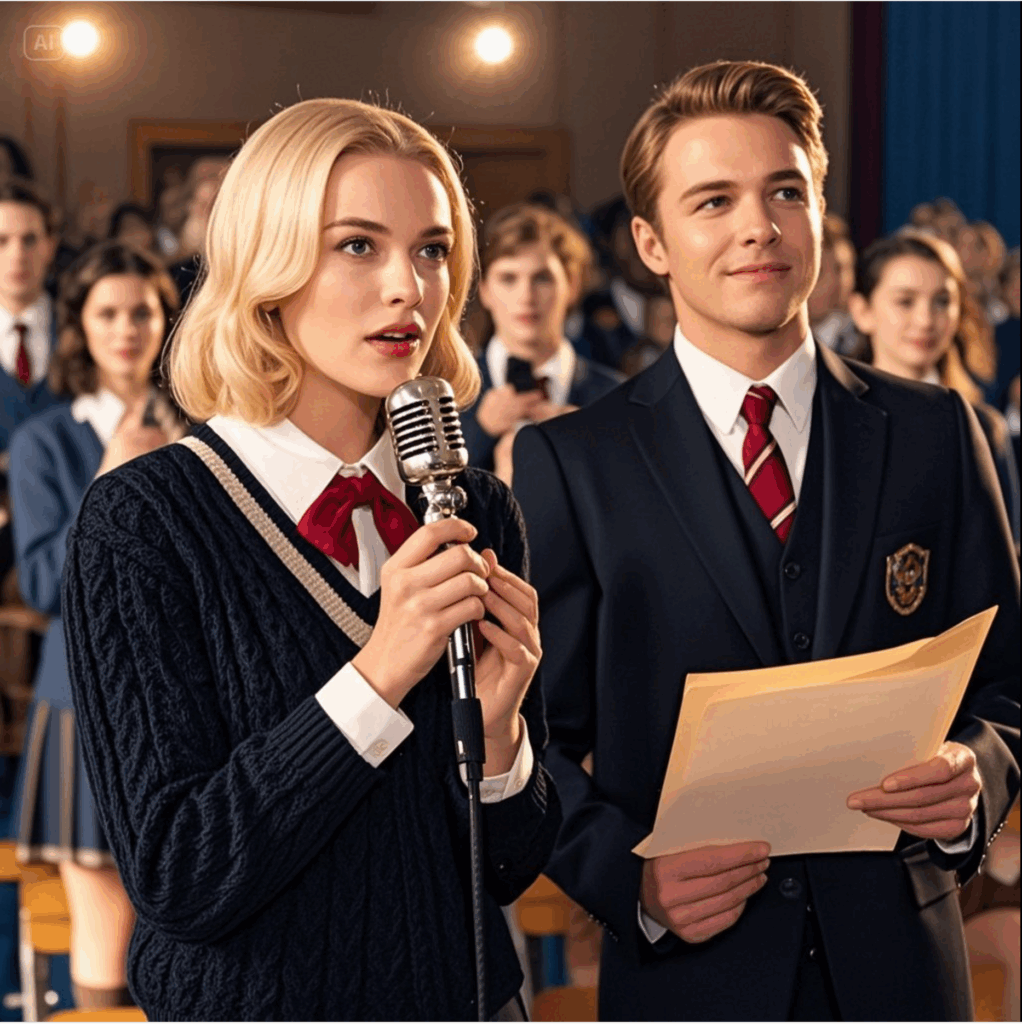
Every note a cry, every breath an exorcism. Rage, loss, pain, pure strength. The entire hall trembled. The chandeliers vibrated. Charles froze. Mr. Dubois, eyes misty, clapped first. Then Charles de Beaumont Sr. stood. And finally, a roar from the entire audience.
Élisa, tears and sweat on her face, was no longer a ghost. She was a warrior.
🕊️ The Heard Star
A week later, the hospital was paid. The Patron’s Scholarship hers. Charles de Beaumont, humble, brought an envelope for her mother, and the torn score.Élisa smiled. “I will not marry you,” she said.“Yes,” Charles replied, with a sincere smile.
She slipped the score into her bag, turned off the light. New York awaited. Her voice, long invisible, would finally be heard.