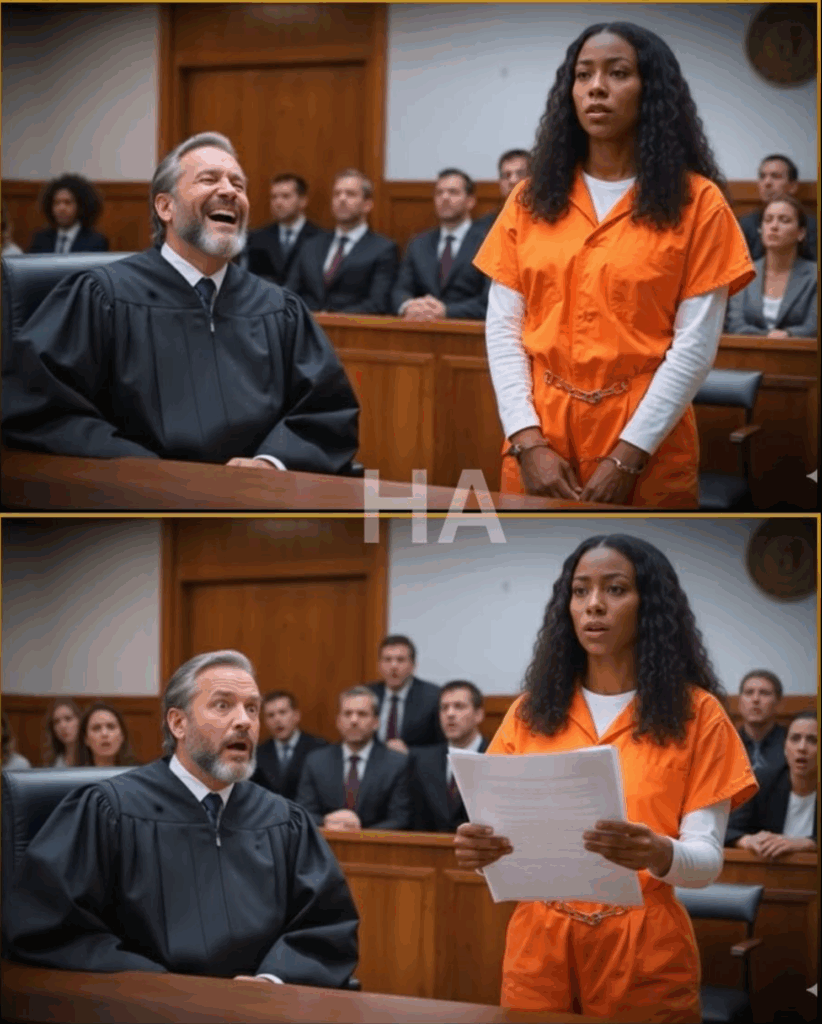
Kesha studied the judge carefully, just long enough to see the blood drain from his face when he muttered a comment he assumed would go unnoticed. “A young woman from Mechanicsville… how many people from her background truly master nine languages?” The words struck like a slap and lingered in the air.
Silence sharpened around them. Cameras clicked, capturing the moment. Marcus Thompson’s smirk stretched into something predatory, aiming at the gallery like a drawn arrow. Kesha’s hands tightened against the cuffs. Her breath evened.
A flash crossed her features—not anger, not fear, but something colder, sharper: the calm of someone tracing a map remembered from a lifetime of survival. Beyond the laughter and smirks, a quiet rhythm beat in her chest—the steady pulse of someone who had learned to turn doubt into fuel.
“You’ve just shown everyone why I am here,” she said, her voice soft but impossible to ignore. “Not because I exaggerated my abilities—but because people refuse to believe that someone like me, without the ‘right’ letters after her name, could hold knowledge they consider precious.
” Dr. Rodriguez’s face softened with relief. The judge coughed nervously, scanning the room, the cameras tracking every flicker. “What I suggest,” Kesha continued, “isn’t spectacle. If this court seeks truth, bring forward the people who evaluated my work.
Let them explain the alleged mistakes.” Marcus Thompson shifted, defensive. “We have experts,” he said. “Experts,” Kesha echoed, a small, sharp smile tugging at her lips. “I would love to meet them. Especially the ones who know Beijing dialects, Moroccan Arabic, or regional Russian idioms.
I’d like to ask them very specific questions about my work.” The judge slammed the gavel, but offered no decision. Cameras, sensing drama within drama, continued filming. Murmurs rippled through the gallery, like a crowd sensing a sudden storm.
An elderly woman in the third row, gray hair tightly coiled, rose slowly. Her eyes met Kesha’s as if recognizing a long-lost portrait. “I know her,” she whispered to a neighbor. Recognition carries its own proof, warmer and truer than any certificate.
The woman stepped forward, urgency in her fingers as she tapped a small screen. Prosecutors floundered in procedure, but a new current ran through the courtroom—people who had seen Kesha teach, translate, and build bridges between languages that left many stranded.
The second hour of proceedings dissolved into administrative pause. Kesha was escorted into a small room, greeted by Dr. Rodriguez, two women, and Mrs. Chun—the elderly teacher. Two others arrived: Daniel Park, a sharp-eyed young man with quick hands on a laptop,
and Dr. Victoria Johnson, a corporate litigation consultant whose presence smelled faintly of order and authority. “You came,” Kesha exhaled, relief and disbelief mingling. Mrs. Chun’s eyes shone. “You’ve always had the ear. Remember Saturdays at the community library?”
At fourteen, Kesha had discovered Mrs. Chun’s free language classes—first Mandarin, then French, then German. In a neighborhood where college seemed a distant island, that battered library room was a world. Kesha patched together study time, late-night translations for immigrant families,
borrowed books, and worn practice tapes pressed into her hands like charms. “We’ve been working,” Daniel said, sliding the laptop toward her. “We tracked complaints, looked for patterns in corporate rejections. You’re not the first.
” Mrs. Chun handed Kesha a thick envelope of handwritten letters—pleas from translators of color discarded after minor technicalities. Dr. Johnson spread photographs: internal emails revealing deliberate filtering of freelancers by credentials, accent, and alma mater.
“It’s not one bad review,” Johnson said. “It’s a system. Accredited houses get the contracts. Independent experts—especially those who undercut fees—are boxed out and then discredited.” Kesha absorbed it, seeing her marginalization exposed in stark relief.
“Three days?” she asked, incredulous. Mrs. Chun took her hand. “Years of stories. Your arrest woke the others.” Back in the courtroom, the atmosphere had shifted. Civic groups and translators from collectives filled benches. Judge Foster attempted to maintain composure, but the day had bent.
“Dr. Morrison?” a voice called. A man in a neat suit approached: James Morrison, former UN ambassador. His briefcase revealed documents stamped by international organizations: letters of commendation, proof of Kesha’s freelance translations for humanitarian missions.
Marcus Thompson protested loudly. “Objection! This man is not on our list!” Morrison’s calm was unshakable. “I have worked with many translators. Miss Williams’ work has appeared in my files. On three missions, her translations were singled out as culturally sensitive and precise.
And these evaluations came from partner organizations—not corporate houses who later rejected her.” The gallery leaned in. Journalists clicked recorders. Daniel allowed himself a small smile. “We have messages and timestamps,” he said. A projection bloomed:
a WhatsApp thread from executives at Global Tech, praising her translation but noting they couldn’t pay freelancers without degrees—then canceled her work. “It could be fabricated,” Thompson muttered, nails white. “Do you speak Mandarin, Mr. Thompson?” Kesha asked.
Irrelevant, he stammered. “Professor Chun,” Kesha said, “read the endorsement.” Mrs. Chun rose, reading the Chinese note aloud, then handed the translation to the court: “This is the most culturally sensitive translation in five years. The translator understands intentions.
We recommend her services.” Dr. Leewi, director at Beijing Trade Corporation, stood. “I wrote that review. Miss Williams saved a negotiation when our delegates misunderstood the wording.” Thompson tried to deflect with “Arabic, Russian, Japanese”—but the evidence crushed him.
Daniel cued an audio recording: a UN CEO admitting they had preferred polished professors over Kesha’s faithful translations. Her versions preserved urgency, tone, and meaning—unlike sanitized “textbook” translations. Handcuffs removed, Kesha’s voice rose, commanding and effortless.
She recited passages in Mandarin, Russian, French, Japanese, Arabic, German, Spanish, Portuguese—each shift fluent, precise, alive. The courtroom froze, journalists silent, cameras locked, witnessing the woman they assumed a fraud speak truth in nine tongues. Dr. Lee broke the hush:
“In twenty years of evaluating linguists, I’ve never seen such breadth or cultural nuance. Miss Williams demonstrates interpretive empathy and technical mastery. That is rare.” Judge Foster’s face drained. His earlier joke, now viral, had reached ethics boards. Phones buzzed;
the gavel felt suddenly small. “Miss Williams,” he said, voice trembling. “All charges dropped. This court apologizes for inappropriate remarks.” Relief washed over her, tempered by purpose. The victory was public, systemic, undeniable. Six months later, Kesha’s case inspired headlines and reforms.
Corporations opened audits; discriminatory executives were disciplined. Kesha joined the UN, translating for humanitarian missions, overseeing inclusive evaluation panels. Mrs. Chun opened the Kesha Williams Institute for Unconventional Talent, mentoring children who lacked letters but not ability.
Kesha’s philosophy was simple: “I want kids to practice without needing verification from those who assume they can’t.” Years later, a young translator knelt with a notebook. Kesha smiled, the same gentle arc from the courtroom. “Then teach me what you know,” she said.
“We’ll make a place where knowledge earns a seat at the table.” The courtroom had been a stage. The real work—teaching, mentoring, shaping systems—was the triumph. In a world equating paper with worth, Kesha showed that value is forged through listening, rendering, and returning the human voice to its owner.
When asked how she learned nine languages, she smiled simply: “I listened.”