The school bell rang across Oakwood Elementary, its crisp chime marking the end of lunch. I, Rebecca Collins, leaned against my classroom door, counting the second graders as they returned from the cafeteria. Nineteen… twenty… twenty-one. One missing. Lily Parker. Again.
This was the third time this week she hadn’t come back with the others. Previously, I’d found her in the library, claiming she’d lost track of time reading. But the librarian confirmed yesterday: she hadn’t been there.
“Katie,” I said to my classroom helper, a bright-eyed seven-year-old with tortoiseshell glasses, “lead silent reading until I return.”“Yes, Miss Collins!” she chirped, practically glowing with temporary authority.
I stepped into the hallway, the late October chill sneaking through the old windows. Widowhood had honed a sixth sense for absence, and something about Lily screamed wrong.
I checked the bathrooms, the water fountain alcove. Nothing. Outside, the playground was nearly empty. Then—a flash of purple, a backpack corner disappearing around the building’s edge toward the woods. Students weren’t allowed there unsupervised. My pulse spiked.
Following her off school grounds was against protocol, but letting a seven-year-old wander alone? Dangerous. I texted the secretary: Checking on Lily Parker behind the school. Back in 10 minutes.
Lily moved along a narrow dirt path between maple trees, purple backpack bouncing. I kept my distance, heart hammering. The woods opened into a clearing. My breath caught.
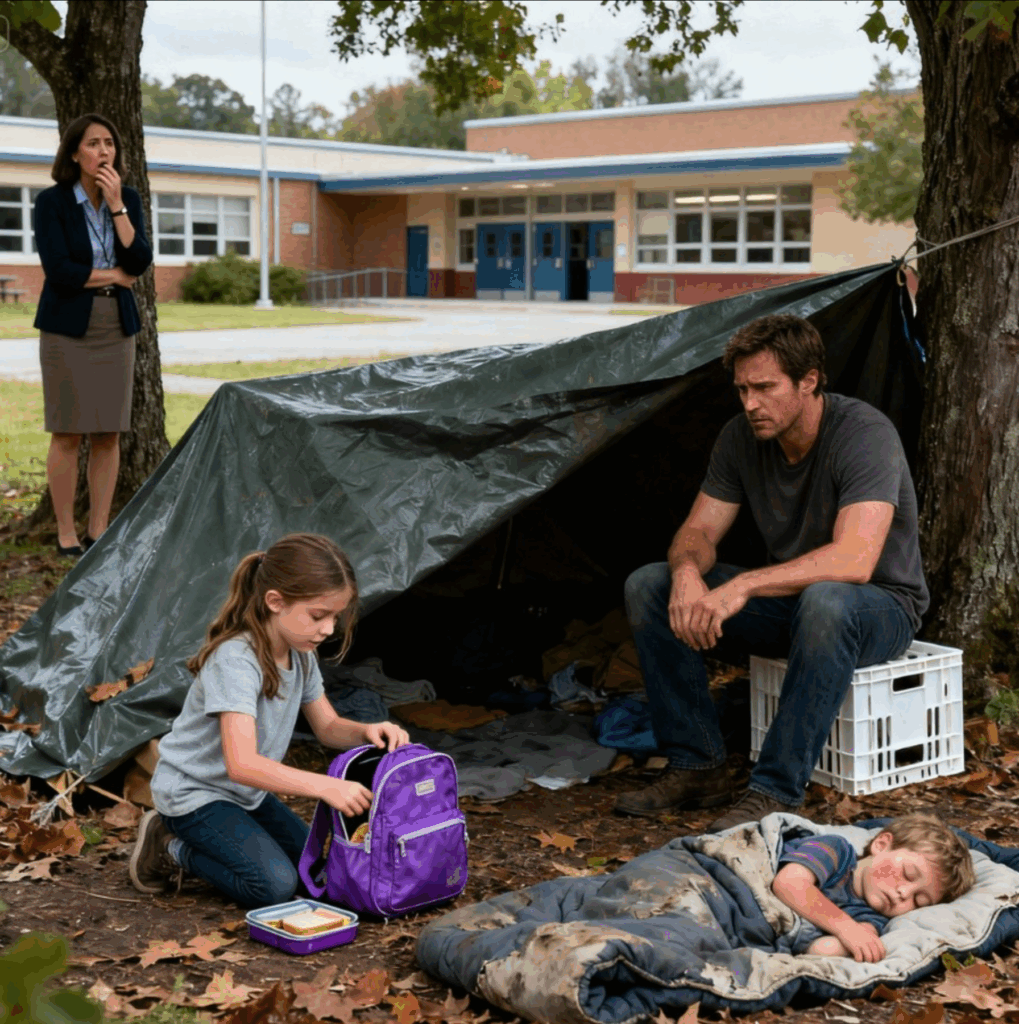
There, cradled in a makeshift shelter of tarps and salvaged materials, a man sat on an overturned milk crate, head in his hands. Beside him, a small boy, four or five, slept fitfully, flushed with fever.
“Daddy?” Lily whispered. “I brought lunch. Is Noah feeling better?”The man lifted his head—hollow cheeks, stubble, deep exhaustion. But the shape of his shoulders spoke of someone who’d never given up.
“He’s still got a fever,” he said softly. “I’ve been giving him Tylenol… almost out.”Lily offered the pudding like a precious gift. “Maybe it’ll help him feel better.”“You’ve been saying you’re not hungry for two weeks,” he said gently. “You need to eat.”
“I’m not hungry,” Lily insisted. “Daddy and Noah need it more.”I stepped forward, leaves crunching. “Lily?”The girl froze. The man stood, protective.“I’m Rebecca Collins—Lily’s teacher,” I said softly.
“Daniel Parker,” he said, voice tight. “And this is my son, Noah.”I checked Noah—burning cheeks, labored breathing. “He needs medical attention now,” I said firmly.Daniel’s shoulders slumped. “They’ll take them away from me… Child Services…”
“I’m calling,” I said, dialing 911. His fear was palpable as paramedics arrived, stabilizing Noah. Relief, panic, and exhaustion warred across Daniel’s face as the ambulance doors closed.
At the hospital, I stayed close, watching doctors check vitals, explaining treatments. Lily clung to her father’s hand. I remembered nights at John’s bedside—helpless, watching, waiting. I understood fear and love intertwining, the way grief reshapes priorities.
Social services arrived, measured and professional. Protocol dictated temporary foster placement. I stepped in.“I have a home,” I said. “A safe, temporary home. They can stay while Mr. Parker regains stability.”
Months passed. Sunlight warmed Oak Lane as boxes were carried inside a new house. Daniel and the children laughed in the yard, a golden retriever bounding around them. A settlement from a wrongful foreclosure had arrived just before Christmas,
giving Daniel financial security to plan carefully. Noah recovered fully, the hospital visits a memory. Lily flourished, her small shoulders freed from burdens too heavy for a child. Daniel had regained confidence; the haunted look in his eyes vanished.
And I—emerging from the careful shell of widowhood—felt alive in ways I hadn’t dared hope.Lily looked up at me, eyes bright. “Home is wherever we’re together,” she said simply.Daniel smiled, slipping an arm around my waist. “Our new chapter,” he said.
And I knew she was right. Home wasn’t walls or rooms—it was love, connection, and the courage to step into someone else’s life when it mattered most.
In saving Noah Parker, I hadn’t just preserved a child’s life. I had saved a father from despair, a little girl from impossible responsibilities, and myself from living a half-life in grief. Protocols mattered, but humanity mattered more.
Sometimes, the hardest, scariest choices—following your heart—were the ones that changed everything.