The spring morning shone with a blinding intensity, as if the sun, defiant of all the world’s pain, insisted on illuminating everything. The light danced across the rails, slid along the wet concrete, and mingled with the sharp, refreshing scent of rust, dust, and post-rain wind.
Every shadow, every still object, even the mist hovering over the platform, seemed to awaken in the brilliance of the day.At the edge of the platform stood Zsófia, a young, pregnant woman. She wore a thin shirt and faded pants, barefoot on the cold concrete, her worn sneakers missing their laces.
Her clothes clung damply to her body, her hair whipped by the wind, and dark circles traced the tired curve beneath her eyes. Yet, in her gaze burned a stubborn, human light that refused to let her dignity vanish entirely.
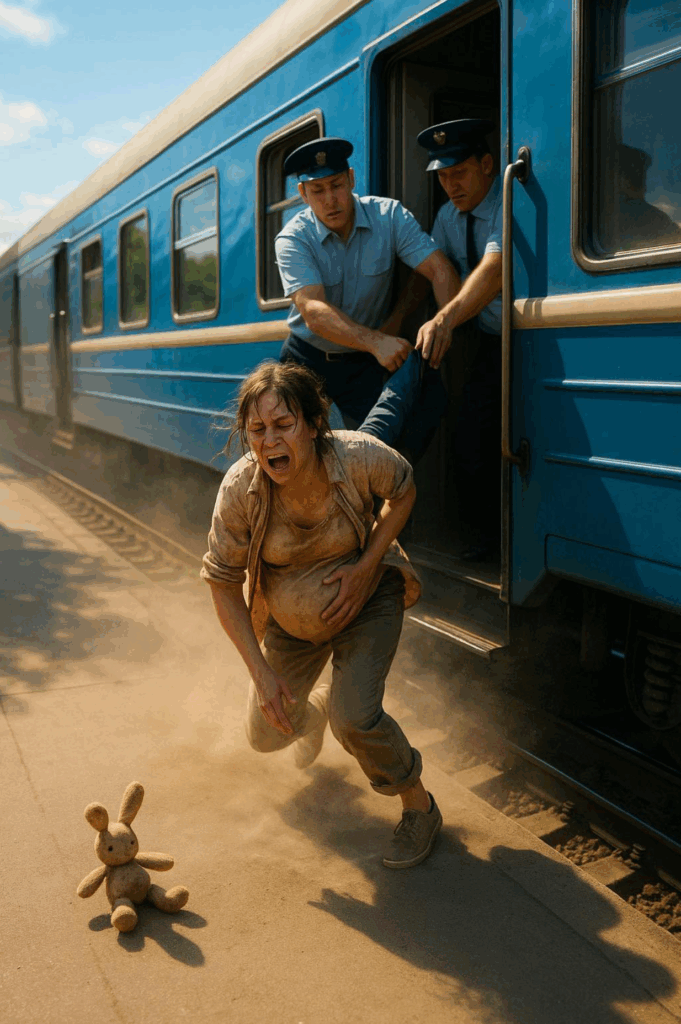
In her hands, she clutched an old plastic bag containing the few belongings she owned and a tattered plush bunny, which she held close as if it were a lifeline.
When the train arrived, Zsófia stepped aboard and settled by the window, closing her eyes as though trying to escape the clamor of the world and the cold, judgmental stares around her. Passengers glanced at her briefly and then looked away.
She was merely an “invisible” presence, a shadow beside the safe routines of their lives.A few minutes later, the conductor approached, her face stern and worn, her uniform stiff with the rigidity of rules.
“Your ticket, please.”Zsófia lowered her head, whispering almost inaudibly:“I don’t have one… I just wanted to go somewhere, anywhere…”“Without a ticket, you can’t travel,” the conductor replied dryly. “You’ll have to get off at the next station.”
The train slowed, and Zsófia stepped onto the platform, clutching her plush bunny tightly. The sun’s dazzling rays struck her eyes, the wind tugged at her damp hair, and her exhausted body sank onto the cold concrete. She placed her bag beside her and whispered, panting:
“Hold on, little one… it’s almost over…”The train pulled away, its wheels monotonously rattling into the distance. As the conductor walked back through the carriage, she noticed something under the seat. She bent down and picked it up: the plush bunny. Around its neck hung a ribbon with a soaked, trembling note:
“If anything happens to me, please help my child. I believe goodness still exists.”The words seemed to freeze time. Amid the train’s rhythmic clatter, her own heartbeat thundered in her ears. She lifted her head, her voice urgent:
“Stop the train! Immediately!”The wheels screeched. Passengers gasped. The engine slowed, then ground to a halt in the middle of a sunlit field.The conductor and two passengers ran back toward the station, carrying hope in their footsteps.
Zsófia was found on the platform, sitting on the ground, clutching her belly, unconscious. The labor had begun. The conductor knelt beside her, still holding the damp plush bunny, a fragile symbol of hope in her hands.
Twenty minutes later, the first cries pierced the morning. The newborn’s voice cut through the brilliant light, as if the sky itself had bent down to witness their arrival, and the world seemed to hold its breath, listening to the miracle of life.
Later, the doctor said only:“If the train hadn’t stopped… they wouldn’t have survived.”For a long time, the city whispered the story of the young woman without a ticket — whose little bunny had stopped the train and saved two lives. Sometimes, the greatest miracles are found in the smallest, most fragile things.