
“ My son deserves to eat a proper home-cooked meal for once!” my mother-in-law announced during Sunday lunch. My husband quietly reached for another helping of the stew I had prepared. Then, in front of the entire family, he finally revealed a secret that had been hidden for three years.
“András, sweetheart, eat properly! You look as though nobody at home takes care of you anymore.”
My mother-in-law, Katalin, delivered the remark while looking directly at me.
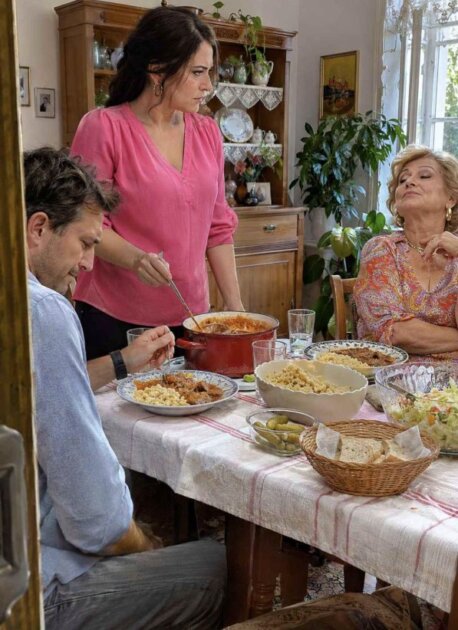
Fourteen people were seated around the dining table. For a moment, nobody knew how to react. Someone nervously tapped their glass, another guest suddenly became very interested in their plate, and my sister-in-law, Nóra, hurriedly tried to change the subject.
I slowly put down my fork.
That morning, I had woken up at five o’clock to prepare the special birthday lunch I had promised to bring. I had spent hours cooking beef stew with paprika, making homemade dumplings, baking two traditional Hungarian poppy seed rolls, and preparing the pickles to accompany the meal.
And now, at my mother-in-law’s sixty-fifth birthday celebration, I was sitting among the entire family, listening to her question my cooking abilities as though I were incapable of preparing a decent dinner.
“Katalin, I actually made the beef stew,” I said calmly.
“I know, dear. That’s exactly why I’m saying András deserves something genuinely delicious today. Fortunately, I also prepared some breaded pork for him.”
My husband, András, was sitting beside me. Instead of defending me, he reached for the serving dish and helped himself to another generous portion of my stew.
“I really like this,” he said.
Katalin waved her hand dismissively.
“Of course you do. You wouldn’t want to hurt your wife’s feelings, would you?”
András glanced at me.
I knew that look very well. We had been married for eight years, and I understood exactly what he wanted me to do.
Stay quiet.
Don’t spoil the celebration.
Don’t upset his mother.
Once again, I was expected to swallow the insult simply to keep the peace.
And I was tired of it.
András and I lived in Szeged, Hungary, in a comfortable three-bedroom apartment. I worked as a dental assistant at a local dental clinic, while my husband was employed as a technical estimator for a construction company.
We weren’t wealthy, but we had a comfortable life. We usually had dinner together after work, went shopping at the Mars Square Market on Saturdays, and spent Sundays visiting one of our parents.
My relationship with Katalin, however, had never been particularly easy.
From our very first meeting, she seemed determined to find something wrong with me.
The first time I brought her homemade stuffed cabbage, she complained that the cabbage rolls were too large.
When I prepared traditional Hungarian meat soup, she said I hadn’t added enough vegetables.
When I baked an apple pie, she informed me that András had eaten much better desserts during his childhood.
Eventually, I stopped asking for her opinion.
But three years earlier, something happened that changed our family routine.
Katalin’s husband, László, passed away unexpectedly. After his death, she was left alone in the family home. For months, she barely went outside and seemed to lose interest in almost everything.
András was deeply worried about his mother.
One Tuesday evening, he asked me whether I could prepare a little extra of the potato casserole we were having for dinner.
“Could you make a bigger portion? I’d like to take some to Mom. She barely ate anything yesterday except a bread roll.”
Of course, I agreed.
The following week, I packed homemade meat soup, Székely cabbage stew, and a few other dishes for him to take to her.
At first, I thought it would be a temporary arrangement.
But gradually, it became part of our weekly routine.
Three or four times a week, I prepared an additional meal for Katalin. I paid attention to her preferences, remembered which ingredients she disliked, and tried to avoid foods that upset her stomach.
When she was feeling unwell, I made a light chicken soup. During the summer, I prepared chilled sour cherry soup. In winter, I cooked hearty bean goulash.
I even adjusted my cottage cheese dumpling recipe several times because she preferred them exceptionally soft.
András always collected the containers and delivered them to his mother’s house.
Katalin never thanked me.
Not once.
I assumed that expressing gratitude simply wasn’t part of her personality.
One evening, I asked András whether his mother had enjoyed the plum dumplings I had prepared.
“She loved them,” he replied. “She ate every single one.”
I was genuinely pleased.
I had no idea what was actually happening inside Katalin’s house whenever my husband delivered those meals.
That afternoon, during her birthday celebration, the truth began to emerge.
Katalin suddenly reached for her phone.
“Everyone, I want to show you something! My son has such a wonderful talent for cooking. Just look at this!”
She proudly passed her phone around the table.
The first photograph showed beautifully presented stuffed peppers covered in rich tomato sauce.
I immediately recognized the dish.
I even remembered the tiny parsley leaf I had placed on top before taking the photograph for my own recipe collection.
The next picture showed my homemade Somlói sponge cake.
Then came my chicken paprikash.
My layered cream cake.
The potato salad I had prepared for Easter dinner.
Every single dish was familiar.
I had cooked all of them.
“All of these were made by András!” Katalin announced proudly. “For three years, he has been taking care of me. Imagine coming home after a full day at work and still finding the time to prepare proper meals for your mother!”
Nóra looked at me in disbelief.
“Vera, did you know about this?”
I couldn’t answer.
But Katalin wasn’t finished.
“I’ve even registered András for next Saturday’s charity cooking competition. I’ve already paid the entrance fee. Everyone in the neighborhood deserves to see how talented my son is!”
The color drained from my husband’s face.
“Mom, what have you done?”
Katalin smiled.
“I wanted it to be a surprise!”
Then she pulled a folded piece of paper from her handbag.
Three dishes were written on it.
I recognized all three immediately.
They were my original recipes.
And that was when I realized that the situation was much worse than I had imagined.
András slowly placed his fork on the table.
“Mom, I can’t prepare these dishes.”
Katalin laughed.
“Oh, stop being so modest!”
“I’m not being modest.”
“Then you’ll have to practice this week.”
My husband looked at me before turning back toward his mother.
“Vera made the beef stew.”
Katalin’s smile disappeared slightly.
“We know that.”
“She also made the stuffed peppers. The Somlói cake. The chicken paprikash.”
Katalin frowned.
“Which chicken paprikash?”
“All of them.”
The entire table fell silent.
“For the past three years, Vera has been preparing the meals I bring to you,” András finally admitted. “I’m only the person who delivers them.”
Katalin stared at him without moving.
“Is this some kind of joke?”
“No, Mom.”
“But you always told me…”
“I know.”
She slowly turned toward me.
“You knew about this?”
“I knew I was cooking your meals. I didn’t know András was presenting them as his own creations.”
Nóra looked at her brother in disbelief.
“You’ve been lying to Mom for three years?”
András rubbed his forehead.
“At first, it just seemed easier.”
“Easier for whom?” I asked.
He sighed.
“When Dad died, Mom refused almost everything people brought her. She didn’t want anyone cooking for her. But one evening, I told her I had made the potato casserole myself. She finally ate a proper meal. She was happy, and I didn’t want to take that away from her.”
“And what happened after that?”
“I didn’t know how to tell her the truth anymore.”
Katalin abruptly stood up.
“I need some fresh air.”
She walked out onto the terrace.
The rest of the birthday lunch was painfully uncomfortable. Nobody mentioned the cooking competition again. The guests eventually finished their desserts, handed over their presents, and gradually began leaving.
I collected my empty food containers from the kitchen.
András followed me.
“Vera, I’m sorry.”
“Three years, András.”
“I know.”
“For three years, you allowed your mother to believe you were the one taking care of her. And during all that time, you listened while she criticized my cooking and questioned whether I knew how to look after my own husband.”
“I never wanted the two of you to argue.”
“No. You just didn’t want to experience an uncomfortable conversation yourself.”
He had no answer.
We drove home almost entirely in silence.
On Monday evening, after work, András found me preparing vegetables in the kitchen.
“What are we taking Mom tomorrow?”
I continued chopping.
“Whatever you cook for her.”
“Vera…”
“I don’t mind that you want to look after your mother. She’s your mother, and I understand that you were worried about her. But from now on, you’re going to decide how you want to do that.”
That evening, András attempted to prepare a simple potato stew.
He asked me three times how much water he should add. He burned the roux on his first attempt, and the second version turned out far too watery.
I didn’t take the wooden spoon from his hands.
I didn’t rescue the meal.
When he finally finished, I tasted it.
“It needs a little more salt.”
The next day, he took the container to his mother’s house.
He returned home unusually early.
“Well?” I asked. “Did she like it?”
“She said she’d rather order something.”
I didn’t laugh.
I wasn’t happy that he had failed.
I simply wanted him to understand how much time, effort, and patience went into preparing the meals he had taken for granted for three years.
On Wednesday, Nóra called me.
“Vera, do you know how many people Mom has told about András’s cooking?”
“I can imagine.”
“She has been talking about it at her retirement club. She even shared recipes with some of the women. She told everyone that András invented them himself.”
I remained silent.
“And there’s something else,” she continued. “The organizers of the charity cooking competition asked Mom to put together a small recipe booklet. The money from selling it would go to a local family support organization.”
“What kind of recipe booklet?”
“One featuring András’s dishes.”
That was when I realized this was no longer simply about my husband accepting compliments for meals he hadn’t cooked.
My recipes were about to be published under someone else’s name.
The following evening, I visited Katalin.
On her dining table lay a spiral-bound notebook, several printed food photographs, and pages of handwritten notes.
“Nóra told me about the recipe booklet,” I began.
Katalin adjusted her glasses.
“I thought she might.”
I picked up the notebook and began turning its pages.
There were more than forty recipes.
Some had dates beside them. Others included little handwritten comments.
February 8: She brought this when I had a fever.
April 16: Very delicious. Less greasy than the way I used to make it.
October 3: It tastes just like something my mother used to cook when I was a little girl.
I stopped turning the pages.
I hadn’t expected to find something like this.
There, in front of me, were three years of my efforts, carefully recorded in Katalin’s handwriting.
She remembered every meal.
She remembered when I had prepared them, which ones she particularly enjoyed, and even the occasions when I had adjusted the ingredients to suit her.
“Why did you never ask whether I was helping András prepare these meals?” I asked quietly.
“Because he told me he made them himself.”
“But why was it so important for you to believe that I couldn’t cook?”
Katalin lowered her eyes.
“Perhaps because I always thought a mother knew her son better than his wife did.”
“And did that mean you had to keep telling everyone that I wasn’t taking proper care of him?”
She didn’t respond immediately.
After a long silence, she finally spoke.
“When László died, I felt as though nobody really needed me anymore. The house was empty, and I didn’t know what to do with myself. Then András started bringing me those meals. It made me feel good to think that my son was doing so much for me.”
“He was doing something for you,” I replied. “He visited you, spent time with you, and helped you. But I was the one preparing the food.”
“I know.”
Her voice was barely audible.
I continued turning the pages until I reached the final sheet.
There was a particularly touching note written at the bottom.
One day, I would like to ask András how he makes his tarragon chicken soup. László would have loved it too.
Katalin noticed that I was reading.
“That was the first meal I managed to eat properly after the funeral,” she explained. “I remember finishing the entire bowl.”
I remembered that soup.
That evening, András had come home at ten o’clock. He told me that his mother had finally eaten a whole bowl of dinner.
The following day, I prepared another portion.
At the time, I believed that perhaps Katalin would eventually understand that I wasn’t her enemy. I was simply another person who wanted to become part of her family.
“The recipe booklet cannot be published under András’s name,” I said.
“It won’t be.”
“And the competition?”
Katalin closed the notebook.
“I’ll withdraw his registration tomorrow.”
On Saturday morning, András and I were shopping at the local market when my phone rang.
It was Katalin.
“Vera, I’d like you both to come to the cooking competition.”
“I thought you had withdrawn András’s registration.”
“I did. But there’s something I want to show you.”
We arrived around noon.
The courtyard was full of activity. Large cooking pots stood over open fires, the smell of fried onions and paprika filled the air, and children ran between the tents while older visitors chatted around long tables.
Katalin was standing behind a small stall.
Nóra was beside her, arranging glasses.
On the table were several freshly printed recipe sheets.
The one at the top featured a photograph of my tarragon chicken soup.
Beneath it was a short description:
“Vera’s Recipe – The Meal That Helped Me Rediscover My Appetite During One of the Most Difficult Periods of My Life.”
I stopped in my tracks.
Katalin noticed me and walked over.
“These are only sample copies,” she explained. “The complete booklet will only be published if you agree.”
A few minutes later, the event organizer picked up a microphone to introduce the participants.
When Katalin’s turn came, she unexpectedly asked to speak.
“I would like to correct something,” she began.
“Many people have heard me talk about what a wonderful cook my son is. Well, it turns out that my son is actually a very talented food delivery man!”
A few people laughed.
András smiled awkwardly.
“The truth is that my daughter-in-law prepared all those meals. For three years, she took care of me, and instead of thanking her, I criticized her cooking in front of other people.”
Katalin turned toward me.
“Vera, I want you to know how ashamed I am. And I want everyone here to understand whose kindness helped me find the strength to sit at the dinner table again after my husband’s death.”
My eyes filled with tears.
It wasn’t because people were applauding.
It was because, after three years, I was finally hearing something from my mother-in-law that should have been said long ago.
She was acknowledging me.
She was acknowledging my work.
And, most importantly, she was acknowledging that I had been there for her when she needed someone.
Over the following months, things gradually changed within our family.
András began learning how to cook properly. He no longer needed to ask me every time he wanted to prepare rice, and his paprika potato stew eventually became quite good.
Katalin and I went through the recipes together.
We decided to include some of her old family recipes as well, so the final booklet featured both of us.
The money raised from its sale went to the local family support organization, just as originally planned.
For the first time, our cooking became something that brought the family together instead of creating arguments.
Before Christmas, Katalin invited us to dinner.
When we arrived, the dining table was covered with homemade food. There was traditional Hungarian meat soup, stuffed cabbage rolls, and freshly baked walnut beigli.
“I hope you’ll like everything,” she said, looking slightly uncertain.
I tasted the soup.
“It’s delicious.”
“Isn’t it too salty?”
“No.”
“And the vegetables? Did they get too soft?”
I smiled.
“Katalin, I’m not here to grade your cooking. I’m here to have dinner with my family.”
She burst out laughing.
After dinner, she called me into the kitchen and handed me a small wrapped package.
Inside was a handmade apron.
It was simple, made from blue cotton fabric, with tiny embroidered flowers decorating the pocket.
“I learned embroidery from László’s mother,” she explained. “I made this for you.”
I hugged her.
It was a small gesture, but it meant more than she probably realized.
We were getting ready to leave when Katalin opened the refrigerator and took out three food containers.
“Take these home. That way, you won’t have to cook tomorrow.”
András reached for them.
“Thank you, Mom!”
But Katalin gently took one of the containers from his hands and handed it directly to me.
“This one is especially for you, Vera. I know how much you like stuffed cabbage.”
Then she added something I will never forget.
“For three years, you made sure I always had a warm meal waiting for me. Now I’d like you to experience what it feels like to go home knowing that someone has already thought about you.”
I carried the still-warm container on my lap during the drive home.
It was an ordinary meal made from cabbage, rice, meat, and a little sour cream.
Nothing expensive.
Nothing extravagant.
Yet it meant more to me than any expensive Christmas present could have.
Because, after all those years, I finally felt that I had a place at that family table for a reason other than being somebody’s wife.
For the first time, I felt that they truly saw me.
And sometimes, the most meaningful apology isn’t a grand speech or an expensive gift.
Sometimes, it’s a simple homemade meal, prepared with care, and offered with the gratitude that should have been there all along.

