
When I opened the refrigerator on Saturday afternoon, I initially thought it had broken down. Then I wondered whether my husband had thrown everything away without telling me.
The shelves were almost completely bare.
All that remained was a half-empty jar of mustard, two lemons, and an opened carton of milk.
The meat, cheese, butter, cold cuts, yogurt, eggs, and even the two portions of stuffed peppers I had prepared on Friday evening had disappeared.
I opened the freezer.
It was practically empty, too.
“Gábor!” I shouted toward the living room. “What happened to our refrigerator?”
My husband was sitting on the sofa, scrolling through his phone as if nothing unusual had happened.
“Mom took a few things,” he answered casually.
“A few things?”
“She has guests coming tomorrow. She didn’t have time to go shopping.”
I stared at him, trying to understand whether he was actually serious.
“Gábor, I spent 48,000 forints on groceries yesterday!”
“So? We’ll buy more.”
“With what money?”
He finally looked up.
“Don’t make such a big deal out of this, Judit. We’re talking about my parents.”
Something inside me changed at that moment.
I didn’t scream. I didn’t throw anything. I simply walked upstairs, opened our bedroom closet, pulled out Gábor’s travel suitcase, and began packing his clothes.
Twenty minutes later, when he noticed the suitcase standing in the hallway, he burst out laughing.
“What is this supposed to be?”
“If you’re so concerned about making sure your parents have everything they need, you can spend a few days living with them.”
“Are you seriously kicking me out over a few slices of ham?”
I looked directly at him.
“Are you moving in with your parents? And what exactly are you going to eat there? Because I’m going to bring back everything your mother took from my refrigerator.”
His expression changed immediately.
“You can’t go there!”
That was when I stopped and looked at him more carefully.
He hadn’t said it was unnecessary. He hadn’t offered to call his mother and resolve the situation.
He had told me I wasn’t allowed to go there.
And suddenly, I was much more interested in finding out what was really happening.
I was forty-one years old and lived in Székesfehérvár, Hungary. I worked as a dental assistant in a private dental clinic, while my husband, Gábor, was a warehouse manager for an automotive parts distributor.
We had been married for eleven years.
Our apartment had actually been mine before the wedding. I had purchased it with financial help from my mother. It wasn’t particularly large, but it was bright, comfortable, and filled with the little things that made a place feel like home.
We were supposed to share our everyday expenses. In reality, however, grocery shopping, cooking, planning meals, and managing the household had gradually become almost entirely my responsibility.
My mother-in-law, Erzsébet, had always been a rather difficult woman.
Whenever she visited, she made a habit of inspecting our refrigerator.
“Why do two people need so much cheese?”
“You’ll never finish all this sausage.”
“Your father loves this kind of homemade jam. I’ll take a jar for him.”
At first, I didn’t pay much attention to her comments.
A jar of jam or a piece of cake wasn’t worth starting a family argument over.
But over the previous few months, I had begun noticing that things were disappearing from our kitchen with surprising regularity.
A packet of coffee. An unopened bottle of cooking oil. The meat I had purchased for Sunday lunch.
Gábor always had an explanation.
“Mom needed it.”
“She’ll replace it.”
“She was in a hurry.”
I usually chose to go back to the supermarket rather than argue with him.
But this Saturday was different.
I was expecting my mother and younger brother for Sunday lunch. I also had several long shifts scheduled for the following week, so I had carefully planned our meals and bought enough food to last several days.
Erzsébet knew this.
We had even discussed my plans over the phone on Friday.
Nevertheless, while I was at work on Saturday morning, she had apparently decided that my refrigerator was her personal grocery store.
I grabbed my coat and headed to her house on the other side of town.
As I walked out, Gábor called after me.
“Judit, at least call her before you go!”
I didn’t.
When I arrived, Erzsébet was standing beside the garden gate. She was handing a large plastic food container to a middle-aged woman I recognized from the neighborhood.
The woman handed her a five-thousand-forint note along with several smaller bills.
“Thank you, Erzsi! I’ll order the same amount again next Saturday.”
My mother-in-law noticed me.
The smile disappeared from her face.
“Judit? What are you doing here?”
“I’m here for my groceries.”
The woman looked uncomfortable, said goodbye, and quickly got into her car.
Erzsébet stepped in front of me.
“Now isn’t a good time. I have guests coming.”
“Gábor said the same thing.”
I walked around her and entered the house.
The kitchen immediately told me more than I wanted to know.
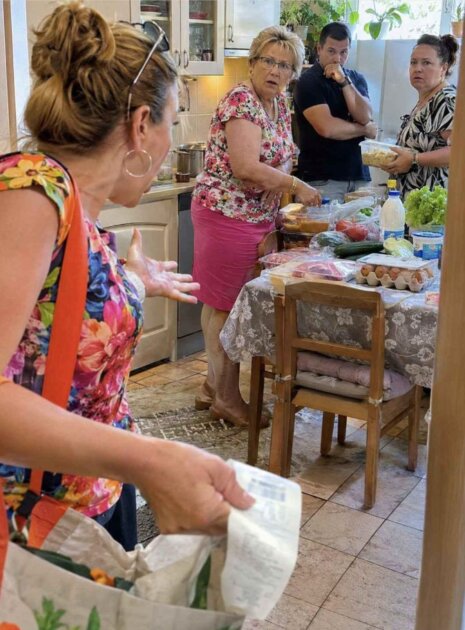
Three enormous pots were simmering on the stove. Plastic food containers were lined up across the dining table, and a familiar smell filled the room.
Stuffed peppers.
My stuffed peppers.
In the corner of the kitchen counter, I spotted one of the reusable shopping bags I had taken to the supermarket the previous afternoon.
Beside it lay a small checkered notebook.
I opened it.
There were names, dates, meal quantities, and prices written across the pages.
Seventeen orders had been recorded for that particular Saturday.
But on the following page, I noticed something that made my stomach tighten.
My own name.
Beside it were the words:
“Ingredients – Saturday.”
Underneath was an amount: 48,000 forints.
Exactly what I had spent on groceries the day before.
“What is this?” I asked.
Erzsébet snatched the notebook from my hands.
“That’s none of your business!”
“My name is written in it.”
“I was just keeping track of a few things.”
“Are you selling meals prepared with groceries I paid for?”
“Don’t you dare speak to me like that!”
At that moment, my father-in-law, László, appeared in the kitchen doorway. He looked genuinely surprised to see me.
“Judit, did you bring something today, too?”
“No. I didn’t bring anything.”
“But Erzsi told me you’ve been doing the cooking together lately.”
My mother-in-law shot him such an angry look that he immediately fell silent.
“What cooking are you talking about?” I asked.
László looked from me to his wife, clearly confused.
“Well, the weekend meals. Since the summer.”
Since the summer.
I slowly pulled out a chair and sat down.
A few months earlier, Erzsébet had complained that her pension wasn’t enough to cover her expenses. I had even offered to help her review her household budget and find ways to save money.
Instead, she had found another solution.
She was using groceries purchased with my money, preparing meals in her kitchen, and selling them to people in the neighborhood.
“What does Gábor know about this?” I asked.
Erzsébet didn’t answer.
“Does he know?”
“He helps bring the ingredients home. I don’t understand why you’re making such a scandal out of this. At least I’m working for my money!”
I looked at her in disbelief.
“I’m working, too. Except I’m also paying for the ingredients that allow you to earn yours.”
I gathered the unopened groceries I could identify from the refrigerator and pantry.
I didn’t take away the meals that had already been prepared. I wasn’t going to punish the people who had paid for them because of a family dispute.
But I made one thing perfectly clear.
This was the last time.
“From now on, you buy your own ingredients with your own money.”
Erzsébet placed her hands on her hips.
“Gábor and I will discuss this.”
“Go ahead.”
When I returned home, my husband was gone.
His suitcase had disappeared from the hallway, too.
A message was waiting on my phone.
“Mom is completely devastated because of you. I’m not coming home until you apologize to her.”
I put my phone down.
For the next two hours, I sat at the kitchen table and reviewed our bank statements from the previous several months.
Since April, our grocery expenses had increased considerably. We had previously spent roughly the same amount every month, but during the summer, there were several occasions when my grocery bills had nearly doubled.
I had blamed rising food prices.
Now I knew that wasn’t the whole story.
On Sunday morning, my mother-in-law called.
“I sincerely hope you’ve had time to calm down and realize how shamefully you behaved yesterday.”
“No, Erzsébet. I haven’t.”
“Gábor is here with us. He’s terribly upset.”
“Then cook him something.”
“I can’t! Everything I prepared yesterday is gone, and you took the ingredients!”
“Then go shopping.”
“Judit, I have to cook again on Monday!”
“Then buy groceries for Monday.”
She hung up on me.
At noon, my mother and my younger brother, Tamás, arrived.
I prepared chicken paprikash with homemade dumplings and baked an apple pie. I didn’t want the incident to ruin our Sunday together, but my mother immediately noticed that something was wrong.
After lunch, I told them everything.
My mother listened without interrupting. When I finished, she remained silent for a long moment.
“Sweetheart, there’s something I don’t understand,” she finally said. “Why did Erzsébet go to such lengths to keep this secret?”
“She wanted to make money.”
“Perhaps. But if that were the only reason, why didn’t she simply ask you to help her start something of her own?”
I didn’t have an answer.
On Monday evening, Gábor finally came home.
He didn’t apologize.
Instead, he began complaining that his mother had lost three regular customers because she couldn’t fulfill their orders.
“I’d like us to go back to the way things were,” he said.
“What way?”
“Mom gets whatever she needs, and we’ll settle everything later.”
I stared at him.
“Show me how you’ve been settling everything so far.”
“We don’t keep a separate record.”
“Your mother does. I saw her notebook.”
He turned away.
“I don’t understand why you’ve suddenly become so distrustful.”
That was when I asked the question neither of them had been willing to answer.
“Where does the money go?”
“To my mother.”
“Are you sure?”
“Judit, just leave it alone!”
But I couldn’t leave it alone anymore.
The next day, one of my colleagues mentioned that her husband regularly ordered homemade lunches from a retired woman.
When I asked her for the woman’s name, I already suspected what she would say.
“Erzsébet. Gábor sometimes delivers the food to their house.”
“My Gábor?”
“Of course! I thought you knew. He even told us that his wife takes care of the grocery shopping.”
I felt a mixture of embarrassment and anger.
My husband had been telling people at my workplace that I was voluntarily helping his mother’s little food business.
I asked my colleague to show me the account number to which customers usually transferred their payments.
The name displayed on the screen was Gábor’s.
That evening, I waited until he came home.
“Are you receiving the money from the meal orders?”
He stopped in the middle of the kitchen.
“Some of it.”
“How much is some?”
“It depends.”
“What do you need the money for?”
“Does it matter?”
“Yes, it does.”
Gábor sat down but continued avoiding my eyes.
“I have certain expenses.”
“What expenses?”
“I’m helping someone.”
My stomach tightened.
“Who?”
“My sister.”
Gábor’s younger sister, Nóra, lived in Veszprém. We rarely saw each other because her job involved a great deal of traveling. I knew her marriage had been struggling, but she had never discussed the details with me.
“Why does she need money?”
“Please don’t get involved in that.”
I barely slept that night.
Questions kept running through my mind.
Why had they needed such an elaborate secret? Why had nobody simply told me what was happening?
If Nóra needed help, why hadn’t they asked me?
The following afternoon, I called her.
“Nóra, I’d like to meet you.”
Her voice sounded uncertain.
“Did Gábor tell you something?”
“He only told me that he’s been helping you.”
There was a long silence.
“Then come and see me on Friday. But please don’t tell Mom.”
On Friday after work, I drove to Veszprém.
Nóra welcomed me into a small rented apartment. I was surprised because I had always assumed she was still living with her husband in their family home.
Several cardboard boxes stood in the living room, and most of the furniture looked secondhand.
“Have you moved out?”
She nodded.
“Three months ago.”
Then she told me what had happened.
Her husband had been controlling her finances for years. He monitored her spending, questioned almost every purchase, and eventually made it difficult for her to access her own salary.
When she finally decided to leave, Gábor and Erzsébet had promised to help her.
“My brother paid part of the apartment deposit,” she explained. “Mom also gives me some money every month.”
“Do you know where that money comes from?”
“Mom said she earns extra money by cooking for people. Gábor told me you were helping them.”
Nóra looked directly at me.
“Weren’t you?”
I explained everything.
I told her about the empty refrigerator, the missing groceries, the notebook, and the money being transferred into Gábor’s account.
By the time I finished, tears were running down her cheeks.
“Judit, if I had known, I wouldn’t have accepted a single forint!”
I reached across the table and took her hand.
“You aren’t responsible for the fact that they never asked me.”
That afternoon, two things became clear.
My mother-in-law hadn’t been keeping all the money for herself.
And my husband really had been trying to help his sister.
But that didn’t change what they had done to me.
For months, they had taken advantage of my work, my salary, and my trust. They had made financial decisions using my money without even giving me the opportunity to agree or disagree.
And the worst part was that they had never needed to do it that way.
If they had honestly explained Nóra’s situation from the beginning, I probably would have been among the first people to offer help.
But instead, they had turned my generosity into something they could secretly exploit.
On Sunday, we arranged a family meeting at my apartment.
Erzsébet, László, Gábor, and Nóra all came.
The moment my mother-in-law saw her daughter, she became visibly irritated.
“Why did you have to involve her in this?”
But Nóra refused to let her continue.
“Mom, did you do all this because of me?”
“I would do anything for you!”
“Then why did Judit have to pay for it?”
Erzsébet’s expression hardened.
“Judit has a good salary. She doesn’t have children, and she doesn’t have as many expenses.”
I froze.
“So you decided my money mattered less because I don’t have children?” I asked.
“That’s not what I said.”
“But that’s exactly what you thought.”
Gábor stared at the floor.
Nóra slowly stood up.
“Mom, I left my husband because I couldn’t stand someone else making decisions about my money and my life. And now I find out that you and Gábor have been doing exactly the same thing to Judit.”
The kitchen fell silent.
For the first time, Erzsébet seemed to have no answer.
Then László finally spoke.
“Erzsi, our daughter is right.”
His wife turned toward him.
“Don’t you start!”
“No. I am going to say something. I believed Judit was helping you voluntarily. If I had known the truth, I would never have allowed this to continue.”
For the first time since the entire situation began, I felt that someone in Gábor’s family actually wanted to acknowledge the problem instead of simply silencing me.
The following weeks brought several changes.
Nóra found a better-paying job and gradually began putting her life back together. I offered to help her furnish her new apartment if she needed anything.
But this time, every bit of assistance was something I chose freely.
Erzsébet stopped taking weekend meal orders. Eventually, she found a part-time position helping at a small local restaurant a few mornings a week. She finally had an income of her own without depending on someone else’s grocery budget.
Things with Gábor were much more complicated.
He admitted that he had been afraid to tell me about his sister’s situation because he thought I might refuse to contribute financially.
“You never even asked me,” I reminded him.
“I know.”
“Then how could you possibly know what my answer would have been?”
He had nothing to say.
We spent several weeks living separately and eventually attended couples counseling to discuss what had happened.
I wasn’t prepared to make a decision about our eleven-year marriage overnight. But I made one thing absolutely clear: I would never return to the old arrangement.
In the middle of December, Erzsébet unexpectedly appeared at my door.
She was carrying two large shopping bags.
“I brought you something.”
Inside one bag were meat, eggs, dairy products, and fresh vegetables. The other contained coffee, flour, cooking oil, and several chocolate bars.
“What is all this?” I asked.
“I bought it with my first paycheck.”
She adjusted her scarf nervously.
“I know this doesn’t replace everything I took from you.”
“No, it doesn’t.”
“But I want to start paying you back.”
I stepped aside and let her in.
As we unpacked the groceries, Erzsébet noticed the shopping list attached to my refrigerator door.
“You know, Judit, I used to think that in a family, people shouldn’t have to ask permission for every little thing.”
“They don’t. Only when they’re taking something that belongs to someone else.”
She nodded quietly.
Before leaving, she asked whether she could take two apples for Nóra.
I smiled.
“Of course. Take four.”
This time, it wasn’t about the apples.
It was about the fact that, after eleven years, she had finally asked.
My refrigerator has been full ever since.
Sometimes there is more food in it than we actually need, and I still enjoy sharing what I have with people who appreciate it.
I haven’t become a less generous person. I still believe that helping family matters, and I would never turn away someone I love simply because they were going through a difficult time.
But I have learned something important.
Generosity is a gift only when it is given freely.
The moment someone else decides how much of your money, time, or effort they are entitled to take, it stops being generosity.
It becomes exploitation.
And no matter how close someone is to you, being family does not give them the right to treat your hard work as their personal property.

