# My Mother-in-Law Slapped Me in Front of Everyone at a Family Celebration: “Don’t You Dare Talk Back to Your Elders!” My Husband Jumped Up to Defend Me, but I Stopped Him With Just One Sentence—and When He Heard What I Was About to Reveal, His Face Turned Completely White…
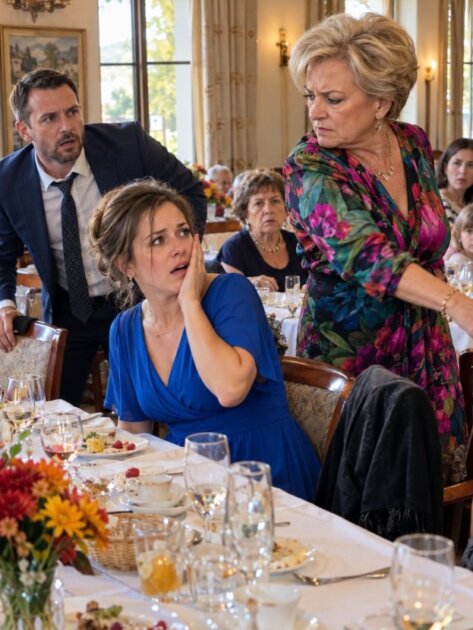
The slap landed across my face with such brutal force that its sound echoed through the private dining room of the restaurant.
Just a moment earlier, I had been holding a cup of coffee. Now, a few drops of the hot drink were running down the front of my light blue dress as a burning pain shot across my cheek. My head instinctively turned to the side, and an unpleasant ringing began in my ears.
Twenty-eight people sat frozen around the table.
Even the two little children coloring at the neighboring table had stopped what they were doing.
My mother-in-law, Magdolna Bognár, stood right in front of me. Her hand was still suspended in the air, her fingers slightly spread. Her face was twisted with such fury that you would have thought I had committed some unforgivable crime.
“Don’t you dare talk back to your elders!” she hissed. “As long as you’re sitting with my family, you’ll learn what respect means!”
My husband, Gergő, jumped to his feet so violently that his chair slid backward and crashed into the flower stand behind him. One of the burgundy napkins fell to the floor.
“Mom! You’re going to explain yourself right now!”
I raised my hand.
“Gergő, sit back down!”
My husband turned toward me in disbelief.
“Zsófi, she hit you!”
“I know. But first, ask your mother why she’s so terrified of Aunt Ilonka reading that old letter aloud.”
The color drained from Magdolna’s face in an instant.
Just moments earlier, she had been standing confidently in front of me. Now she reached for her handbag as if it contained something dangerous.
And in that moment, I understood that the envelope she had been trying to get from me all morning contained far more than an old family keepsake.
But let me start at the beginning.
That September Saturday, I had absolutely no idea that a family birthday celebration would turn into an event that would change all our lives forever.
We had gathered in a charming old restaurant in Székesfehérvár to celebrate the seventy-fifth birthday of Gergő’s aunt, Ilonka.
Warm autumn sunlight streamed through the windows of the private dining room. The tables were covered with crisp white tablecloths, burgundy napkins, and small glass vases filled with chrysanthemums. Old framed photographs hung on the walls, while soft music played in the background.
I had arranged the menu with the restaurant manager weeks earlier: homemade chicken soup with tiny pasta, breaded pork cutlets with parsley potatoes, chicken paprikash with dumplings, and finally, homemade cream slices, Ilonka’s favorite dessert.
I had done everything I could to make sure the birthday woman wouldn’t have to worry about a single thing.
Aunt Ilonka was particularly close to me. She was a petite, fragile woman with neatly styled hair, graceful movements, and such a warm smile that even after a terrible day, you couldn’t help feeling better when you saw her.
She had worked in an elementary school library for forty years. Her husband had passed away long ago, and they had never had children, but everyone in the family loved her.
Or at least, that was what I believed.
Gergő and I had been married for eight years. I was thirty-four and worked as a medical assistant at a clinic in Székesfehérvár. My husband was an electrical engineer who commuted to Veszprém for work.
We weren’t wealthy, but we had everything we needed: our own apartment, a six-year-old son named Marci, and a mostly peaceful family life.
There was just one person who regularly disturbed that peace: my mother-in-law.
Magdolna was never loud, vulgar, or openly aggressive. Quite the opposite. She always dressed elegantly, appeared with perfectly styled hair, and had a remarkable talent for insulting people so politely that they sometimes didn’t realize what had happened until hours later.
If I bought Marci a new coat, she would comment that he would probably still be cold in it.
If we didn’t visit her for Sunday lunch, she would call Gergő and tell him in a sorrowful voice that she had spent the entire day sitting alone in her apartment.
And whenever I disagreed with her about anything, she always used the same sentence:
“You’ll understand when you’re as old as I am, dear.”
Gergő’s father, László, usually stayed in the background. After thirty-nine years of marriage, he had learned that the safest way to deal with his wife was to remain silent.
He never interrupted her, never argued, and never tried to defend anyone.
I suppose that over the years, he had convinced himself that silence was the best way to preserve family peace.
But something happened that week that even Magdolna couldn’t handle with her usual confidence.
Three days before the celebration, Aunt Ilonka called me.
“Zsófikám, I have a small favor to ask. Could you bring something for me from the second drawer of my dresser on Saturday?”
“Of course. What should I look for?”
“An envelope. Old, yellowed paper. You’ll find it underneath the photographs. Magdolna’s name is written on it.”
“Is it some kind of special birthday present?”
There was a long silence on the other end of the line.
“No, my dear. It’s more about settling an old matter.”
Her voice was so serious that I instinctively straightened in my kitchen chair.
“Aunt Ilonka, has something happened?”
“Nothing is wrong. It’s just that sometimes people wait too long to say something. And then one day, they realize they might not have as much time left as they thought.”
The following afternoon, I went to visit her.
The envelope was lying on the kitchen table between an old photo album and a porcelain sugar bowl. It was made of thick, yellowed paper, with tiny cracks along the edges. The address had been handwritten in blue ink.
Ilonka stared at it for a long time before handing it to me.
“Take this with you on Saturday.”
“Why don’t you give it to her yourself?”
“Because if she sees it here, she’ll try to take it away.”
I looked at her in surprise.
“Magdolna?”
Ilonka nodded.
“There’s one thing I want you to promise me, Zsófika. Don’t give it to her until I tell you to. No matter what she says or promises, don’t let her take it.”
“But what’s inside?”
The elderly woman slowly shook her head.
“A truth someone has been waiting fifty years to hear.”
I didn’t ask anything else. I carefully slipped the envelope into the bottom of my handbag.
On Saturday, I could already sense that something was wrong when we arrived. Magdolna seemed unusually tense.
When she saw the flowers, she narrowed her eyes.
“Chrysanthemums aren’t exactly birthday flowers.”
“These are white and burgundy. They’re Ilonka’s favorites,” I replied patiently.
“They’re still chrysanthemums.”
Then she criticized the cake.
“That’s not going to be enough for everyone.”
“I ordered one with thirty-two slices.”
“Well, I hope you know what you’re doing.”
After every remark, she smiled as though we were having a perfectly innocent conversation. I tried not to let her ruin the celebration.
But before lunch, she pulled me aside into the hallway.
The narrow corridor was empty at that moment. The smell of roasted meat and freshly prepared soup drifted out of the kitchen.
Magdolna stepped closer.
“I heard Ilonka gave you something.”
My stomach tightened.
“Yes.”
“An envelope?”
I didn’t deny it.
“Yes.”
“Give it to me!”
Her voice was no longer pleasant.
“Aunt Ilonka asked me to wait until she tells me to hand it over.”
“Zsófia, don’t play dumb! That’s a family matter.”
“Then perhaps Aunt Ilonka should decide when it comes out.”
Magdolna’s eyes narrowed.
“You have no idea what you’re getting yourself into.”
“I don’t want to know. I’m simply respecting her request.”
Just then, Aunt Ilonka appeared at the end of the hallway, leaning on her walking stick.
“Is everything all right?”
Magdolna immediately transformed. Her expression softened, and a smile appeared on her lips.
“Of course! We were just talking about the cake.”
But Ilonka didn’t take her eyes off her.
“Magdi, I’d like to talk to you today.”
“Let’s enjoy the celebration, Ilonka. Don’t worry yourself with these things!”
“We will celebrate. But I don’t want to postpone this any longer.”
Magdolna said nothing. She turned around and walked back into the dining room.
As she passed me, I caught the strong scent of her expensive perfume.
At the time, I still didn’t understand why her hands would tremble later when she raised her glass.
The first hour of lunch passed relatively pleasantly.
Marci and his cousins were drawing at the table by the window. The men were discussing Ferencváros’s latest football match, while the women chatted about their children, their jobs, and the upcoming holidays.
Ilonka received a flower from everyone. When Marci handed her a drawing he had made himself, tears filled the elderly woman’s eyes.
“I’ll have this framed,” she promised, gently stroking his head.
After the main course, László stood up, tapped his glass, and gave a short toast.
“Ilonka, seventy-five years is a long time. Thank you for always being there for us. You were the one who held this family together, even when the rest of us couldn’t manage to speak to one another properly.”
Several people around the table nodded.
Magdolna applauded loudly and lovingly took her husband’s hand.
Then Aunt Ilonka stood up too.
She slowly rose from her chair, adjusted her cardigan, placed both hands on the edge of the table, and looked around at the guests.
“I’d also like to say a few words.”
Her voice was quiet but firm.
“At seventy-five, you begin to see many things differently. You think about the people you’ve loved, the people you’ve lost, and the things you perhaps should have done differently.”
Magdolna put down her fork.
Ilonka continued.
“I’ve realized that family secrets don’t disappear just because we refuse to talk about them for decades. They simply make our lives heavier.”
“Ilonka, I think we should leave this for another time,” Magdolna interrupted.
The elderly woman looked directly at her.
“No. I want to say it today.”
Then she turned toward me.
“Zsófikám, would you take out the envelope?”
I pulled it from my handbag.
Magdolna stood up so abruptly that the table shook.
“Absolutely not!”
Everyone turned toward her.
Ilonka slowly put down her glass.
“Magdi, why not?”
“Because you have no right to bring this up now! This is nobody’s business!”
“It is the business of everyone whose life it changed.”
“You’re not going to ruin your own birthday over some old misunderstanding!”
“It’s not a misunderstanding, Magdolna.”
I took out the envelope but didn’t hand it over just yet.
“Aunt Ilonka, are you sure you want to do this now?”
“Yes, my dear.”
Magdolna suddenly grabbed my wrist.
Her fingers squeezed so tightly that I immediately felt pain.
“Put it away!”
“Please let go of me.”
“I said put it away!”
I carefully pulled my hand free.
“Mrs. Magdolna, this is Aunt Ilonka’s birthday. You’re not the one who gets to decide what she can or cannot tell her own family.”
The next moment, the slap landed.
And now you understand why I was standing there in my light blue dress, my cheek burning, while my husband jumped out of his chair.
Gergő stared at his mother with clenched fists.
“Mom, you hit my wife!”
“She deserved it!” Magdolna snapped. “She needs to learn that she can’t speak to me like that!”
My mother-in-law stared at her son in disbelief.
“Now you’re turning against me too?”
“I’m not turning against anyone. But what you just did is unacceptable.”
Then Aunt Ilonka spoke with a force I had never heard from her before.
“Enough, Magdolna!”
The entire room fell silent.
“I’m going to read it now.”
I placed the envelope on the table.
Meanwhile, Gergő asked his cousin Eszter to take Marci out onto the terrace. He didn’t want our little boy to witness what was about to happen.
Aunt Ilonka slowly opened the envelope.
The rustling of the paper seemed incredibly loud in the silence.
Two folded letters and an old black-and-white photograph fell out.
“This was taken in the summer of 1974,” Ilonka explained. “The third woman was named Ágnes Fekete. She was our best friend.”
László leaned closer.
“I remember her.”
Magdolna shifted nervously in her chair.
“Ilonka, please don’t continue!”
Ilonka ignored her.
“Ágnes worked at the local cultural center back then. She was incredibly talented. She drew, painted, designed stage sets, and was planning to attend an applied arts program in Budapest.”
Ilonka placed the photograph in the middle of the table.
“But there was something even more important to her. She was in love with a young man.”
Then she slowly raised her eyes toward László.
“A man named László Bognár.”
My father-in-law’s face tightened.
Magdolna lowered her head.
“This is a fifty-year-old story,” she whispered.
“Yes,” Ilonka replied. “And for fifty years, we’ve been waiting to finally tell the truth about it.”
Over the next few minutes, things came to light that nobody had expected.
In October 1974, Ágnes received a letter that supposedly came from László. In it, he wrote that he wanted to end their relationship because he had fallen in love with Magdolna. He also asked Ágnes never to contact him again.
The young woman was only twenty-two years old at the time.
The letter devastated her so badly that she quit her job and moved to Szolnok to live with a relative.
László sat motionless for a long time.
“I never wrote her a letter like that.”
Ilonka nodded.
“I know.”
“Then who did?”
The elderly woman turned toward Magdolna.
“She wrote it. In your name.”
Someone at the table gasped.
Magdolna jumped to her feet.
“That’s a lie!”
“No, Magdi. You showed me the draft yourself. You told me you only wanted to frighten Ágnes so she would leave the two of you alone.”
“Nothing serious was ever going on between them!” Magdolna shouted.
László slowly turned toward her.
“Then why did you have to lie?”
Magdolna didn’t answer.
“I’ve been married to you for thirty-nine years,” my father-in-law continued. “I thought Ágnes had simply left. You told me she had moved to Budapest with an older man.”
“I only heard…”
“From whom?”
Magdolna’s lips began to tremble.
“I don’t remember anymore.”
László gave a bitter smile.
“You remember exactly what dress Zsófia wore at last year’s Christmas lunch, but you can’t remember who told you that story?”
Under the table, my husband took my hand.
I could feel that he was thinking the same thing I was: his mother hadn’t simply made a mistake decades ago. She had changed another woman’s entire life and then hidden the truth for half a century.
Ilonka put the first letter down.
“Ágnes died in February. She contacted me last autumn and told me she no longer wanted revenge on anyone. There was only one thing she wanted to clear up before she passed away.”
She took out another sheet of paper.
“Ágnes had a daughter.”
Magdolna suddenly grabbed the edge of the table.
László could barely breathe.
“How old is she?”
“Fifty-one.”
“And who is her father?”
Aunt Ilonka looked at him for a long moment.
“According to Ágnes, you are.”
The next moment, Magdolna burst into a nervous, almost hysterical laugh.
“This is ridiculous! You’re going to destroy our family based on the claims of a dead woman? What’s next? Some stranger will show up demanding money?”
“She didn’t ask for money,” Ilonka replied. “Her name is Réka. She’s an accountant in Szolnok. She has two grown sons. She wants only one thing: to meet her father.”
László slowly turned toward his wife.
“You knew Ágnes was expecting a child?”
Magdolna remained silent.
“Magdi, I’m asking you a question!”
“I didn’t know for certain,” she whispered.
“What does that mean?”
“I met her once before she moved away. She told me her period was late. But I didn’t know whether the child was yours!”
László’s face twisted with pain.
“And you never told me?”
“Your relationship was already over!”
“Because you ended it!”
For the first time, my father-in-law raised his voice in genuine anger.
Gergő stood up and placed a hand on his father’s shoulder.
“Dad, come outside with me for a moment.”
László shook his head.
“No. I’ve been silent for fifty years. I want to hear the whole truth now.”
Then, unexpectedly, he turned toward me.
“Zsófia, how are you?”
It was such a simple question, yet it brought tears to my eyes.
“My cheek hurts, Uncle László. But I’ll be all right.”
He nodded and looked at his wife again.
“Apologize to her!”
Magdolna pressed her lips together.
“Is that really the most important thing right now?”
“Yes. Because today you hit your son’s wife. And I’m not going to pretend that’s acceptable.”
My mother-in-law looked at me.
“I’m sorry things turned out this way.”
“They didn’t just turn out this way,” I replied quietly. “You hit me. That was your decision.”
Her expression tightened.
“What else do you want?”
“I want to hear you say that you had no right to hit me. And that it wasn’t my fault.”
Magdolna remained silent for several seconds.
Then she grabbed her handbag and headed for the door.
Ilonka called after her one last time.
“Magdi! For once in your life, stop running away from your own actions!”
My mother-in-law didn’t answer.
The door closed quietly behind her.
The birthday celebration never really resumed after that. The guests began gathering their belongings awkwardly. Some hugged Ilonka goodbye, while others simply left without saying a word.
Several slices of birthday cake remained untouched.
A little later, Marci came running toward me.
“Mom, why did Grandma hit you?”
I knelt in front of him and straightened his sweater.
“Because she got very angry and made a bad decision.”
“But grown-ups aren’t allowed to hit people either.”
“That’s right, sweetheart. Nobody is allowed to do that.”
Marci wrapped his little arms around my neck.
“So does that mean we don’t love Grandma anymore?”
I pulled him close.
“We can still love someone without allowing them to hurt us.”
On the drive home, Gergő barely spoke.
The city lights passed one after another outside the car window. Marci was sleeping peacefully in the back seat, still clutching the little toy car he had received at the celebration.
When we stopped at a red light, Gergő finally spoke.
“I’m sorry.”
“For what?”
“For not stopping her sooner. I saw how threatening she was being with you in the hallway.”
“You weren’t the one who hit me.”
“But I allowed Mom to treat you this way for years. I always thought that if I didn’t react, she would eventually calm down.”
I looked out at the autumn trees.
“Gergő, I don’t want you to choose between me and your mother. But I don’t want Marci growing up believing that humiliation is part of being loved.”
My husband nodded.
“He won’t.”
In the weeks that followed, László met Réka.
Their first meeting took place in a café in Szolnok. We didn’t go with him. He said he wanted to get to know his daughter privately first.
Réka was fifty-one, with brown hair and an average build. She worked as an accountant, had two grown sons, and had lost her mother after a long illness.
She didn’t want money, demand an inheritance, or threaten legal action.
She simply wanted to find out what kind of man her father was.
And László wanted to know whether he really had a daughter he had never known about for half a century.
The paternity test, arranged by mutual agreement, eventually removed every doubt.
Réka really was László’s daughter.
When the results arrived, my father-in-law spent an entire evening at our apartment.
For a long time, he simply sat in the living room holding the paper. Every now and then, he read the results again, as if he still couldn’t quite believe them.
“Fifty-one years,” he finally said. “Fifty-one years I’ll never get back.”
Gergő sat down beside him.
“But now you have the chance to get to know each other.”
László nodded, although the pain remained visible in his eyes.
In mid-November, Magdolna appeared at our apartment door.
She hadn’t called beforehand.
Over the intercom, she simply announced that she wanted to speak to me.
When I went downstairs, she was wearing a thick beige coat. Her hair was carefully styled, and she was holding a paper bag tightly in one hand.
“I brought you an apple pie,” she said.
“Thank you. But I assume that’s not the only reason you’re here.”
Her gaze wandered for a moment.
“No.”
We stood outside in the cold air of the entrance hall. Neither of us spoke for several seconds.
Then Magdolna took a deep breath.
“I hit you because I was afraid. I thought that if I made a big enough scene, Ilonka wouldn’t read the letter.”
“So you deliberately tried to silence her?”
“Yes.”
It was the first time she had admitted what she had done without trying to justify herself.
“And why have you come now?”
“László has moved out. He’s staying with Ilonka for the time being. Gergő barely speaks to me. And Ilonka told me she doesn’t want to see me until I properly apologize to you.”
I looked at the woman who had spent years insisting on having the final word in every family situation.
For the first time, she seemed unable to find the right words.
“Mrs. Magdolna, do you know what hurt the most?”
She shook her head.
“It wasn’t even the slap. It was the fact that Marci saw it. He saw his grandmother hit his mother because she refused to obey her.”
Tears filled Magdolna’s eyes.
“I’m sorry, Zsófia. I truly am. I shouldn’t have hit you. I had absolutely no right to do that.”
This time, she didn’t add that I had provoked her. She didn’t explain why she had been upset. She didn’t try to minimize what had happened.
She simply stood there, waiting for my answer.
“I accept your apology,” I said. “But that doesn’t mean everything will go back to the way it was.”
“I understand.”
“For now, you won’t be seeing Marci. Gergő and I will decide together when the time is right.”
Magdolna slowly nodded.
She placed the paper bag beside the stairs and turned to leave.
“Mrs. Magdolna!” I called after her.
She looked back.
“Uncle László has already met Réka. He thinks she’s a good person.”
Her face tightened.
“I’ve heard.”
“Perhaps one day you could get to know her too.”
“I don’t know if I could do that.”
“That’s not for me to decide.”
Magdolna didn’t answer. She slowly walked toward the entrance.
In mid-December, Aunt Ilonka invited us to her apartment for Sunday lunch.
The rooms smelled of cinnamon and freshly baked apple cake. Her dining table was beautifully set with her finest porcelain dishes.
László was there, along with Gergő, Marci, and me.
And Réka was there too.
As soon as she walked in, I noticed how much she resembled Gergő. She raised her left eyebrow in exactly the same way when she felt embarrassed, and the same smile appeared on her face whenever something amused her.
Gergő noticed it too.
“This is unbelievable,” he whispered to me.
Réka overheard him and laughed.
“Dad already told me there are some similarities.”
László’s expression changed immediately when he heard that word.
Dad.
It was as if he still needed to get used to the fact that someone could call him that.
After lunch, Marci ran over to Réka.
“Aunt Réka, do you know how to make paper airplanes?”
“Of course!”
A few minutes later, they were racing down the hallway to see whose airplane could fly the farthest.
László watched them from the living room doorway. His eyes filled with tears, but this time he was smiling.
And then I finally understood that what had happened on that September afternoon wasn’t simply an old family secret coming to light.
A man had finally found his father after fifty-one years.
A father had discovered that he had a daughter.
And an entire family had been forced to face the truth they had buried for decades.
Later, Aunt Ilonka called me into the living room.
The old envelope was lying on the coffee table.
“Zsófikám, I’d like you to understand why I chose you to look after that letter.”
“Because I visit you often?”
“That too. But not only that.”
The elderly woman took my hand.
“When I broke my wrist, you came to see me. You didn’t ask why I wasn’t calling the other relatives. You didn’t tell me what I should do. You went shopping, cooked, washed the dishes, and listened whenever I wanted to talk.”
She smiled.
“I knew that if I trusted you with that envelope, you wouldn’t protect Magdolna or try to spare Gergő from an uncomfortable situation. You would respect my wishes.”
My throat tightened.
“I never thought it would become so important.”
“Neither did I. But there’s something else. When Magdi hit you, you stopped Gergő from reacting out of anger. That allowed everyone to focus on the truth instead of another family argument.”
Just then, Marci came rushing into the living room.
“Mom! Look! Aunt Réka taught me how to make a paper airplane that can fly all the way down the hallway!”
He proudly held up a blue paper airplane.
Ilonka burst out laughing.
“Then I absolutely have to see this!”
We all went into the hallway.
Marci held the airplane carefully with both hands, stepped backward, and released it with a dramatic throw.
The little paper plane glided through the air, passed the coat rack in the entrance, and landed right in front of László’s shoes.
My father-in-law bent down, picked it up, and smiled at his grandson.
“Who taught you to make this?”
“My new aunt!”
László glanced at Réka.
His daughter smiled back.
And something incredibly touching happened in that moment. My father-in-law pulled Réka toward him and embraced her for a long time, holding her as if he never wanted to lose her again.
Of course, our family didn’t become perfect overnight.
Magdolna later began working with a professional to confront her behavior and her past. László didn’t move back in with her immediately. Gergő and I didn’t rush into reconciliation either. Marci didn’t see his grandmother again until several months later, during short, carefully agreed visits.
I understood that an apology matters, but rebuilding trust takes time and genuine change.
However, something changed forever on that September day.
Nobody in our family could ever again claim that older people were automatically right. Nobody had to pretend that preserving peace meant accepting every insult and humiliation.
Shortly before Christmas, Aunt Ilonka called me again.
Her voice sounded much happier this time.
“Zsófikám, do you know what the best birthday present I received this year was?”
“The family? Getting to know Réka?”
“That too. But not quite.”
She paused for a moment.
“It was realizing something at seventy-five that I probably should have understood much earlier.”
“What is that, Aunt Ilonka?”
“Peace isn’t the same as silence. Love doesn’t mean hiding the truth, and a family doesn’t stay together because everyone is afraid to speak their mind.”
I remained silent for a long time.
Then I looked out the window, where the first December snowflakes were beginning to fall.
I remembered that September afternoon, the deafening slap, Magdolna’s suddenly pale face, the yellowed envelope, and the moment when I stopped my husband with a single sentence.
Back then, I thought I was standing in the middle of a family argument.
Today, I know something much bigger had happened.
A fifty-year-old lie had finally come to an end.
And I had learned that sometimes the greatest act of courage isn’t striking back.
It’s finally refusing to let anyone silence you.