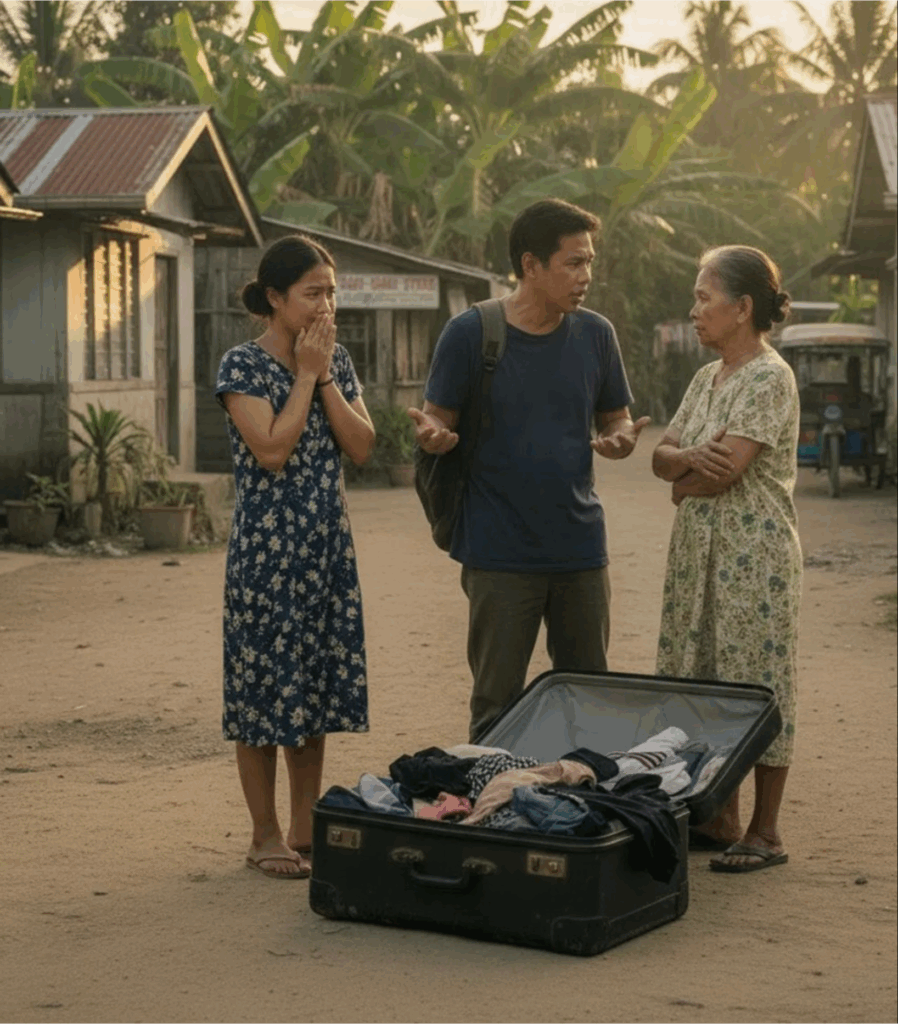
“You Kicked That Country Bumpkin Out! Where Did She Get a Townhouse?” – My Mother-in-Law Fumed When She Saw Her Ex-Daughter-in-Law’s Luxurious Home
“That country bumpkin has really gone too far this time!” Nina Arkadyevna’s voice sliced through the morning silence so sharply that Maksim nearly choked on his coffee. “She just turns up as if nothing ever happened! And with that miserable, battered old suitcase of hers!”
Maksim didn’t even look up from his phone.
After three years of marriage, he had learned that his mother’s loud complaints rarely had any particular reason behind them. All it took was a plate left in the wrong place, a dinner prepared differently than she expected, or a single comment from Marina, and Nina Arkadyevna would behave as though she had suffered a personal attack.
Marina was standing by the window. Outside, someone was watering the flowers on the neighboring balcony. It was July, the air was heavy and humid, and the sun was already scorching the streets early in the morning.
She heard every word her mother-in-law said, but she didn’t turn around.
She had learned by then that arguing with certain people was completely pointless.
Meanwhile, Nina Arkadyevna marched into the kitchen and carelessly dropped her handbag onto the chair Marina had carefully cleaned the previous evening.
“So, what’s for lunch?” she asked, looking her daughter-in-law up and down. “Or have you ordered something again? I see cooking has become beneath you two.”
“Mom, we had dinner at home last night,” Maksim remarked.
“At home?” the woman scoffed. “You call instant noodles a proper meal? When I was your age, I put a three-course dinner on the table every single day!”
Marina finally turned around.
“Nina Arkadyevna, I work until eight in the evening. If you’d like something for lunch, everything you need is in the refrigerator. Feel free to prepare something for yourself.”
Her mother-in-law stared at her as though Marina had just committed an unforgivable offense.
“Did you hear that, Maksim? She’s trying to tell me what to do in my own son’s apartment!”
“Marina, can we please not start this again?” the man sighed. “You know Mom doesn’t mean any harm.”
Marina looked at her husband for several seconds.
He always said the same thing.
She didn’t mean any harm. She was just honest. She was only worried. She only wanted to help.
And somehow, Marina was always the one expected to put up with everything.
“All right,” she finally replied. “I’ll see you tonight.”
She picked up her bag and left for work.
That evening, she got home at half past eight. The kitchen looked as though a small war had broken out inside it. Dirty dishes were piled high in the sink, dried sauce stains covered the stove, and onion skins were scattered across the floor.
So Nina Arkadyevna had eventually decided to cook after all.
Maksim was sitting in the living room, watching television.
“Mom says you really hurt her feelings,” he announced without turning around.
Marina put down her keys.
A strange calm came over her. It wasn’t anger or resentment. It was more like the moment when someone finally realizes that a door they have spent years trying to open was never meant to let them in.
“Maksim, do you even understand what’s happening between us?”
“What do you mean?”
“I mean that I’m your wife, not your mother’s employee. Yet every single day, you two treat me as though I should be grateful that you even allow me to live in this apartment.”
“Mom just wants everything to be all right.”
“Then tell her to start by putting her own behavior in order.”
Maksim finally turned toward her.
“Don’t talk about her like that!”
Marina smiled. Sadly, but without bitterness.
“You know what? Your mother is right. I really don’t feel comfortable here.”
The man stared at her in confusion.
“What is that supposed to mean?”
“It means I’m leaving.”
Over the next twenty minutes, Marina packed her most essential belongings.
She took only one suitcase. It was medium-sized, with wheels, and one of its handles had been loose for months.
Nina Arkadyevna appeared in the bedroom doorway. A satisfied smile spread across her face.
“Well, good luck, my dear! I hope you soon realize that life isn’t as easy as you think.”
Marina didn’t answer.
She grabbed her suitcase, slung her handbag over her shoulder, and walked out.
Naturally, the elevator wasn’t working. She had to walk down all five flights of stairs.
Outside, the heat was still rising from the asphalt. Marina stopped in front of the building and stood there for a long time, simply staring at the street.
She had no idea where to go.
Only one person came to mind: Sveta, an old acquaintance who worked as a caretaker at a student dormitory.
She called her.
“Marina? What happened?” the woman asked as soon as she heard her voice.
“Sveta, could you help me? I just need a room for a few days.”
“Don’t explain anything! Come over. I have an empty room.”
The room was barely eight square meters. It contained a narrow bed, a worn desk, and an old wardrobe. The window overlooked the courtyard, and a faded mark on the wall suggested that a picture had once hung there.
Marina put down her suitcase, sat on the edge of the bed, and remained motionless for a long time.
She didn’t cry.
She was simply trying to comprehend how her entire life had changed in just a few hours.
Then she opened her laptop.
The following morning, she went to work as usual, as though nothing had happened.
She worked as a financial analyst at a small investment company. She wasn’t a manager, journalists weren’t lining up to interview her, and her name meant nothing in the business world.
But she had one special ability.
She could see what others often overlooked in the numbers. She was able to identify weaknesses in businesses, predict risks, and discover opportunities that other analysts simply walked past.
Her colleagues often told her:
“Marina, you have some kind of sixth sense for this.”
She would simply smile.
It wasn’t a sixth sense. It was years of hard work.
She spent four months at the dormitory.
She woke up at six every morning and went to bed late at night. During the day, she worked, and at night, she devoted herself to an independent analytical report she had been putting off for months.

Sometimes, she ate nothing but a coffee and a pastry all day.
She lost seven kilograms, but she refused to give up.
Eventually, the completed study attracted the attention of people whose names she had previously encountered only in professional articles.
One morning, she received a call from an unfamiliar number.
“Marina Sergeyevna? This is Oleg Dmitrievich Krasnov. I’ve read your analysis, and I find it extremely interesting. I’d like to meet with you in person.”
Krasnov owned a financial media company. They produced podcasts, published investment analyses, and operated private business clubs.
He was looking for a professional who could explain money, investments, and the consequences of financial decisions in a way ordinary people could understand.
At first, Marina thought she had misunderstood the offer.
Then an opportunity came along that she simply couldn’t refuse.
She wrote her first article in a single weekend.
Within hours of its publication, it was already being shared across several financial groups. The following morning, Krasnov called her again.
“Marina, you’re exactly the person I’ve been looking for.”
From that moment on, everything accelerated.
Six months later, she had two hundred thousand followers. A year later, she was being invited to speak at conferences. After eighteen months, she was hosting her own podcast, which had become one of the ten most popular business programs in the country.
She didn’t use complicated technical jargon. She didn’t try to make herself sound smarter than everyone else.
She simply talked about how to manage money, avoid bad decisions, and why no one should ever surrender control over their own life.
People listened.
Meanwhile, Maksim never contacted her once.
As for Nina Arkadyevna, she believed the whole story was over for good. She had even started planning a new wardrobe for the bedroom that had become available.
But Marina’s story was only just getting interesting.
When she signed the purchase agreement for her first townhouse, the notary smiled and asked:
“Your first property?”
“Yes,” Marina replied.
Then she signed the documents and spent several seconds simply looking at her name on the page.
She hadn’t received it as a gift. She hadn’t inherited it. No wealthy man had bought it for her.
She had worked for every single square meter.
And that meant more to her than any luxury ever could.
Nina Arkadyevna, however, didn’t find out about it until much later.
Klava, the neighbor from the fourth floor, showed her a video on her phone.
On the screen sat an elegant woman wearing a light-colored blazer, confidently explaining something about investments in a television studio.
The caption read:
**Marina Volkova – Financial Analyst and Host of the “Money Without Illusions” Podcast.**
Nina Arkadyevna narrowed her eyes.
“That’s not Marina.”
“Of course it is!” Klava laughed. “She used to live at your place! I recognized her immediately.”
“Oh, please! They just put makeup on her and fixed her hair. She’s still the same country bumpkin!”
That evening, however, when she was alone, she searched for the program.
At first, she listened for only three minutes.
Then another five.
Eventually, she sat in front of the television for almost an hour.
Marina’s voice was calm, her delivery confident, and her ideas so clearly expressed that even Nina Arkadyevna could easily understand what she was talking about.
For some reason, that irritated her even more.
At half past ten, she called her son.
“Maksim! Have you seen what your ex-wife is up to?”
“Mom, it’s late. What’s happened?”
“She appears on television! She has her own show! She’s lecturing other people about money! Where did she get all that money?”
Maksim remained silent for a long time.
“I don’t know, Mom.”
“What do you mean, you don’t know?! You kicked her out! She left with just one suitcase! And now she’s living like a princess!”
“I didn’t kick her out,” the man said tiredly. “She left on her own.”
“Oh, don’t split hairs!”
Maksim hung up.
Nina Arkadyevna continued staring angrily at her phone for several minutes.
She couldn’t understand how any of this had happened.
The woman she had always looked down on now seemed more successful than anyone in her circle.
And worst of all, Marina had achieved everything without her.
Three months later, Marina had completely settled into her new home.
The townhouse was bright, spacious, and modern, but not ostentatious. Paintings hung on the walls, books lined the shelves, and the living room opened directly onto a small garden.
She had chosen every piece of furniture herself.
Every curtain, every lamp, every little decorative item.
Nobody told her what color something should be, what needed rearranging, or what the neighbor thought would look better.
An apple tree stood in the garden. Beside it was a wooden bench and a small table where her coffee steamed every morning.
Marina often sat there for fifteen minutes.
Without her phone. Without work. Without anyone else’s opinions.
One morning, her phone rang.
It was Maksim.
“Hi,” he greeted her cautiously.
“Hi.”
“I heard things are going well for you.”
“Yes, fortunately.”
A long silence followed.
“Mom would like to visit you,” Maksim finally said.
Marina put down her cup.
“Why?”
“She just wants to see how you’re living.”
“Maksim, your mother wasn’t interested in how I felt even once during our three years together. And now, all of a sudden, she’s interested in my life?”
“Don’t take it that way…”
“Then how should I take it?”
The man didn’t answer.
Marina finally said:
“If she wants to see me, she can make an appointment. I’m no longer obligated to open my door to everyone.”
But Nina Arkadyevna wasn’t the kind of woman who asked permission.
A few days later, she simply showed up at Marina’s house.
She was wearing a floral dress, carrying a handbag with a gold clasp, and had applied so much hairspray that even a strong wind wouldn’t have been able to mess up her hairstyle.
When Marina opened the door, her former mother-in-law was speechless for a moment.
Then she looked the house up and down.
“Well… so this is how we’re living these days,” she remarked instead of greeting her.
“Good afternoon, Nina Arkadyevna.”
“Good afternoon.”
Without being invited, the woman stepped inside.
First, she inspected the hallway, then the living room, and finally the kitchen.
“Quite a nice little house,” she said grudgingly. “I imagine it didn’t come cheap.”
“No, it didn’t.”
“And the furnishings? Did you choose all this yourself, too?”
“I had help from an interior designer.”
Nina Arkadyevna ran her finger along the windowsill.
She couldn’t find even a speck of dust.
That annoyed her particularly.
“I see business is going well,” she remarked. “Meanwhile, Maksim is struggling all alone. Don’t you think you could at least help him a little?”
Marina looked at her calmly.
“Why should I help him?”
“Because he was your husband!”
“Exactly. He *was*.”
“Don’t be so cruel! My son is suffering terribly. He barely eats, sleeps badly, and has completely withdrawn into himself.”
“Then perhaps he should see a doctor.”
“How can you talk like that?!”
“Nina Arkadyevna, Maksim is a thirty-four-year-old grown man. It’s not my responsibility to put his life back together.”
The woman fell silent for a moment, then changed the subject.
“And tell me, how long do you think this success will last? These days, everyone is a blogger, everyone thinks they’re an expert. In a year, nobody will even remember you!”
Marina smiled.
“Possibly. But for now, people still remember me.”
Nina Arkadyevna left an hour later.
Marina politely walked her to the door and closed it behind her.
She felt no anger.
Not even satisfaction.
She simply felt that, at last, she no longer had to prove anything to anyone.
A week later, another opportunity came knocking.
This time, over the phone.
“Marina Sergeyevna? This is Irina Larina, a producer at First Business Television. We’d like to offer you your own program. Once a week, broadcast live to a nationwide audience.”
Marina was sitting at her desk. She looked out into the garden, where the branches of the apple tree were swaying gently in the breeze.
“Please send me the proposal by email,” she replied. “I’ll review it carefully.”
After the call, she sat quietly for a few minutes.
She didn’t scream with excitement or call every person she knew.
She simply smiled.
She knew she would accept.
But first, she would read the contract. A person should handle their own success just as carefully as they handle their money.
Maksim showed up on Friday evening.
Marina saw him on the intercom screen. He was wearing an old blue T-shirt, his hair was untidy, and his face showed deep exhaustion.
She let him in.
Maksim stepped inside and looked around for a long time.
“Beautiful,” he said quietly.
“Thank you.”
“I never thought you’d have a house like this one day.”
“Back then, I didn’t know I’d have a house like this one day, either.”
The man nodded awkwardly.
They sat down in the kitchen. Marina made tea, while Maksim spent a long time simply turning his cup around in his hands.
“I’ve thought a lot about that evening,” he finally said. “The night you left with that suitcase.”
“So have I.”
“I thought you’d come back after a few days.”
Marina looked at him.
“I know.”
“Mom always said you wouldn’t manage on your own.”
“And you believed her.”
Maksim lowered his eyes.
“Yes.”
“That was the biggest problem, Maksim. It wasn’t that your mother didn’t like me. It was that you never stood by my side.”
The man remained silent for a long time.
“I’m sorry.”
Marina honestly considered what she felt.
“I don’t hold a grudge against you anymore.”
“Can you forgive me?”
“I forgave you a long time ago. But that doesn’t mean we should get back together.”
Maksim nodded.
He left at nine that evening.
Marina closed the door behind him and realized that this was the last time her past would come knocking.
Her television program premiered in early September.
Its title was simple:
**“Volkova. Money.”**
The producer had initially wanted a softer, friendlier name, but Marina insisted on her own idea.
Four hundred thousand people watched the first episode.
Seven hundred thousand watched the second.
After the third episode, she received a particularly touching message.
A fifty-two-year-old woman had written:
“Today, I opened my own bank account for the first time. My husband has managed our money my entire life, and I have never had a single ruble that he didn’t know about. Now, at last, I have my own savings. Thank you for showing me that this is possible for me, too.”
Marina read the message three times.
Then she saved it.
This was why she did what she did.
Not for the ratings. Not for fame. But to show other people that financial independence wasn’t a privilege reserved for a lucky few. It was an opportunity worth fighting for.
One evening, Nina Arkadyevna accidentally switched to Marina’s program.
The moment she saw her on the screen, she immediately shouted:
“Maksim! Come here! Right now!”
Her son walked out of his room.
On the screen, Marina was standing in a dark blue blazer, explaining a financial statement.
Nina Arkadyevna was practically trembling with anger.
“Look! Just look at what she’s doing! You kicked that country bumpkin out! Where did she get a townhouse? Where does she get all that money? How can she afford to live so well?”
Maksim watched the screen for a few seconds.
Then he spoke quietly.
“She worked for it, Mom.”
“Everyone works! I’ve worked my entire life, too!”
For the first time, Maksim looked his mother straight in the eyes.
“No, Mom. You’ve spent your entire life trying to control other people’s lives. Marina built her own.”
Nina Arkadyevna stared at him in disbelief.
“How dare you speak to me like that?”
“By finally saying what I was too afraid to say before.”
The man returned to his room.
His mother remained alone in front of the television.
For a long time, she stared at the screen, where an advertisement was now playing.
A strange feeling came over her.
Perhaps, for the first time, it occurred to her that Marina hadn’t made it so far simply because she was lucky. It wasn’t because someone had helped her, nor because she had some secret connections.
She had simply worked hard.
And she, Nina Arkadyevna, who had always been so proud of her ability to put everyone in their place, had reached the age of sixty with very little she could genuinely be proud of.
The thought was unpleasant.
So she quickly pushed it away.
In October, Marina bought a car.
Not a luxury vehicle, just a beautiful, silver-colored, comfortable little car with heated seats and an excellent sound system.
One evening, she was driving home while soft jazz played through the speakers.
She stopped at a red light and glanced at her phone.
Sveta had sent her a message.
The same woman who had opened her door without asking questions on that hot July evening.
“I saw you on television yesterday. I’m so proud of you! I always knew you’d go far.”
Marina smiled and replied:
“And I’ll never forget that you took me in that evening. When nobody else wanted me.”
Sveta sent her a heart.
The traffic light turned green.
Marina drove on.
At home, silence, her garden, and her favorite coffee machine were waiting for her.
She had never thrown away the old suitcase with the broken handle.
She kept it on one of the shelves in the storage room.
Not because she missed the past.
But because it reminded her of that evening when everything seemed lost, yet she still took the first step toward a new life.
In November, another important offer arrived.
One evening, Oleg Krasnov called her.
“Marina Sergeyevna, I’d like to offer you something more substantial. A joint business venture. We’d create a platform to help women achieve financial independence. Online courses, personal consultations, educational materials. You would be the project’s professional director and public face. I’d provide the investment and business infrastructure.”
Marina thought it over.
This was no longer just a television show or another podcast.
It could become a business that genuinely changed many people’s lives.
She asked for twenty-four hours to consider it.
The following day, she called Krasnov back.
“I accept your offer.”
The project launched a few months later.
It was called **“My Own Account.”**
The business press picked up the news. An article featuring Marina’s photograph appeared, introducing the new venture and explaining its mission.
One morning, Nina Arkadyevna read the news on her phone.
At first, she only glanced at the headline.
Then she opened the article.
Marina was smiling in the photograph. Behind her was a bright, modern office.
Nina Arkadyevna stared at the screen for a long time.
Finally, she called her son.
“Maksim, come here for a moment!”
The man walked over, read the article, and handed the phone back.
“Well?” his mother asked. “What do you think?”
“Nothing.”
“What do you mean, nothing? This is an entire business!”
Maksim walked over to the window.
“Mom, Marina simply built her own life.”
“But how?!”
“By not sitting at home waiting for someone to rescue her after she left.”
Nina Arkadyevna fell silent.
She wanted to say something else. A cutting remark, another insult, something that would allow her to regain the upper hand.
But this time, nothing came to mind.
Meanwhile, Marina was sitting in her own garden.
The lamp beside the gate cast a warm glow over the pathway. Dry leaves rustled beneath the trees, and her favorite coffee was steaming in her hands.
Two years earlier, she had been standing on an unfamiliar street with a single suitcase, not even knowing where she would spend the night.
Now she had her own home, her own business, a secure income, and a life in which she finally made her own decisions.
And she knew what her greatest victory was.
It wasn’t the townhouse.
It wasn’t the car.
It wasn’t the television program or the hundreds of thousands of followers.
It was the fact that she no longer needed anyone’s permission to be happy.
Because sometimes, life’s greatest turning point doesn’t begin when someone finally gets what they’ve always wanted.
It begins when they finally close the door behind them—the door to a place where they were never truly valued.
Marina took another sip of her coffee and looked around the garden.
Everything was peaceful.
And for the first time, that silence truly belonged to her.