He Spent Fifteen Years Staring Out the Window, Then He Picked Up a Pencil. What He Created Captured the Attention of All Moscow
The accident happened in 1999.
Sergei was only twenty years old. He was riding home from the district center on an old motorcycle. He was carrying medicine for his mother, Maria Petrovna. On the way, a truck suddenly cut in front of him. The motorcycle skidded off the road and plunged into a ditch.
Sergei suffered a severe spinal injury. After a lengthy examination, the doctors delivered the verdict that shattered a young man’s life in a single moment:
“You will never walk again.”
Maria Petrovna refused to accept it.
She took her son from one hospital to another. She sold the cow, borrowed money from the neighbors, and clung to every doctor she heard might be able to help. She showed his medical records to professors, pleaded with them, asked questions, and kept hoping.
But the doctors only shook their heads.
Finally, one of them spoke to her impatiently.
“Madam, you must understand! There will be no miracle here. You need to take your son home and learn to live with this.”
Maria Petrovna took Sergei home.
But she never gave up on her son.
They lived in a remote village surrounded by the taiga, on the bank of a cold river. Their house was old and had only two rooms. In winter, the wind found its way through even the smallest gaps in the window frames.
Sergei was placed in the back room, right beside the window. His mother made a bed for herself in the kitchen, next to the stove.
From that day on, their lives began moving in two different directions.
Every morning, Maria Petrovna got up, fed the animals, went to work on the farm, and then returned home to care for her son.
Sergei, meanwhile, lay in bed.
At first, he was furious.
He threw mugs against the wall, pounded the edge of the bed with his fists, and cursed the whole world. He was angry with the truck driver, the doctors, God, and most of all, himself.
“Why won’t you let me die?” he shouted at his mother. “Why do you have to watch me like this? You’d be better off without me!”
Whenever this happened, Maria Petrovna gathered the broken pieces, wiped the floor, and quietly returned to the kitchen.
Later, she brought him food, changed his bed linen, and gently massaged his legs.
His thin, motionless legs, which she tried for long minutes to bring back to life.
“Mother, stop it!” Sergei sometimes snapped. “Don’t you understand that it’s over? Go and live your own life! I’m nothing but a burden to you now!”
His mother would stop, look at him, and always give the same answer.
“You are my son. If you were in this condition and I were the one lying in bed, would you abandon me?”
Sergei never answered.
He turned toward the wall and sometimes refused to speak to her for days.
Then, one day, he simply stopped shouting.
And that was much worse.
Anger at least meant he was still fighting. But silence settled over him like winter snow on a rooftop: slowly, heavily, burying everything beneath it.
Sergei would lie for hours, staring at the wall. Sometimes days passed with barely a word from him. His mother would return from work to find him lying in exactly the same position in which she had left him that morning.
He asked for nothing. He complained about nothing. He never asked what the weather was like outside.
It was as though he no longer expected anything from life.
The villagers felt sorry for Maria Petrovna, but their sympathy gradually gave way to impatience.
“How much longer are you going to keep doing this?” one neighbor asked. “Put him in a care facility! Doctors will look after him there. You deserve a little peace, too.”
“I won’t abandon my son,” Maria Petrovna replied.
“But you don’t have a life of your own anymore!”
The woman remained silent for a moment, then looked at her firmly.
“Who says I don’t? He is alive. And I am here with him.”
The neighbor merely waved her hand dismissively.
“Suit yourself, Maria. But don’t say we didn’t warn you!”
Maria Petrovna said nothing. She went home, warmed some soup, sat beside her son, and took his hand.
Sometimes, that was their entire conversation for the day.
One hand holding another.
A mother who refused to leave.
And a son who no longer believed that anything good could ever happen to him again.
Fifteen years passed this way.
A February Evening That Changed Everything
It was February. The temperature had plunged to nearly thirty degrees below zero. A thick layer of ice covered the river, and frost had turned the tree branches white.
Maria Petrovna returned late from the farm that day. Her hands were so frozen that she could barely light the stove. Once the wood finally caught fire, she rubbed her palms together and went to check on her son.
Sergei was lying beside the window.
His mother was just about to return to the kitchen when she heard his voice.
“Mother!”
She stopped.
It had been years since Sergei had called out to her like that without any particular reason.
“Yes, my son?”
The man continued looking out the window.
“Everything looks so beautiful today, somehow.”
The piece of firewood nearly slipped from Maria Petrovna’s hands.
“What is beautiful, Seryozha?”
“Look at the river! The snow on the trees… The smoke rising from the neighbor’s chimney. And there, by the fence, a crow. It’s been sitting there for minutes.”
His mother slowly walked over to the window.
She saw nothing extraordinary outside. It was an ordinary winter evening, the kind the villagers experienced a hundred times every year.
But for the first time in fifteen years, her son wasn’t talking about his past, his pain, or everything he had lost.
He was talking about what he could see.
“Yes, my son,” she said, her voice breaking. “It really is beautiful.”
Sergei remained silent for a while.
Then he spoke again.
“Mother, could you bring me a pencil and a few sheets of paper?”
Maria Petrovna didn’t understand.
“Do you want to draw?”
“I’d like to try something.”
She hurried to the old cupboard as though she feared that if she took too long, her son might change his mind. She found a short pencil stub and an old squared notebook.
Sergei took the pencil in his hand.
His fingers trembled. After fifteen years, he had almost forgotten how to draw. Yet somewhere deep inside, he still remembered the movements.
When he was a child, his teacher had often told him:
“Sergei, you have talent. Don’t waste it! One day, you’ll go far with your drawings.”
Back then, however, he had other plans. He wanted to work, ride motorcycles, fall in love, and start a family. Drawing had been nothing more than a hobby, something he eventually put aside.
Now, that forgotten ability had suddenly returned to him.
Sergei leaned over the paper and began to draw.
He sketched the river, the pine trees on the opposite bank, the snow-covered branches, and the smoke curling above the neighbor’s house.
His first drawing was crooked. The lines wandered uncertainly, the roof came out disproportionately tall, and the trees stood along the riverbank as though they might topple over at any moment.
Sergei stared at the paper for a long time.
Then, for the first time in fifteen years, he smiled.
“Well, this isn’t going to end up in an exhibition.”
Maria Petrovna stepped closer and bent over the drawing.
“I would hang it on the wall.”
“This?” her son asked in disbelief.
“Yes, this. You made it.”
The next day, Sergei drew again.
And the day after that, too.
Within a week, he had filled the notebook.
His mother went to the district center and spent whatever money she could spare on a sketchbook, pencils, and erasers.
From that moment on, Sergei had a reason to wake up.
Every morning, he opened his eyes, looked toward the window, and wondered what he would draw that day.
The river in spring, when enormous sheets of ice broke free and drifted downstream.
The river in summer, when sunlight scattered thousands of tiny stars across the water.
The forest in autumn, with its yellowing birch trees and dark pines.
The winter sky, sometimes so blue that it looked as though someone had poured paint across it.
He drew the crows, magpies, and tits that came to the feeder his mother had hung outside the window.
He drew the neighbor chopping firewood, the elderly woman walking home from the well with two buckets, and the children laughing as they sledded down the village street.
Then he began drawing things he could now recall only from memory.
The river where he had swum as a little boy.
The forest path where he had gathered mushrooms with his father.
The old motorcycle whose engine had once filled the village roads with its roar.
And a girl he had been in love with before the accident.
He could barely remember her face anymore, but he remembered her eyes. They were large, light-colored, and slightly sad.
Sergei drew those eyes again and again.
It was as though he were trying to reclaim, through the paper, everything the years had taken from him.
Meanwhile, Maria Petrovna watched as more and more drawings appeared in her son’s room.
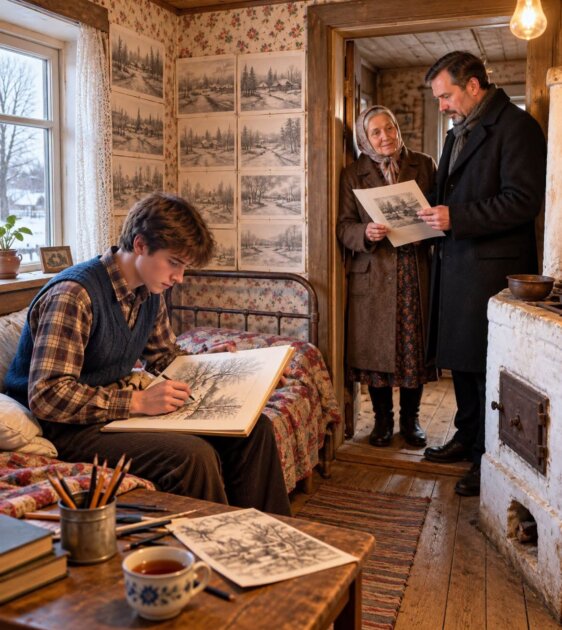
At first, she pinned them above his bed. Later, she covered the opposite wall as well. Then she added some to the door, and finally even the narrow strip of wall beside the window was filled.
By spring, the room had practically become an art gallery.
Rivers, forests, faces, and skies covered the walls. Every drawing was different, yet they all shared something in common: they had been created by someone who had spent years observing the world from a single place and had learned to notice things that other people often overlooked.
At first, the villagers came to visit out of curiosity.
Then they began lingering longer in front of the pictures.
“Did Seryozha really draw this?”
“Yes,” Maria Petrovna replied.
“But it’s beautiful!”
The woman would simply smile.
She had known for a long time that her son was capable of more than people could see.
She had only been waiting for Sergei to believe it again himself.
That summer, a photographer from Moscow arrived in the village.
His name was Ilya. He was a tall, bearded man with an expensive camera hanging around his neck. He was collecting photographs for an album called *The Russian North*. He photographed old wooden houses, abandoned churches, sunsets along rivers, and everyday life in villages tucked away at the edge of the taiga.
One afternoon, his car became stuck in a muddy stretch of road on the outskirts of the village. No matter how hard Ilya tried, he couldn’t get it free. Eventually, he got out and walked toward the nearest house to ask for help.
It was Maria Petrovna’s home.
“Come inside!” the woman invited him. “We’ll have some tea, and then I’ll call the neighbor. He has a tractor.”
Ilya stepped inside, shook the mud from his shoes, and was just about to thank her for her hospitality when he noticed the walls.
He fell silent.
Then he set down his bag and stepped closer to one of the drawings.
He studied it for a long time.
He moved to the next wall and stopped again. Then he went to the third.
“Excuse me… Who made these?”
“My son,” Maria Petrovna replied. “Sergei.”
“Is he an artist?”
The woman smiled slightly.
“Perhaps he is now.”
Ilya looked over the drawings again.
“Would you introduce me to him?”
Maria Petrovna led him into the back room.
Sergei was lying in bed, his back supported by pillows. A sheet of drawing paper rested on his lap, and he held a pencil in his hand. He was working on a riverside scene.
Ilya stood in the doorway for several seconds without saying a word.
Then he stepped closer.
“Did you draw this?”
Sergei looked up.
“No, the neighbor’s crow did. I’m just holding the pencil for it,” he replied dryly.
Ilya burst out laughing.
“Fair enough. Sorry. I’m Ilya, a photographer. I’ve come from Moscow. I’d like to photograph your drawings.”
“Go ahead.”
“Do you know what you’re going to do with them?”
Sergei shrugged.
“For now, I draw them on paper.”
Ilya smiled, but his expression remained serious.
“No. I mean, do you realize that these drawings could be exhibited in a gallery?”
Sergei put down his pencil.
“I haven’t left this house in fifteen years. Do you think I know much about exhibitions?”
“Then it’s time you learned.”
That day, Ilya photographed almost every drawing. He took close-ups and wider shots, paying attention to the smallest details. He also photographed Sergei’s hand as the pencil slowly moved across the paper and the light streaming through the window illuminated the drawing sheet.
Before leaving, he shook Sergei’s hand once more.
“I’ll show these in Moscow. I have contacts in the art world. I can’t promise anything, but I can promise you this: I won’t let these drawings remain on these walls where no one else can see them.”
Maria Petrovna didn’t answer.
She had heard too many promises in her life.
But when the car finally got free of the mud and Ilya drove away from the village, she returned to her son’s room.
Sergei was drawing again.
“Seryozha,” she asked quietly, “would you believe it if your pictures were actually exhibited one day?”
Her son thought for a long time.
“I don’t know, Mother. But now I have a reason to try.”
The Man Who Walked Around the Room Three Times
Two weeks later, there was another knock at the door.
Ilya stood on the doorstep, accompanied by an elegantly dressed man of about forty-five, wearing an expensive coat and carrying a briefcase.
“Good afternoon! My name is Arkady Lvovich. I represent the Northern Bridge Gallery in Moscow. May we come in?”
Maria Petrovna stepped aside.
The gallery owner entered and stopped when he saw the walls.
He didn’t pretend to be interested out of politeness. He didn’t immediately offer flattering compliments. He simply looked at the drawings.
He walked along one wall, then turned around and continued along the other. Finally, he took out his glasses, cleaned them, put them on, and examined the pictures again.
“I’ve worked in the art world for twenty years,” he finally said. “I’ve seen all kinds of work. But it’s rare to encounter such honesty.”
Maria Petrovna wiped her hands on her apron.
“They’re my son’s drawings.”
“Then I’d like to speak with your son.”
In Sergei’s room, Arkady Lvovich sat beside the bed.
He didn’t pity him. He didn’t speak to him as though he were a child. Instead, he asked about the drawings, the colors, the landscape, and why Sergei kept returning to the same river.
At first, Sergei answered briefly. Then he began to speak more freely.
He explained that the river was never the same twice. The same riverbank looked completely different at dawn than it did in the evening. Winter wasn’t just white; it was blue, gray, and sometimes almost purple. A person truly learned to notice the world when there was no way to run away from it.
Arkady Lvovich listened quietly.
When Sergei finished, the gallery owner closed his briefcase.
“I’d like to organize an exhibition of your work in Moscow. We would select twenty pieces. Some of them would also be put up for auction.”
Sergei said nothing.
“There is growing interest in naive art and what is known as outsider art,” the man continued. “But what makes your work interesting isn’t simply the technique or style. It’s the way you see the world.”
“And how much could a drawing like this sell for?” Maria Petrovna asked from the doorway.
Arkady Lvovich turned toward her.
“The starting price would be thirty thousand rubles per piece. Some works could be worth considerably more. Of course, the final auction prices will depend on the buyers. The gallery’s commission is thirty percent.”
Maria Petrovna felt dizzy.
Thirty thousand rubles for a single sheet of paper?
She had worked hard her entire life and had never seen so much money at once.
But Sergei wasn’t thinking about the amount.
“What if nobody likes them?”
“Then at least we will have tried,” Arkady Lvovich replied. “But I haven’t come here to encourage you out of politeness. These drawings deserve to be shown to people.”
Sergei glanced at his mother.
Maria Petrovna stood in the doorway, clasping her hands so tightly that her fingers had turned white.
At last, her son nodded.
“All right. Let’s try.”
Then he added:
“I have just one request. If it doesn’t work out, tell me honestly. And don’t give my mother false hope. She has already suffered enough because of me.”
Arkady Lvovich stood up.
“I promise.”
Twenty Drawings Set Off for Moscow
Over the following month, everything changed in the little village house.
Arkady Lvovich selected the twenty pieces he considered the strongest. Ilya took professional photographs of them, and the gallery began preparing the exhibition.
For the first time, Sergei received a phone of his own. It was a touchscreen device that Arkady had given him so he could follow the arrangements.
Maria Petrovna alternated between laughing and crying. Sometimes she even got up in the middle of the night to check that the drawings were still hanging on the walls and that the whole thing hadn’t been a dream.
Meanwhile, rumors began spreading through the village.
Some people claimed Sergei had already received a million rubles.
Others were certain it was all a scam and that the city men would eventually disappear with the drawings.
“Maria, is it true? Are they really paying that much for the pictures?”
“I don’t know anything yet,” she replied. “We’ll see.”
In November, the exhibition opened at a gallery in Moscow.
The poster read:
**“View from the Window. Graphics by Sergei S.”**
Ilya sent them a video of the opening.
Elegantly dressed visitors wandered through the gallery, moving from one picture to another. Some stood in front of individual drawings for several minutes. Others took notes, snapped photographs, and spoke quietly among themselves.
A woman standing before the drawing of the river wiped her eyes.
A man returned to a picture he had already seen and studied it at length once more.
Maria Petrovna sat at the kitchen table, staring at the screen of her phone.
Tears streamed down her face.
“Seryozha, look!” she whispered. “Look how many people are looking at your pictures!”
Sergei watched the footage in silence.
His face remained calm, but his fingers trembled where they rested on the blanket.
For fifteen years, he had believed the world had forgotten him.
Now the world was looking at his rivers.
Three days after the exhibition closed, the auction took place.
Eighteen of the twenty works found buyers.
Three drawings sold for one hundred thousand rubles each. Five were purchased for two hundred thousand rubles apiece. And someone paid five hundred thousand rubles for the piece titled *The April River*.
The total proceeds came to almost three million rubles.
When Arkady Lvovich called Maria Petrovna, she initially couldn’t understand what she was hearing.
Then the phone slowly slipped from her hand.
She sank to the hallway floor beside the coat rack.
“What happened, Mother?” Sergei called from his room.
She tried to answer, but only a whisper emerged.
“Three million, Seryozha. Almost three million rubles…”
Her son remained silent for a long time.
Then he spoke.
“Mother, come here!”
Maria Petrovna struggled to her feet and went to his bed.
Sergei reached out, took her hand, and lifted it to his lips.
His mother’s hand was rough, her joints swollen, and her skin cracked from decades of hard work.
Sergei kissed it.
“This money belongs to you, too. For everything you’ve done for me. For every sleepless night. For every day you came back to me even when I had already given up on myself.”
Maria Petrovna began to cry.
Not the quiet kind of crying people do when they don’t want anyone to notice.
She sobbed loudly and uncontrollably.
Fifteen years of pain, fear, exhaustion, and suppressed hope came pouring out of her.
And Sergei continued to hold her hand.
For the first time, it wasn’t his mother comforting him.
It was he who comforted his mother.
When News of the Money Spread Faster Than Love
It didn’t take long for everyone in the village to learn that Sergei’s drawings had sold for millions.
And those who had once advised Maria Petrovna to send her son to a care facility suddenly became frequent visitors.
“Maria, we always knew Seryozha was special!”
“Remember? I told you back in school that he was talented!”
“Could you help us a little? Our roof is leaking…”
Distant relatives also began appearing. Some hadn’t sent a single letter in years, yet now they spoke as though they had only parted ways yesterday.
Maria Petrovna listened to them.
She didn’t hate these people. She knew that people could sometimes be weak, envious, or selfish. But she also knew how easy it was to talk about love when no sacrifice was required anymore.
“The money belongs to Sergei,” she finally said. “He will decide what he wants to do with it.”
When they were alone, Sergei gazed thoughtfully out the window.
“Mother, I’d like a new house.”
“A new house?”
“Yes. One with wide doorways, a ramp, and large windows overlooking the river. I want to go out onto the veranda instead of watching the world only through a window.”
Maria Petrovna nodded. She could already picture the new house, even though not a single brick had been laid.
“And what about the rest of the money?”
Sergei looked at his mother.
“I want to buy something for you, too.”
“What would I need?”
“A beautiful fur coat. And new teeth.”
The woman laughed awkwardly.
She had indeed been missing teeth for a long time. Years of hard work, poverty, and lack of money had meant she had never been able to afford proper dental treatment.
“Don’t be silly, son! I’m old already. I don’t need anything.”
“But I do,” Sergei replied. “I want you to receive something for once in your life, after spending all those years taking care of everyone else.”
Maria Petrovna turned her head so her son wouldn’t see her tears.
A little later, Sergei spoke again.
“And there’s something else I want.”
“What is it, my son?”
“To go to Moscow. To see my second exhibition. I want to see the faces of the people who stop in front of my pictures.”
Maria Petrovna squeezed his hand.
“Then we’ll go. Together.”
Back on the Road After Sixteen Years
The following May, Sergei left the village for the first time since his accident.
They rented a specially adapted minibus equipped with a lift. Sergei sat in a lightweight, modern wheelchair that the gallery had helped him obtain.
Maria Petrovna wore a new dress, and on her head was a scarf her son had chosen for her online.
All morning, she nervously adjusted her clothes.
“Isn’t this too formal?” she kept asking.
“Mother, we’re going to Moscow, not to the neighbor’s to pick potatoes,” Sergei replied with a smile.
The minibus set off.
Soon, they reached the highway where Sergei’s life had changed in 1999.
The forest was the same. The road was the same. So was the bend.
Maria Petrovna noticed her son looking out the window.
“Are you afraid?” she asked softly.
Sergei watched the trees standing along the roadside for a long time.
“No, Mother.”
Then he added:
“I’ve drawn this bend a hundred times. I know every line of it. I don’t want to erase it from my life. What happened, happened. But it’s not the only thing that has happened to me.”
Maria Petrovna said nothing.
She simply took her son’s hand.
In Moscow, the second exhibition was much larger than the first. Thirty works were displayed, and the exhibition was given a new title:
**“Sergei S. — The Art of Light.”**
Sergei sat in his wheelchair in the middle of the gallery.
His drawings hung on the walls around him.
The river he had watched from his window for fifteen years.
The landscape that other people might have taken in with a single glance, but which he knew in every tiny detail.
Now people stood in front of his pictures, taking the time to truly look at them.
An elderly woman wearing glasses approached him.
“Are you Sergei?”
“Yes.”
The woman looked a little embarrassed.
“I bought your drawing titled *The April River*.”
Sergei nodded.
“I’d like to tell you something,” she continued. “My husband died six months ago. Since then, I sometimes feel as though the whole world has stopped. But when I look at this river, something changes inside me. I think about how the water keeps flowing even when someone is no longer by our side.”
Her eyes filled with tears.
“Thank you for drawing this.”
Sergei tried to answer, but he couldn’t find the words.
Finally, he reached out and gently squeezed her hand.
That was when he truly understood that his drawings were no longer just about him.
They were helping other people keep going, too.
The New House Where the World No Longer Had to Fit Inside a Single Window
In June, they returned home.
A new house was already being built on the site of the old one. It was spacious and bright, with enormous windows overlooking the river. Wide doorways and a ramp were being installed so Sergei could move around more independently.
A separate studio was also being built beside the house.
Sergei designed it himself. He explained over the phone to the architect where the windows should go, how much light he needed, and how he wanted his workspace arranged.
When it was finally finished, he spent hours looking around the new room.
A floor-to-ceiling window stood in front of the easel. Outside lay the river, the forest on the opposite bank, and the vast, ever-changing sky above it all.
Everything was the same as what he had seen before.
And yet everything had changed.
Now he no longer viewed the world only from a bed. He could roll out onto the veranda, feel the breeze coming from the river, and watch the birds from up close.
Every morning, a pencil and paper waited for him in the studio.
And Sergei drew again.
One day, the river. The next, the trees. The day after that, the sky.
Then one morning, he decided to create something entirely different.
He wanted to draw his mother.
Maria Petrovna sat beside the window, holding a cup of tea. Her hair had turned completely gray. Deep wrinkles crossed her face, and her hands bore the marks of decades of hard work.
But Sergei wasn’t focusing on her wrinkles.
He was drawing her eyes.
The eyes that held every sleepless night, every suppressed tear, and every morning that had seemed hopeless.
And, above all, the love that had never disappeared, even when her son had stopped believing in himself.
“Well, how do I look?” the woman asked when she finally approached the easel.
Sergei blushed.
“It’s not finished yet.”
“But does it look like me?”
Her son smiled.
“I don’t know, Mother. I’ve never seen you from the outside the way I’m drawing you now.”
Maria Petrovna burst out laughing.
“Then look at me in the mirror! There’s a nice big one in the hallway. Not like the old one, which made even a person’s nose look crooked.”
She walked into the hallway and stood in front of the mirror.
An elderly woman with gray hair and a tired face looked back at her.
But there was a special light shining in her eyes.
Not because of the money.
Not because of the new house.
But because her son was planning, creating, laughing again, and setting goals for himself.
The woman gazed at her reflection for a long time.
Then she whispered:
“Well, Maria, it really was worth it after all.”
“I’ve Been Living All Along. You Just Couldn’t See It.”
That evening, Maria Petrovna sat on the veranda.
A cool breeze drifted in from the river, and the air carried the scent of bird cherry blossoms. The sun slowly sank behind the trees, and the sky turned pink.
Her neighbor came over.
The same woman who, years earlier, had advised her to send her son to a care facility.
Now she looked over the house, the veranda, the wide doorway, and the beautiful view.
“Well, Maria! Now you can finally enjoy life!” she said with a smile. “With all that money and a house like this… Some people never get so much in their entire lives.”
Maria Petrovna slowly turned toward her.
“I’ve been living all along.”
The neighbor fell silent.
“You just couldn’t see it,” the older woman added.
The neighbor didn’t understand.
She thought Maria Petrovna was talking about money. About no longer having to go without necessities or turn every ruble over twice before spending it.
But the woman was thinking about something else entirely.
The evenings when she had sat beside her son’s bed, holding his hand.
The nights when Sergei had shouted in pain and she had stayed awake in the kitchen, afraid that he might need her help.
The mornings when Sergei refused to eat and she patiently coaxed him:
“One spoonful for Mother, another for Father…”
Just as she had fed him when he was a little boy, except that now their roles had been reversed.
She remembered those fifteen years when her son had barely spoken a word to her. When he might no longer have meant anything to the world, but he had remained her son all the same.
She hadn’t known that Sergei would one day become a famous artist.
She hadn’t known that people would pay millions for his drawings.
She hadn’t known that they would ever travel to Moscow, where strangers would stand in front of her son’s work, deeply moved.
She had known only one thing.
Her son was alive.
And as long as he was alive, she would never abandon him.
“I was living then, too,” she repeated softly. “Because my son was beside me. And now, I’m living even more fully.”
With that, she stood up and went inside.
Sergei was waiting for her in the studio.
His portrait of his mother was almost finished. Only a few final strokes remained.
The evening light streaming through the window swept across the paper.
Maria Petrovna stopped behind her son and watched as his pencil touched the page again and again.
She remembered that February evening when, after fifteen years of silence, Sergei had asked her for something for the first time.
“Mother, could you bring me a pencil?”
Back then, neither of them had any idea that those few words would open a new chapter in their lives.
A pencil.
A few sheets of paper.
A window through which a young man rediscovered the world.
And a mother who had never turned her back on him, even when everyone else said there was no reason left to hope.
Because miracles don’t always arrive the way we imagine.
Sometimes, they don’t come in the form of a cure.
Sometimes, they don’t change what has happened.
Sometimes, all they do is allow a person to look out the window one morning and see the river again.
And feel the urge to draw it.
For fifteen years, Sergei believed that his life had ended on that highway in 1999.
But he was wrong.
His life hadn’t ended. It had simply fallen silent for a long time.
Then, with the help of a pencil, it found its voice again.
First, on a sheet of paper.
Then, on the walls of a Moscow gallery.
And finally, in the hearts of people who had never met him but recognized something of themselves in his pictures.
The river Sergei had drawn continued to flow.
And his life began moving forward again alongside it.
That was the real miracle.
Not the three million rubles.
Not the new house.
Not the exhibitions or the recognition.
It was the fact that a man who had spent years staring at a wall once again saw the beauty of the world.
And that someone had believed in him all along, until he learned to believe in himself again.
Because sometimes, one person’s unwavering love is enough to keep someone from giving up.
And sometimes, the most beautiful story begins in the very place where all hope seemed to have disappeared.