
Vera died in January. One evening, she was still laughing in front of the television. By the following morning, she was gone forever. Nikolai had only touched her shoulder, and he immediately understood that something irreversible had happened. The woman he had shared thirty years of his life with would never open her eyes again.
She was forty-eight. Nikolai was fifty.
A snowstorm raged on the day of the funeral. Vera lay in her coffin wearing her favorite blue dress, her face peaceful, as if she had simply fallen asleep. Nikolai stood at the edge of the grave, snow stinging his eyes, while one thought kept pounding through his mind: How could this have happened? We were only just about to start living! The children had grown up, and we had grandchildren. We wanted to travel to the sea. Vera had always dreamed of seeing the southern coast. There was still so much we wanted to do together…
But death does not ask permission, nor does it wait until a person is ready to let go.
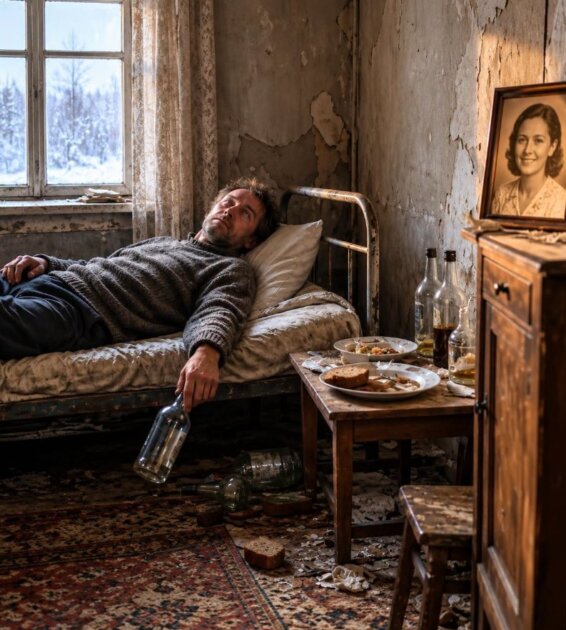
After the funeral, neighbors and relatives gathered around the table. Some offered words of comfort, while others cried. Nikolai sat in a corner, silently drinking whatever was poured into his glass. After the first shot, the pain seemed a little easier to bear. After the second, the world grew hazy. By the third, he felt as though the iron grip squeezing his chest had loosened for a few precious moments.
He remembered that feeling.
The very next day, he began drinking alone in the kitchen. Not because he was thirsty, and not because he wanted to enjoy himself. He simply did not want to think. He did not want to look at Vera’s empty chair, listen to the silence, or accept that the woman who had stood beside him all his life would never come home again.
Then one day passed. Then another. Then a week.
A month later, Nikolai was rarely sober.
The house slowly fell apart around him. He barely heated the stove and slept in his clothes beneath old blankets. He stopped cooking and survived on whatever kindhearted neighbors brought him. He no longer bothered to shave or wash. He left the house only when absolutely necessary.
He drank whatever he could find: vodka, homemade moonshine, even hawthorn tincture from the pharmacy. Once, he discovered some industrial alcohol in the shed and drank that, too. For two days afterward, he could barely get out of bed, terrified that his heart might stop. But he survived.
And he kept drinking.
At first, the neighbors tried to help. Aunt Zina, who lived across the road, visited almost every day.
“Kolia, please, enough! Vera wouldn’t have wanted this. You’re destroying yourself!”
Nikolai usually stared at the wall.
“Can you hear me at all?” she asked, touching his shoulder.
“I can hear you, Zina. Go home.”
Eventually, the neighbors grew tired, too. People can worry about someone for a long time, but when every attempt to help is met with silence or rejection, they eventually give up. Nikolai’s house gradually disappeared from the village’s daily life. Nobody paid attention anymore to the crooked fence, the leaking roof, or the boarded-up windows.
His children did not know what else to do.
His son, Alexei, visited him for the first time a year after Vera’s death. When he entered the house, he barely recognized the man he had once admired as strong and hardworking. Nikolai was unshaven and filthy, his hands trembled, and his eyes looked clouded and distant.
“Dad…”
“Alosha? Is that you? I thought the postman had come.”
Alexei felt his throat tighten.
“Dad, look at yourself! Come with me to the city. I’ll take you to a doctor. You can get help, and we’ll get everything back on track.”
Nikolai slowly shook his head.
“I need Vera. But she’s gone. Do you understand? She’s gone.”
“But Mom wouldn’t want you to live like this!”
Suddenly, Nikolai exploded.
“Don’t tell me what she would have wanted! She was my wife for thirty years! Thirty years, Alosha! You can’t understand that! She’s gone, and I went with her. Only my body is still here!”
Alexei eventually returned to the city empty-handed.
Six months later, his daughter, Olga, tried to help. She brought groceries, cleaned the kitchen, and began collecting the empty bottles into a garbage bag. But Nikolai snatched the bag from her hands.
“Don’t touch those!”
“Dad, they’re garbage!”
“This is my life!” he shouted, clutching the bag to his chest. “Without this, I have nothing! When I drink, at least I don’t see Vera. I don’t have to experience her death all over again!”
Olga left the house in tears.
And Nikolai was left completely alone.
Three years passed. Three long years in which the man slowly lost everything he had once built. He had worked as a mechanic in the village garage since the days of the old collective farm, but when he began disappearing into drinking binges that lasted for weeks, his boss had no choice but to dismiss him.
“Kolia, I respect you, but we can’t go on like this,” he told him. “We need someone who can work, not someone we have to worry might need an ambulance at any moment.”
Nikolai did not argue. He knew the man was right.
That evening, however, he drank more than usual. The following morning, a tractor driver found him in a roadside ditch, buried beneath the snow. He carried Nikolai home, laid him on the bed, and quietly left.
It was not the first time something like that had happened.
Once, Nikolai had fallen asleep in the cemetery, right beside Vera’s grave. He woke to find a stray dog licking his face. The animal’s warm tongue brought him back to his senses, and he looked into its eyes. There was something unusual in that silent gaze, something almost understanding.
“Go away,” he whispered.
The dog did not move.
For the first time in three years, Nikolai began to cry. Not because of his loss, but because of the shame that overwhelmed him. Vera lay beneath the earth, and he, still alive, had ended up lying drunk beside her grave.
The next day, he drank again.
Then came the night of Epiphany.
Outside, the temperature had dropped to nearly forty degrees below zero. The house was so cold that the water in the bucket had frozen solid. Nikolai lay trembling beneath a pile of blankets. For once, even the bottle beside his bed held no appeal.
He only wanted to sleep.
And then he saw Vera.
She was standing on the bank of the river where they had first met. She looked exactly as she had at nineteen, wearing a light blue dress with a white collar. The wind played with her hair, and her face carried the same smile that had made Nikolai fall in love with her all those years ago.
“Vera…” he whispered. “Is it really you?”
“I’m here, Kolia.”
“But you’re dead…”
She looked at him attentively. There was no anger in her eyes, no accusation. Only a sadness that hurt more deeply than any angry words could have.
“And you?” she asked. “Are you still alive?”
Nikolai could not answer.
“I came to say goodbye,” Vera told him. “For three years, you haven’t let me go. You keep me tied to your suffering, to your drinking, to your tears. You think that if you keep hurting, you somehow remain close to me. But I don’t want you to remember me this way. It hurts to watch you give up on yourself day after day.”
“I never wanted this…” Nikolai’s voice broke. “I just don’t know how to live without you.”
“You can live. You’ve always been stronger than you believed. You’ve simply forgotten who you are.”
Vera stepped closer and placed her hand against his cheek. Nikolai felt warmth, so real that it seemed she was truly standing before him.
“I love you, Kolia. I always will. But now you must let me go. And you must find your way back to yourself, too. Your children are worried about you. Your neighbors pray for you. And here you are, lying in this house, slowly disappearing. But you’re still alive. And those who are alive still have a life to live.”
“I hear you,” Nikolai whispered.
“Then remember this: you were never truly alone. You aren’t alone now, either. You just have to learn to feel my presence in a different way.”
Vera stepped back. She was smiling just as she used to when she called to him from the kitchen doorway, reminding him not to forget to buy bread.
Then she spoke the four words that would change everything.
“Live, Kolia! For us!”
The next moment, she disappeared. The river, the riverbank, and the wind all vanished with her. Darkness returned, but somehow it no longer felt so cold. It was as though the warmth of Vera’s hand had remained on his cheek.
When Nikolai opened his eyes, it was morning. The first rays of sunlight were appearing above the forest, frost had painted white patterns across the windowpanes, and the house was so quiet he could almost hear winter breathing.
He lay motionless for a long time. Then he sat up and looked around.
The empty bottles. The dirt. The cold stove. The misery that had accumulated over three years.
For the first time, he did not see these things as his life. Instead, he saw the remains of a life belonging to someone who had lost himself long ago.
“Enough,” he said aloud.
It was not a promise or a sudden burst of enthusiasm. It was a simple, firm decision, as cold and clear as the ice outside on that Epiphany morning.
The following days were painfully difficult. Nikolai’s body had grown dependent on alcohol, and suddenly stopping could cause dangerous withdrawal symptoms. He needed medical help to get through the process safely. During the hardest hours, he kept thinking about the four words from his dream.
Live, Kolia! For us!
Slowly, day by day, he began finding his way back to himself.
A week later, he stepped outside for the first time without intending to buy alcohol. He simply stood on the porch, breathed in the sharp winter air, and looked at the forest, the river, and the sky. That was when he realized how much he had missed it all. Not only Vera, but life itself, a life he had barely noticed for three whole years.
Aunt Zina was the first to notice the change. When she saw Nikolai clean-shaven and wearing a fresh shirt, tears filled her eyes.
“Kolia… Is that really you?”
“It’s me, Zina.”
“But what happened to you?”
Nikolai fell silent for a moment.
“Vera came to me in a dream. She told me it was time to start living again.”
Aunt Zina crossed herself and asked no more questions.
Nikolai began restoring the house. He carried out three bags of empty bottles, scrubbed the floors, repaired the stove, fixed the roof, and strengthened the fence. At first, the neighbors watched in disbelief. Later, some offered to help.
But he shook his head.
“I have to do this myself. With my own hands. I owe it to this house. And to Vera.”
Two months later, he went to his old workplace. His former boss barely recognized him at first.
“I’m looking for work,” Nikolai said.
The man studied him for a long moment.
“Are you serious?”
“Completely. I haven’t had a drink in months.”
At last, his boss nodded.
“All right. You can start Monday. But if you ever…”
“I’m not going back to that life,” Nikolai replied.
This time, he did more than simply say the words. He proved it through his actions, one day at a time.
Six months later, he called his son himself. Alexei initially thought someone was playing a trick on him. It had been three years since he had heard his father’s voice sound clear and sober.
“Dad? Is that really you?”
“It’s me, Alosha. Could I come and visit?”
There was a long silence.
“Come, Dad. We’ll be waiting.”
Alexei, his wife, Irina, and their two children were waiting for him at the train station. Ten-year-old Vanya recognized his grandfather immediately and threw his arms around him. Little Masha, however, hid shyly behind her mother. Until then, she had only seen her grandfather in an old photograph.
“This is your grandpa,” Alexei told her. “And he’s here with us now.”
That evening, Irina prepared a special dinner. Alexei automatically opened a bottle of wine, but when he noticed his father’s expression, he stopped.
Nikolai spoke calmly.
“I’d rather have some tea. Black tea, with mint.”
Without a word, Alexei put the bottle aside. Irina made the tea, and the family sat together talking late into the night. There was laughter, there were tears, and there were long, thoughtful silences. Nikolai told them about his dream, Vera’s smile, and the four words that had given his life a new direction.
Nobody interrupted him.
“I’m going to live now,” he said at last. “For her. And for all of you.”
Afterward, he traveled to see his daughter, Olga. When she saw her father standing in the doorway, she sank to the floor and burst into tears. Nikolai helped her up, wrapped his arms around her, and held her close for a long time.
“Forgive me, sweetheart.”
“You forgive me, Dad. We thought there was nothing more we could do to help you.”
Nikolai gently stroked her hair.
“You didn’t abandon me. I abandoned myself. You were always there. I was just too lost to see you.”
Two weeks later, he returned to his village.
He stepped inside the house, switched on the light, and looked around. The walls no longer seemed like the ruins of an abandoned life. The house felt like a home again, the place where his memories of Vera lived, and where perhaps new memories could still be made.
He opened the drawer of the old dresser and took out a photograph of his wife. In it, Vera was wearing her favorite blue dress. Nikolai placed the photograph on the table and gazed at her face for a long time.
“Well, Vera,” he said softly. “I’m living. For us.”
Outside, the sun was setting. The river shimmered gold, the snow was beginning to melt beneath the trees, and the air carried the promise of spring.
Nikolai still missed his wife. The pain did not disappear overnight, and the dream could not magically change the past. But he no longer tried to escape his memories.
He had learned that love does not mean destroying yourself after losing the person you love. Sometimes, the greatest proof of love is to keep living, preserve the memories you shared, and make room for all the good things that may still lie ahead.
Vera could never return.
But Nikolai had finally returned to life.
And every morning, when he opened the window, he heard the same four words in his heart:
Live, Kolia! For us!

