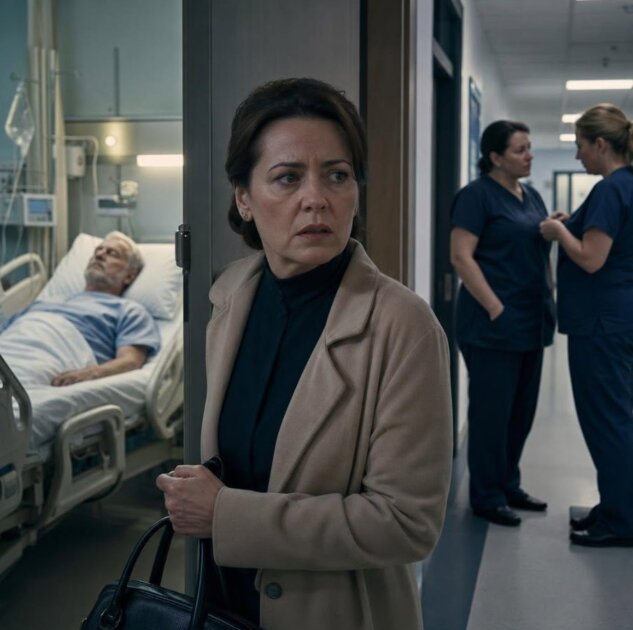
Olga was about to leave the hospital when she stopped at the window at the end of the corridor to button her coat.
The top button had caught in the lining again.
She freed it with her fingernail and reached for her bag.
The keys inside jingled.
So did the little package of knitted socks she had brought for Viktor.
She had never managed to give them to him.
His feet were always cold now, but he barely had the strength to move. The socks had remained unopened on his bedside table.
She would take the thermos of broth home too.
He hardly ate anything anymore.
Behind the corner, near the utility room, water was running.
Two nurses were rinsing cleaning cloths and talking quietly, in the ordinary tone of people who had become accustomed to being around other people’s suffering.
“I feel sorry for his wife,” one of them said. “She comes every single day. Brings him broth. And for what?”
“What do you mean, for what?” the younger nurse replied. “It’s already been left to the other one.”
Olga froze.
“The younger woman?”
“She came yesterday with the paperwork. I saw her myself. The notary came with her. Viktor Pavlovich signed everything. Properly and officially.”
“You’re kidding.”
“No. His wife is bringing him homemade broth while the apartment is going right past her. That young woman knows exactly what she’s doing.”
The older nurse sighed.
“Keep your voice down. It’s none of our business.”
The water continued running.
The conversation ended.
Olga stood by the window, unable to feel her fingers.
The younger woman.
Who was she?
Viktor had no children.
At least, that was what Olga had believed for thirty years.
Before their wedding, Viktor had once looked into her eyes and said:
“I’m alone in this world, Olya. No family. No relatives. No children.”
She had believed him.
For thirty years, she had believed him.
Olga slowly buttoned her coat all the way to her throat and walked outside.
Snow was falling in tiny, sharp flakes.
She didn’t realize until she reached her car that she was still clutching the unopened package of socks.
That evening, she didn’t drive straight home.
She drove around the city.
Past their apartment building.
Past the pharmacy.
Past the school where she had once worked.
Only three phrases kept pounding through her head.
“The notary.”
“He signed.”
“The apartment is going to someone else.”
Their apartment.
The two-bedroom apartment on the fifth floor.
The balcony filled with her geraniums.
They had bought it two years after getting married, back in 1997.
Olga had still been working at a school then, while Viktor spent weeks away on business trips.
They had saved for years.
Borrowed money.
Paid it back.
For twenty-eight years, Olga had washed those floors, changed the wallpaper, cleaned the windows and cared for the flowers on the balcony.
They had never had children.
Not together. Not separately.
It simply never happened.
That apartment had become everything to them.
Their home.
Their refuge.
Their whole life.
And now someone had quietly told her:
The apartment might no longer be hers.
Olga didn’t sleep that night.
She lay on her side of the bed, staring at the empty half beside her.
Viktor had been gone from that side for six months.
But for the first time, she wasn’t thinking about his illness.
She was thinking about the woman.
Who was she?
A young neighbor?
A nurse?
Maybe the hospital staff had misunderstood.
But no.
They had said his full name.
Viktor Pavlovich.
Her Viktor.
By six in the morning, Olga had made a decision.
She wouldn’t arrive at ten as usual.
She would be at the hospital at eight.
And she would see this “young woman” with her own eyes.
—
At eight in the morning, the hospital corridor was almost empty.
It smelled of disinfectant and boiled porridge.
Olga sat on the bench opposite Viktor’s room, her handbag on her lap.
She waited.
At half past eight, the woman arrived.
She looked about thirty-five.
Dark coat.
Large shoulder bag.
A food container in one hand and a bag of apples in the other.
She moved through the hospital as though she had been coming there for months.
She greeted the nurse at the desk.
Then she opened Viktor’s door.
Olga’s heart seemed to stop.
She counted to twenty.
Then she stood and followed her inside.
Viktor was lying on his side, facing the wall.
The young woman was arranging apples in a vase.
Olga’s vase.
The very vase Olga had brought from home.
The woman turned.
Their eyes met.
For several seconds, neither spoke.
“Hello,” the woman finally said quietly. “You must be Olga Nikolaevna.”
Olga’s voice barely came out.
“Who are you?”
The woman placed an apple in the vase.
Her hands were trembling.
“My name is Kristina.”
A pause.
“I’m Viktor’s daughter.”
The room went silent.
Only the radiator could be heard.
Olga stared at her.
“Viktor doesn’t have children.”
“That’s what he told you?”
“He told me that for thirty years.”
Kristina gave a bitter little smile.
“Then he told you a lot of things.”
From the bed came a weak voice.
“Olya…”
Olga looked at her husband.
His eyes were clear.
And full of guilt.
“Olya, please,” he whispered. “Not here.”
Olga stared at him.
At the man she had spent almost thirty years with.
At the man she thought she knew better than anyone.
Then she turned and walked out.
Kristina started to follow.
Olga raised her hand.
“Don’t.”
And she walked away alone.
—
An hour later, Olga called Tamara.
Tamara had been her best friend for forty years.
She was also a lawyer.
If anyone understood property, inheritance and notarial documents, it was Tamara.
Within an hour, they were sitting together in Tamara’s car.
“Start from the beginning,” Tamara said, pouring tea into two cup lids. “What do you know about this woman?”
“She says she’s Viktor’s daughter.”
“Biological daughter?”
“Probably.”
“Fine. We’ll verify that. But first, the apartment. What exactly did Viktor sign?”
“They said there was paperwork. A notary was there.”
Tamara looked at her carefully.
“It could be a will.”
“And if it isn’t?”
“Then it could be a gift deed.”
Olga’s face went pale.
“What’s the difference?”
Tamara took a breath.
“A will only takes effect after death. While Viktor is alive, he can change it whenever he wants.”
“And a gift deed?”
“That’s different. If he gave away his share of the apartment and the transfer was registered, then that share belongs to the other person while he is still alive.”
Olga stared at her.
“So the apartment…”
“Wait. There’s something more important.”
Tamara leaned closer.
“When did you buy the apartment?”
“1997.”
“Were you already married?”
“Yes.”
“Then remember this: it was marital property. Your share is yours.”
Olga slowly raised her eyes.
“Half?”
“Half.”
“Even if the apartment was registered in Viktor’s name?”
“Even then.”
Olga closed her eyes.
At least something was certain.
Half of the apartment was hers.
“But he could do whatever he wanted with his half,” Tamara continued. “He could give it to anyone. Even his daughter.”
Olga looked out at the snow.
“Twenty-eight years, Tamara.”
“I know.”
“I built that home with him.”
“I know.”
There was silence.
Then Olga whispered:
“What if he wasn’t mentally competent when he signed?”
Tamara’s expression changed.
“That matters.”
“He’s been unconscious most of the time these past few days.”
“What medication was he taking?”
“I don’t know.”
“Then we need his medical records. If we can prove that he wasn’t capable of understanding what he was signing, the transfer could potentially be challenged.”
“In court?”
“In court.”
Olga lowered her head.
“I’d have to go to court over my own husband.”
“Not against your husband. Against what he did.”
Olga was silent.
Tamara eventually squeezed her hand.
“And there’s something else. You’re retired, right?”
“Yes.”
“Then depending on the circumstances, inheritance rules concerning a surviving spouse may also matter. You aren’t without legal protection.”
Olga gave a bitter smile.
“You’re trying to comfort me as a lawyer.”
“No,” Tamara said quietly. “I’m telling you as your friend: you’re not powerless.”
Olga watched the snow falling outside.
“Tamara… what would you do?”
Tamara didn’t answer for a long time.
“I don’t know.”
“If you were me?”
“I still wouldn’t know.”
Then she added:
“The law tells you what you can do. Your conscience has to tell you what you should do.”
—
That evening, Olga opened the old metal box where Viktor kept his documents.
She emptied everything onto the bed.
Passports.
Insurance papers.
Old receipts.
The apartment purchase agreement.
1997.
They had been married.
Tamara was right.
At least half was legally hers.
Then Olga noticed something at the bottom of the box.
A worn envelope.
No address.
Only one word written across the front:
“For Olya.”
In Viktor’s handwriting.
Olga stared at it for a long time.
Then she opened it.
The first line read:
“Olya, if you’re reading this, it means I didn’t have the courage to tell you myself.”
Olga continued.
And after thirty years of marriage, she learned the truth.
There had been another woman.
Before her.
In another city.
And there had been a little girl.
Kristina.
Viktor had left.
He hadn’t paid support.
Hadn’t written.
Hadn’t called.
He had simply disappeared.
Then he met Olga.
And decided to start over.
As though his past didn’t exist.
“I told you I was alone. At first it was one lie. Then it became easier to keep lying.”
Olga’s hands began to shake.
The letter continued.
Kristina had found him six months earlier.
She hadn’t come for money.
She hadn’t come for the apartment.
She hadn’t even come to blame him.
She had only wanted to see her father.
“She comes to see me. She sits beside my bed. She brings apples. I wasn’t her father for her entire life, and still she comes. Olya, I’m ashamed of myself.”
Olga’s eyes filled with tears.
At the bottom of the letter, Viktor had written:
“I want to give her my half of the apartment. I won’t touch yours. That’s yours. You earned it. But let my half be hers. Maybe it won’t make up for what I did. But at least at the end of my life, I will have done one thing that wasn’t only for myself.
Please don’t blame her.
She did nothing wrong.
This is all my fault.”
Olga sat motionless.
Two voices fought inside her.
One screamed:
“He betrayed you! He lied to you for thirty years!”
The other whispered:
“What if that had been your daughter?”
Olga closed her eyes.
“What if someone had erased you from your own father’s life for thirty years?”

The next morning, she told Tamara about the letter.
The lawyer was silent for a long time.
“Then we still need to check the property records,” she finally said.
“Why?”
“Because we can’t guess. We need to know whether the transfer has already been registered.”
They ordered the official property record.
Several days later, it arrived.
Tamara sat at the kitchen table, put on her glasses and read it carefully.
Then she sighed.
“Olya…”
“What?”
“It was registered.”
Olga said nothing.
“Viktor transferred his half to Kristina.”
“So he really did it.”
“Yes.”
Olga stared at the document.
Strangely, she didn’t feel the same panic she had felt on that first night.
The letter had changed something inside her.
“Can I still challenge it?” she asked.
“Yes.”
“So I still have a choice?”
“Yes.”
Tamara put the paper down.
“But now it’s not really a legal question.”
“What is it?”
“You.”
—
Viktor was conscious that day.
Olga sat beside his bed.
The letter was in her hand.
He saw it immediately.
“You read it.”
It wasn’t a question.
Olga nodded.
“Thirty years, Viktor.”
“I know.”
“For thirty years you looked me in the eyes and told me you had nobody.”
“I know.”
“I felt sorry for you. I thought you were alone. I thought you had no one in the world.”
Her voice broke.
“And you had a daughter.”
Viktor closed his eyes.
“I was afraid.”
“Of what?”
“That you’d leave me.”
Olga gave a bitter laugh.
“And now?”
“Now it doesn’t matter.”
He stared at the ceiling.
“I made one mistake when I was young. I abandoned my daughter. Then I spent the rest of my life repeating the same mistake. Hiding. Staying silent. Lying.”
Olga looked at him.
“Why did you give her the apartment?”
Viktor slowly turned toward her.
“Because I never gave her anything.”
“And me?”
“You have your half.”
“But that apartment was our life.”
“I know.”
His voice was barely a whisper.
“But for her, I was the father who never came.”
Silence.
“If you can,” he whispered, “leave it to her.”
Olga looked at him.
“And if I can’t?”
Viktor smiled faintly.
“Then take me to court. You have every right. I won’t blame you.”
He closed his eyes.
“Just know one thing, Olya. She didn’t come for the apartment.”
“What did she come for?”
He swallowed.
“Her father.”
—
Kristina arrived later that afternoon.
For the first time, Olga didn’t walk past her.
“Tell me about yourself,” Olga said. “I know nothing.”
Kristina sat beside her.
She told her about her mother, who had raised her alone while working two jobs.
About how her mother had never spoken badly about Viktor.
“She always said, ‘He left. Adults sometimes leave.’”
As a child, Kristina had invented stories about her father.
Sometimes he was a sea captain.
Sometimes a geologist working in Siberia.
Anything was better than admitting that he had simply abandoned her.
“When Mom died,” Kristina said, “I suddenly realized how alone I was.”
She searched for Viktor.
“When I saw him, I wanted to leave. Then he looked at me and said, ‘Kristina?’”
Tears filled her eyes.
“He knew it was me.”
“Why did you stay?”
“I don’t know.”
She smiled sadly.
“Maybe because I’d spent my whole life missing him. And when he was finally there, I couldn’t walk away again.”
Olga was silent.
“Did he offer you the apartment?”
“Yes.”
“I didn’t want it.”
“Why?”
“Because I didn’t want it to look as though I’d shown up waiting for my dying father’s money.”
Kristina lowered her eyes.
“But he begged me. He said, ‘Let me leave you something. Please.’”
Then she looked directly at Olga.
“If you want to challenge the gift, do it. I won’t fight you.”
“Why?”
“Because he was your husband for thirty years.”
Kristina smiled through her tears.
“I was his daughter for six months.”
Viktor died eleven days later.
Quietly.
In his sleep.
The funeral was small.
Olga.
Tamara.
A few neighbors.
Former colleagues.
And Kristina.
She stood near the back, as though she wasn’t sure she belonged there.
Olga raised her hand.
“Come here.”
Kristina came closer.
And the two women stood beside the same grave.
The wife.
And the daughter the man had abandoned.
—
After the funeral, Tamara pulled Olga aside.
“Have you decided?”
Olga knew exactly what she meant.
“Yes.”
“And?”
“I won’t challenge it.”
Tamara stared at her.
“Are you sure?”
“Yes.”
“Olya, you’re giving half your apartment to a woman you didn’t even know existed a week ago.”
Olga looked toward Kristina.
“She isn’t a stranger.”
“You didn’t even know she existed.”
“Maybe she was a stranger to me.”
Olga paused.
“But she was Viktor’s daughter.”
Tamara sighed.
“You could regret this.”
“Maybe.”
“And if she sells her share?”
“Then we’ll deal with it.”
“What if someone else moves in?”
“We’ll deal with that too.”
Tamara shook her head.
“This isn’t the law, Olya.”
“I know.”
“Then what is it?”
Olga looked at the grave outside.
“Conscience.”
—
A year passed.
Olga stayed in the apartment.
Kristina didn’t sell her share.
They didn’t divide the furniture.
They didn’t count who paid for what.
Sometimes Kristina came to visit.
She brought pastries.
Helped with cleaning.
At Christmas, they decorated the apartment together.
Before Easter, Olga taught her how to make Viktor’s favorite cabbage pie.
The first time they made it together, both women cried.
Then they pretended it was because of the onions.
One winter afternoon, Kristina arrived without calling.
“What are you doing here?” Olga asked.
“I came to clear the snow from the balcony.”
“I can do it myself.”
Kristina raised an eyebrow.
“There isn’t a man in this house. So today, I’m the man.”
Olga watched from the window as Kristina shoveled the snow.
And for the first time, she realized that the apartment didn’t feel quite so empty anymore.
There was a drawing hanging on the wall.
Kristina’s seven-year-old daughter had made it.
A little house.
Five windows.
Red flowers on the balcony.
Underneath, in crooked letters:
“For Grandma Olga.”
Olga had never had grandchildren.
She never thought she would.
And yet there it was.
“Grandma Olga.”
Sometimes, when she was alone, she still asked herself:
Had she made the right decision?
Perhaps she had given away something that legally belonged to her.
Perhaps she had sacrificed too much.
Perhaps Tamara had been right.
But then she remembered Viktor’s letter.
Kristina’s childhood.
And the little girl who had spent thirty-five years without a father.
And Olga found herself asking a different question:
If I had been that little girl…
what would I have wanted from my father?
A piece of an apartment?
Or simply one chance to know that I mattered to him?
Olga never found a perfect answer.
But she knew one thing.
When she looked in the mirror, she didn’t have to look away.
And perhaps that was what her decision had really been about.
Not what the law said she could take.
But what she could live with for the rest of her life.
**What would you have done in Olga’s place?**
Would you have fought for the other half of the apartment, after spending thirty years building that life together?
Or would you have respected Viktor’s final wish and allowed his forgotten daughter to keep the share he left her?
And what do you think about Viktor?
Can a person ever be forgiven for hiding a child from his wife for thirty years?
Tell me in the comments what you would have done.
Because sometimes the hardest family decisions aren’t about money at all.
Sometimes the law tells us what we’re entitled to.
And our conscience asks us what we’re willing to live with.
If you enjoy emotional family stories about marriage, betrayal, inheritance and the difficult choices that divide people, follow the page. There are more stories like this coming—and I don’t want you to miss the next one.