
Here is a tighter version at approximately 850 words, with the suspense and emotional progression preserved.
The first thing I noticed wasn’t the trash.
It was my daughter’s face.
She was ten years old, sitting on the edge of the bed with her shoulders curled inward, still wearing the soft clothes she’d been given after another brain-tumor treatment.
Her hands were locked together in her lap.
Too tightly.
She wasn’t crying.
That frightened me more than anything.
My daughter had cried through needles, painful procedures, endless hospital nights, and the moments when doctors spoke carefully because they were afraid of frightening us.
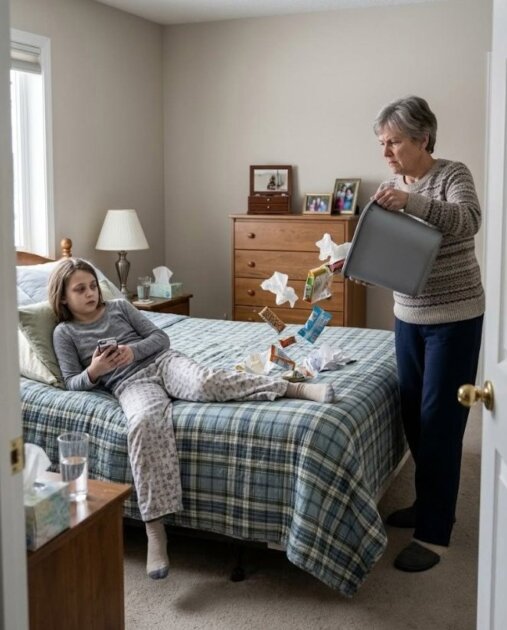
But that day, she sat completely still.
Then I saw the room.
Papers covered the blankets. Wrappers were scattered across the floor. Old food containers sat beside the bed.
And standing in the doorway was my mother.
My daughter’s grandmother.
The woman I had trusted to care for her while I struggled to keep our lives together.
“She made the mess herself,” Grandma said.
I looked at my daughter.
She didn’t defend herself.
She didn’t argue.
She simply stared at her hands.
Something inside me tightened.
Children who are accused usually explain themselves. They protest. They cry.
My daughter did none of those things.
She looked like a child who had already decided nobody would believe her.
My mother walked away.
“She’s been difficult lately,” she added.
Difficult.
The word stayed in my mind.
Sometimes adults call a child difficult when the child is actually frightened, exhausted, or desperately trying to communicate something.
I watched my daughter follow Grandma with her eyes.
Only after the footsteps disappeared did she move.
Slowly, she reached beneath her pillow and pulled out a folded hospital appointment card.
The corners were bent.
Her fingers trembled as she handed it to me.
Then she whispered:
“Grandma got angry because I told the doctor what happens here.”
For a moment, I couldn’t breathe.
My daughter hadn’t called me because she was simply tired.
She hadn’t called because she missed home.
She had called because she was scared.
And I had almost misunderstood her.
I stared at the little card in my hand.
It was just an appointment reminder.
Something most people would throw away.
But my daughter had hidden it beneath her pillow as though it were the only thing protecting her.
Suddenly, all the moments I’d ignored came rushing back.
The way she became quiet whenever I mentioned Grandma’s house.
The way she changed the subject.
The way she kept saying, “I’m okay,” without looking me in the eyes.
I’d blamed the treatment.
The exhaustion.
The fear of being sick.
I had never imagined she might be afraid of the person caring for her.
I sat beside her and took her hand.
“You never have to stay quiet to keep someone else happy,” I said.
Her fingers tightened around mine.
Then she started crying.
Not loudly.
Not dramatically.
Just quiet tears from a little girl who had been holding too much inside for too long.
I pulled her close.
And I made my decision.
The explanation could wait.
The argument could wait.
My daughter was coming home.
I began packing her clothes, her favorite blanket, her appointment bag, and the stuffed animal she pretended she was too old to need.
Then my phone rang.
My mother’s name appeared on the screen.
I answered without leaving my daughter’s side.
She didn’t ask if my daughter was okay.
She didn’t ask whether she’d eaten.
She didn’t apologize.
Her first words were:
“You need to call that doctor and tell them she misunderstood me.”
My stomach dropped.
She wasn’t asking what had happened.
She wanted me to erase the story.
I stayed calm.
“She’s coming home with me.”
There was silence.
Then my mother’s voice hardened.
“You don’t understand what you’re doing.”
Maybe I didn’t understand everything yet.
But I understood one thing.
My daughter had finally told me the truth.
And I wasn’t going to teach her that telling the truth only creates more trouble.
The days that followed were painful.
My mother said she was overwhelmed. She said my daughter was emotional because of treatment. She said she had only been trying to manage the situation.
But every explanation focused on her.
Not my daughter.
Not the ten-year-old child recovering from a serious illness.
Not the little girl who had been afraid to speak.
I began realizing that children don’t always say, “Someone is hurting me.”
Sometimes they say, “I don’t want to go there.”
Sometimes they whisper, “Can you come get me?”
Sometimes they simply become quiet.
And sometimes, when they finally find enough courage, they hand you the smallest piece of proof they’ve been protecting.
For weeks, I kept the appointment card on my kitchen counter.
At first, I saw it as evidence.
Later, I saw something else.
It was proof that my daughter had tried to protect herself.
She hadn’t known whether anyone would believe her.
She had still found a way to speak.
My relationship with my mother changed after that.
Some things can be repaired.
Some things need distance.
But trust cannot be rebuilt by pretending nothing happened.
Trust begins when someone says, “I believe you.”
That was what my daughter needed most.
Not a perfect explanation.
Not a dramatic apology.
She needed to know that when she reached out, someone would come.
Months later, she was stronger.
She wasn’t magically healed. There were still difficult days.
But she laughed more.
She asked for things again.
She stopped closing her bedroom door whenever someone walked past.
One afternoon, she found the appointment card while cleaning a drawer.
She stared at it for a moment.
“Do you still need this?” I asked.
She shook her head.
“No.”
Then she folded it carefully and placed it inside a small memory box.
Inside were a hospital bracelet, an old drawing, and a photograph of the two of us.
Things that once represented fear.
Now they represented survival.
Later, my daughter asked me something that broke my heart.
“Are you mad at Grandma?”
“I’m hurt,” I told her.
She looked down.
“Because of me?”
I immediately took her hand.
“No. Never because of you.”
She was quiet.
Then she asked:
“Did I do the right thing?”
I squeezed her hand.
“You did the bravest thing.”
“What?”
“You told the truth.”
That was when I understood that healing wasn’t only about removing fear.
It was about rebuilding what fear had taken away.
Trust.
Confidence.
The belief that her voice mattered.
Little by little, she started choosing what she wanted instead of saying, “Whatever everyone else wants.”
She told me when something bothered her.
She laughed without checking whether anyone else was upset.
She was finding herself again.
Months later, we passed the room where everything had happened.
My daughter stopped.
I thought she might be remembering the worst of it.
Instead, she looked at me and said:
“I don’t feel scared anymore.”
“Why?”
She shrugged.
“Because I know you’ll come.”
Those words stayed with me.
Because that was what she had been asking for all along.
Not a perfect rescue.
Not someone who could fix everything.
Just someone who would come.
And now, whenever my daughter asks for me, I don’t wonder whether she’s being dramatic.
I go.
Because sometimes the most important promise a parent can make isn’t something they say.
It’s something they prove.
Again.
And again.
And again.

